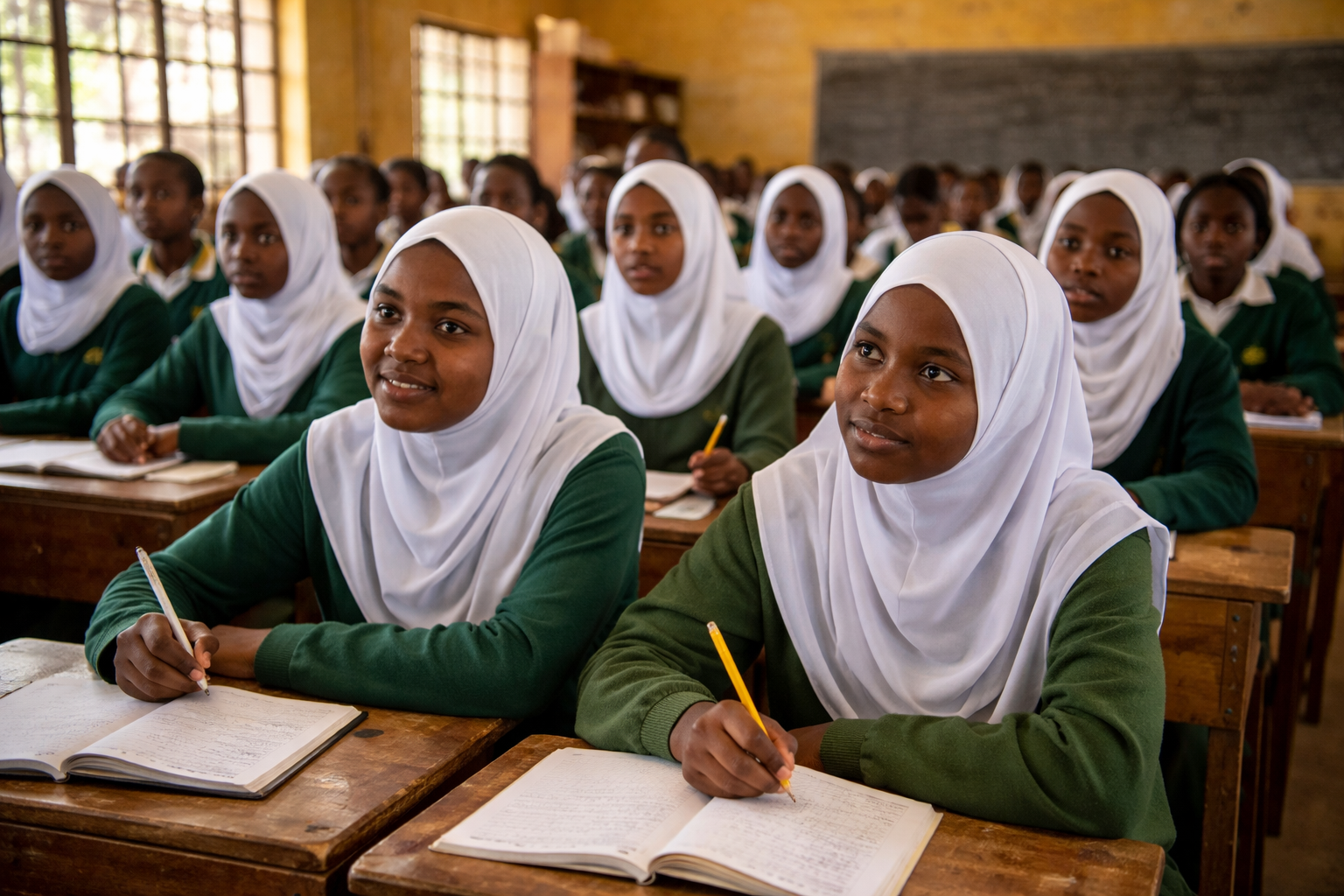
 The hijab primarily signifies modesty, privacy and faith for Muslim women. /AI
Fresh controversy has erupted over the wearing of hijabs in schools after St Mary's Lwak Girls High School in Siaya county reportedly sent home a Grade 10 learner for donning the attire during the holy month of Ramadhan.
The hijab primarily signifies modesty, privacy and faith for Muslim women. It acts as a physical and spiritual barrier that reflects submission to God, shields the wearer from unwanted attention and fosters self-respect.
Wearing a hijab during Ramadan symbolises heightened devotion and serves as a personal expression of religious dignity, aligning physical appearance with inner spiritual purity.
The dress code dispute at Lwak Girls found its way to Parliament on Thursday, with the Public Accounts Committee suspending the main agenda on audit queries in the Ministry of Education to question Basic Education Principal Secretary Julius Bitok over the matter.
The committee, chaired by Butere MP Tindi Mwale, pressed the CS to act swiftly and ensure the girl resumes schooling immediately, citing constitutional provisions on freedom of worship.
"If I can come with a hijab and sit in a Public Accounts Committee, what is denying kids from the Muslim community to go to school?" Garissa Woman Rep Amina Udgoon asked the PS.
Committee members said Article 27 of the Constitution guarantees equality and freedom from discrimination and entitles every person equal protection by the law.
It prohibits both direct and indirect discrimination on grounds such as race, sex, health status, ethnic origin or religion, while promoting affirmative action and gender equality.
"Article 27 of the Bill of Rights is very clear. No person, not even a child, should be discriminated against because of religion or otherwise," Teso South MP Mary Emaase said.
PS Bitok asked to respond to the matter at a later date after reviewing a preliminary report from the sub-county director of education, but committee members shut him down, saying the issue was sensitive and urgent.
"You just direct and the girl will be back in school," Rarieda MP Otiende Amollo, in whose jurisdiction the school falls, said. "You swore to defend the Constitution, the Constitution is very clear on freedom of worship," Mwale said.
Bitok said he would issue the directive "as soon as now", bringing the heated debate to a close.
The uniform dispute has revived memories of past controversies over the wearing of the hijab that landed in court, drawing mixed verdicts from judges of the Court of Appeal and the Supreme Court.
On September 7, 2016, the Court of Appeal allowed the wearing of the hijab in schools, ruling that a March 5, 2015 High Court ruling prohibiting Muslim students from wearing the religious attire and trousers in school was discriminatory, illegal and violated their constitutional rights to religion, belief and freedom from discrimination.
In the case, the Methodist Church in Kenya petitioned against a decision by educational authorities allowing Muslim students at St Paul’s Kiwanjani Day Mixed Secondary School in Isiolo county to wear hijabs and trousers, contrary to the school’s prescribed uniform policy.
The school, sponsored by the church, had a uniform policy to which students and parents agreed upon admission.
However, following pressure from local officials and an informal request by the Isiolo deputy governor, a directive was issued by the County Director of Education permitting Muslim girls to wear hijabs and white trousers.
The church argued that the directive caused tension, disrupted harmony and indirectly discriminated against non-Muslim students, violating its rights as the school sponsor.
Mohamed Fugicha, a parent of Muslim students at the school, joined the suit in the High Court in Meru as an interested party, supporting the directive to allow hijabs on religious freedom grounds.
The 1st respondent in the High Court was the Teachers Service Commission. The petitioner’s grievance against it was that it had transferred the principal of the school on account of his stand regarding the established school uniform.
The claim against the TSC was dismissed by the judge, saying the court cannot interfere with the constitutional, statutory and administrative functions of an independent commission.
The High Court ruled in favour of the church, but Fugicha appealed.
The Court of Appeal in Nyeri was asked to pronounce itself on the issue of free exercise of religion in public schools in Kenya.
The appellate court reversed the High Court decision, ruling that prohibiting hijabs indirectly discriminated against Muslim students.
The court held that forcing students to abandon or refrain from a practice or observance dear to them and genuinely held as a manifestation of their religious convictions violated their conscience, curtailed their freedom and was thus unconstitutional.
The court said school rules ought to be flexible to accommodate learners' needs and, where they intend to limit students from certain actions, it ought to be in line with principles for permissible limitations to the fundamental rights and freedoms as stipulated in Article 24 of the constitution.
The Ministry of Education was tasked to come up with rules to guide schools countrywide in dealing with the issue, ensuring that it engaged and secured participation of all the relevant stakeholders so that the concept of accommodation could be clarified and regulatory and oversight powers set out in the Basic Education Act.
The Methodist Church appealed the decision at the Supreme Court, with Fugicha becoming the 1st respondent, defending the appellate court's ruling in favour of the students’ religious expression.
On January 23, 2019, the Supreme Court set aside the Court of Appeal judgment dated September 7, 2016, ruling that individual schools, including church-sponsored public schools, have the authority to determine their own dress codes, which may include prohibiting the wearing of hijabs.
The apex court directed St Paul’s Kiwanjani Day Mixed Secondary School Board to consult with parents and students and amend the relevant school rules touching on the school uniform so as to provide for exemptions to be granted to accommodate those students whose religious beliefs require them to wear particular items of clothing in addition to the school uniform.
"This judgment be immediately served upon the Cabinet Secretary for Education for his perusal and consideration with a view to formulating and putting in place rules, regulations and/or directions after due consultations," the court ruled.
The court said any such rules must be aligned with the fundamental right to freedom of religion and belief under Article 32 of the constitution and equality and freedom from discrimination under Article 27 of the constitution for all pupils and students in Kenya’s educational system.
Article 32 of the constitution guarantees every person the right to freedom of conscience, religion, thought, belief and opinion.
It protects the right to manifest any religion or belief through worship, practice, teaching or observance, either individually or in community, in public or private.
Commenting on the provisions of the law, Health Cabinet Secretary Aden Duale said discriminating against students wearing hijab is unacceptable.
"I want that school principal and the Ministry of Education to read that article and take it. Individuals cannot be forced to act against their belief and they cannot be denied access to public service, including education, due to their religious dress," Duale said.
He said in the spirit of collective responsibility, he will not sit and watch as schools violate the law and government directives.
"It's the President who said people should go to school without even uniform for transition purposes. It's the President who said, why would you tell a girl not to wear a hijab? We won't allow that as government."