 Research shows that regular exposure to subtitles improves decoding speed, word recognition, spelling accuracy and reading fluency. /AI
Nina and Henry were two parents who were worried about their children’s reading and vocabulary. Each passing day meant mounting anxiety.
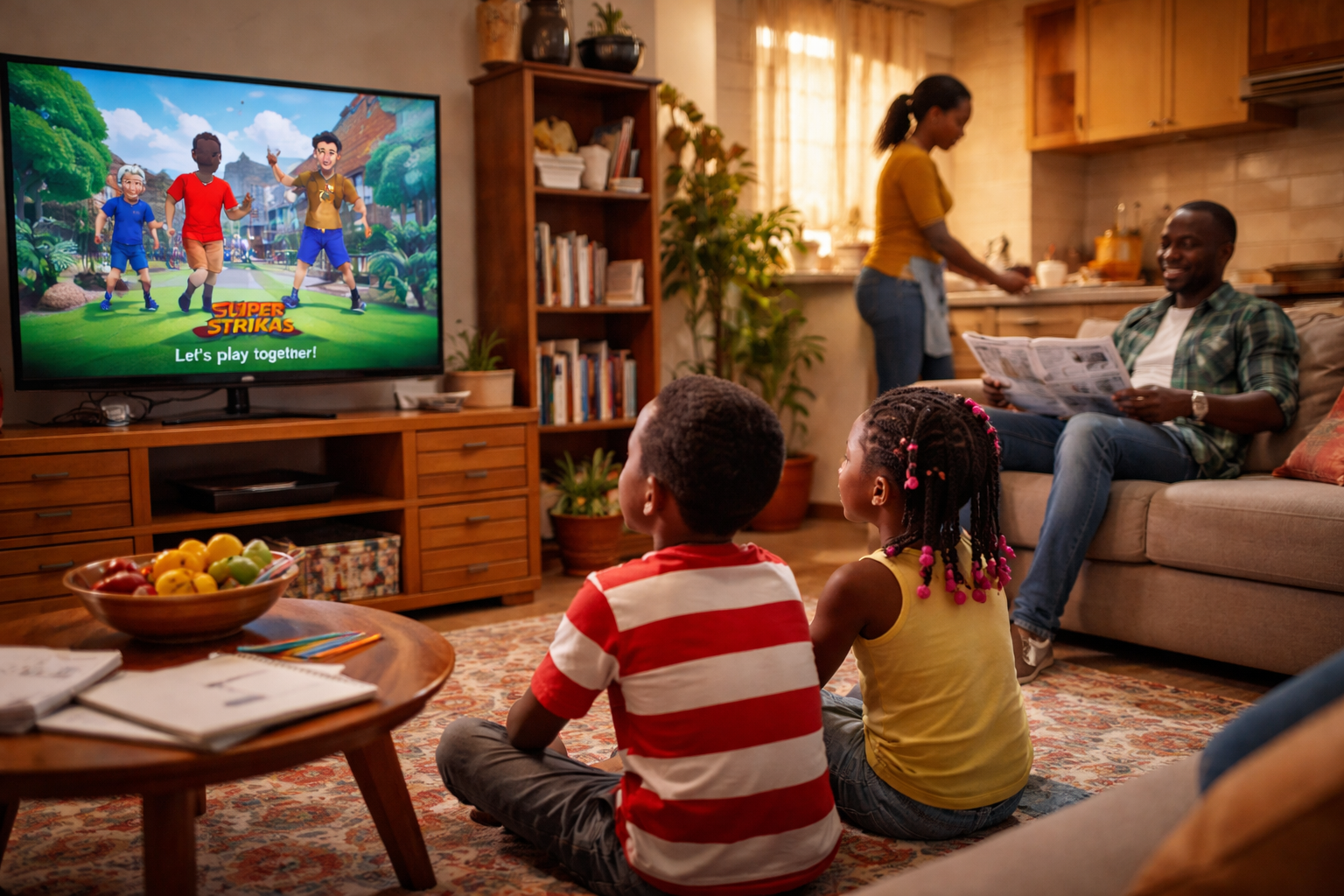
Evenings at home often meant television time, but they began to notice something curious: when subtitles appeared on screen, their children followed the words instinctively.
Coming from a background in education, they soon saw the power of quality subtitles to improve children's literacy.
What started around a kitchen table soon built momentum - switching on subtitles to reinforce vocabulary and pronunciation became routine - a routine that eventually grew into Switch On Read On, now one of the world’s largest literacy initiatives.
This week, that idea found a home in a Kenyan home through a partnership with Akili TV, Kenya's first and only dedicated free-to-air educational children's and family television network.
The initiative birthed Read Along Hour, a weekday television block airing from 5–6pm and embeds literacy grade subtitles into popular children’s shows, transforming passive screen time into structured reading exposure.
The launch comes at a moment of heightened concern about foundational skills in early childhood education.
The 2025 Foundational Literacy and Numeracy Assessment (FLANA) report, released on January 26, paints a troubling picture.
Conducted between June and July 2025 across all 47 counties, the survey assessed 49,835 children aged 10 to 15 years, both in and out of school, spanning Grades 3 to 9.
The survey found that 51.3 per cent of Grade 6 learners in public primary schools are unable to comprehend a Grade 3-level English passage.
In private schools, 42.3 per cent face the same challenge.
Grade 6 marks the final year of primary education before transition to junior school under the Competency-Based Education framework, making the findings particularly stark.
“Literacy is the foundation of all learning. Without the ability to read, even numeracy becomes difficult because many questions are text-based,” said Usawa Agenda Executive Director Emmanuel Manyasa during the release of the FLANA 2025 report.
Against that backdrop, positioning subtitles to children's TV shows isn't merely an accessibility add-on; it's a literacy infrastructure.
During Read Along Hour, familiar shows such as Supa Strikas and Wild Kratts now air with embedded, grade-level subtitles.
Research shows that regular exposure to subtitles improves decoding speed, word recognition, spelling accuracy and reading fluency.
As children hear dialogue while simultaneously seeing the printed word, they engage in what literacy specialists describe as multimodal reinforcement — linking phonology, orthography and meaning in real time.
Each episode also features an “L-Bar” displayed at the beginning and end of the show, indicating the total number of words read, alongside three tricky spellings and three advanced words.
The design encourages brief parent-child interaction to practise pronunciation, clarifying definitions and revisiting unfamiliar vocabulary.
In effect, the television becomes a scaffold for guided reading.
The unveiling of the Read Along Hour has been reinforced by renowned celebrity parents Nameless and Wahu, who are championing the initiative in Kenya.
“Reading is the foundation of how children learn, express themselves and understand the world. As parents, we’re constantly looking for ways to make learning feel natural and enjoyable at home," Wahu said.
"Read Along Hour does exactly that, turning everyday TV time into an opportunity for growth. When children see reading reflected in the content they love and parents feel empowered to be part of that journey, the impact is lasting.”
Nameless added, “As an artist and video editor, I have always been fascinated by subtitles. I have realised that many fans never fully caught our earlier lyrics simply because subtitles weren’t a thing added onto music videos years back.
"The reality is that reading through subtitles naturally builds literacy. That’s why partnering with Switch On | Read On matters to us as it speaks directly to Kenyan families and to our fans.”
Henry Warren, founder of Switch On | Read On, framed the approach as deliberately simple.
“Stories are powerful teachers. If you’re a parent who cares about your child’s literacy, this is one of the simplest things you can do, and it’s completely free.”
Akili TV CEO and co-founder Jeff Schon said education gives better outcomes when it goes hand in hand with entertainment.
“If children are already watching, that time should give something back.”
International literacy advocates see the model as both timely and scalable.
Andrew Kay of the World Literacy Foundation said children are already watching TV after school, making the learning process seamless and needing no coercion.
"By integrating literacy infrastructure into screen time, Switch On Read On is helping families support reading in ways that fit naturally into their daily routine,” he said.
While the FLANA survey underscored the scale of Kenya’s literacy gap, it demonstrated that handicaps in literacy has a ripple effect even in numeracy as questions are text-based.
"Overall, 43 per cent of Grade 6 learners were unable to solve a Grade 3-level numeracy problem, with rural learners more affected than those in urban areas," the survey said.
While subtitles alone will not resolve systemic challenges, proponents argue they offer a low-cost, high-frequency intervention embedded in daily life.
As educators and parents alike ponder over how to accelerate foundational skills before learners transition to junior school, the flicker of a subtitle may represent the best starting point.