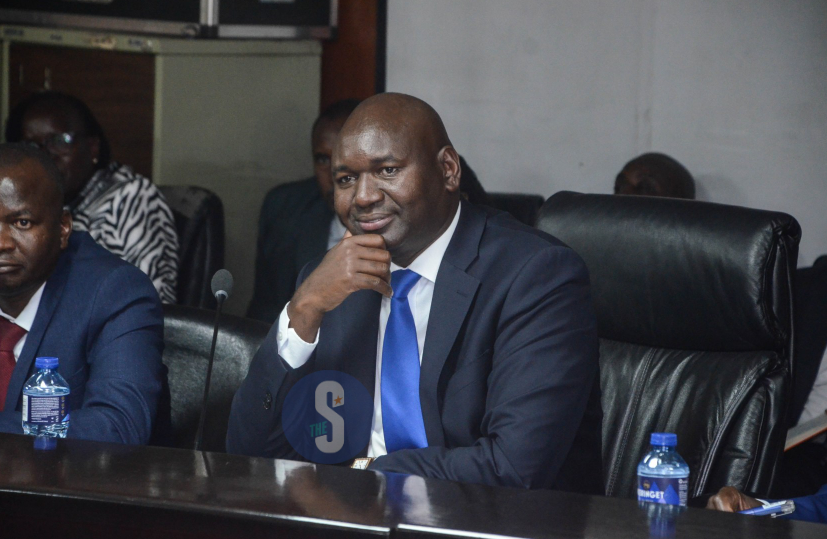
 Basic Education PS Julius Bitok appears before the National Assembly Committee on Education on February 24, 2026. /DOUGLAS OKIDDY
The release of the school data verification report on February 12 by the Ministry of Education revealed to the public the extent of carefully choreographed fraud that has been going on in some public schools, leading to the loss of billions of shillings in false capitation claims.
The exercise, which started on September 1, 2025, uncovered discrepancies in the number of learners declared by schools as captured in the National Education Management Information System (NEMIS), compared to the actual number of students in school.
The verification, which covered public primary, junior, secondary and special needs schools across all 47 counties, established that 973,634 learners were non-existent, yet the government had been sending capitation to support their education in schools where they were declared enrolled.
The audit found that primary schools recorded the highest variance, with 885,904 ghost learners flagged.
While data on NEMIS as submitted by heads of institutions showed 5,833,175 learners were in school, verified enrolment stood at 4,947,271.
In secondary schools, data captured on NEMIS showed an enrolment of 3,352,884, but the audit found that only 3,265,154 learners were actually in school.
This means that for the entire period before the audit, the government had been dispatching capitation for 87,730 non-existent secondary school students.
In addition, 10 secondary schools and 17 primary schools were found to be non-operational due to insecurity, lack of learners, relocation of communities or administrative closure, but their status had not been reported to the ministry, and they continued to appear in NEMIS.
These may appear mere statistics until the inaccurate data is quantified in terms of money lost through capitation.
Every year, the government invests significant public funds in the provision of free and compulsory basic education, with funds allocated strictly on the basis of learner enrolment as captured in NEMIS.
On February 2, the government said it had disbursed Sh44.2 billion in capitation for term one to support learners in primary, junior and secondary schools.
Of the total amount, Sh3.7 billion was allocated for free primary education, Sh14.4 billion for free day junior school education and Sh26.08 billion for free day secondary school education.
Before the review of the fee structure on February 6, the government was providing Sh1,420 per child per year for primary education, Sh15,042 for junior secondary education and Sh22,244 for free senior school education.
How much was lost?
Following the findings from the learner verification exercise, Education Cabinet Secretary Julius Ogamba said the government had suspended resource allocation to all unverified learners in order to protect public funds and uphold accountability.
"Funding for the affected learners will only be restored upon verification. Non-operational schools will be subjected to formal closure or deregistration in accordance with existing laws and regulations," he said.
But the knee-jerk reaction may have come too late, as funds amounting to millions of shillings had already been lost.
At the primary school level, where the audit flagged 885,904 ghost learners, and with Sh1,420 allocated per child per year, over Sh1.25 billion was lost.
In senior schools, where the audit flagged 87,730 ghost learners, up to Sh1.95 billion was potentially lost per year at Sh22,244 per learner.
These figures exclude capitation potentially disbursed to 14 institutions that did not submit learner enrolment data.
This means that cumulatively, the government lost in excess of Sh3.2 billion per year alone.
Assuming the fraud had been ongoing for 10 years, this would translate to about Sh32 billion, all factors remaining constant.
In a surprising twist, the audit found that in junior schools, 543,250 learners were not on NEMIS. School heads reported an enrolment of 2,430,398 learners, but the verified number was 2,973,648.
The ministry said it had immediately initiated action to hold officials accountable, including for criminal negligence on the part of school heads and sub-county directors of education.
Heads of institutions are the custodians of school data and are personally responsible for the accuracy, completeness and timeliness of all learner records entered into the system.
Subcounty Directors of Education, on the other hand, are responsible for oversight, supervision and validation of schools within their jurisdiction.
Ogamba said any deliberate falsification, inflation or misrepresentation of enrolment data constitutes gross misconduct.
He said the report had been submitted to the Directorate of Criminal Investigations for further action and forwarded to the Teachers Service Commission for appropriate administrative action against 34 heads of institutions.
Action would be taken against 14 of them for failure or refusal to submit data for verification, while 20 would face action for submitting inflated student enrolment data.
Similarly, the Cabinet Secretary said administrative action would be taken against 28 subcounty directors of education and quality assurance and standards officers in areas where systemic failures or supervisory lapses are established.
While appearing before the National Assembly Standing Committee on Education on Tuesday, February 24, Basic Education Principal Secretary Julius Bitok confirmed that administrative action was already in motion.
"We have been able to send show-cause letters to 28 sub-county directors of education to explain why, in their jurisdictions they were overseeing areas where there was a problem with the number of learners."
Ogamba said that where culpability is established, criminal proceedings will be initiated against ministry officials once the DCI concludes its investigations, while administrative action will be taken against school heads, including dismissal.
Both the TSC and the DCI are yet to give an update on their findings and the progress of the disciplinary process, but the audit points to a systemic rot that has cost the country large sums of money that may never be recovered.
To enhance accountability and guard against further loss of funds, the ministry said it is accelerating the transition to the Kenya Education Management Information System (KEMIS), which will introduce stronger validation controls, real-time reporting and improved interoperability.
"We have trained so many officers and teachers and there is a lot of progress towards ensuring that we have the new system," Bitok told MPs during the presentation of the 2026–27 education budget policy statement before Parliament.
The ministry said it is facing a Sh48 billion funding gap even as the National Treasury proposed allocating the education sector the lion’s share of Sh767 billion in the proposed Sh4.7 trillion national budget for the 2026–27 financial year.
Primary education received Sh7 billion against a requirement of Sh9.7 billion, resulting in a Sh2.7 billion deficit.
Junior secondary education was allocated Sh28.9 billion against a requirement of Sh49.7 billion, leaving a shortfall of Sh20.8 billion, while senior secondary education received Sh51 billion against a requirement of Sh76 billion, creating a Sh24 billion gap.