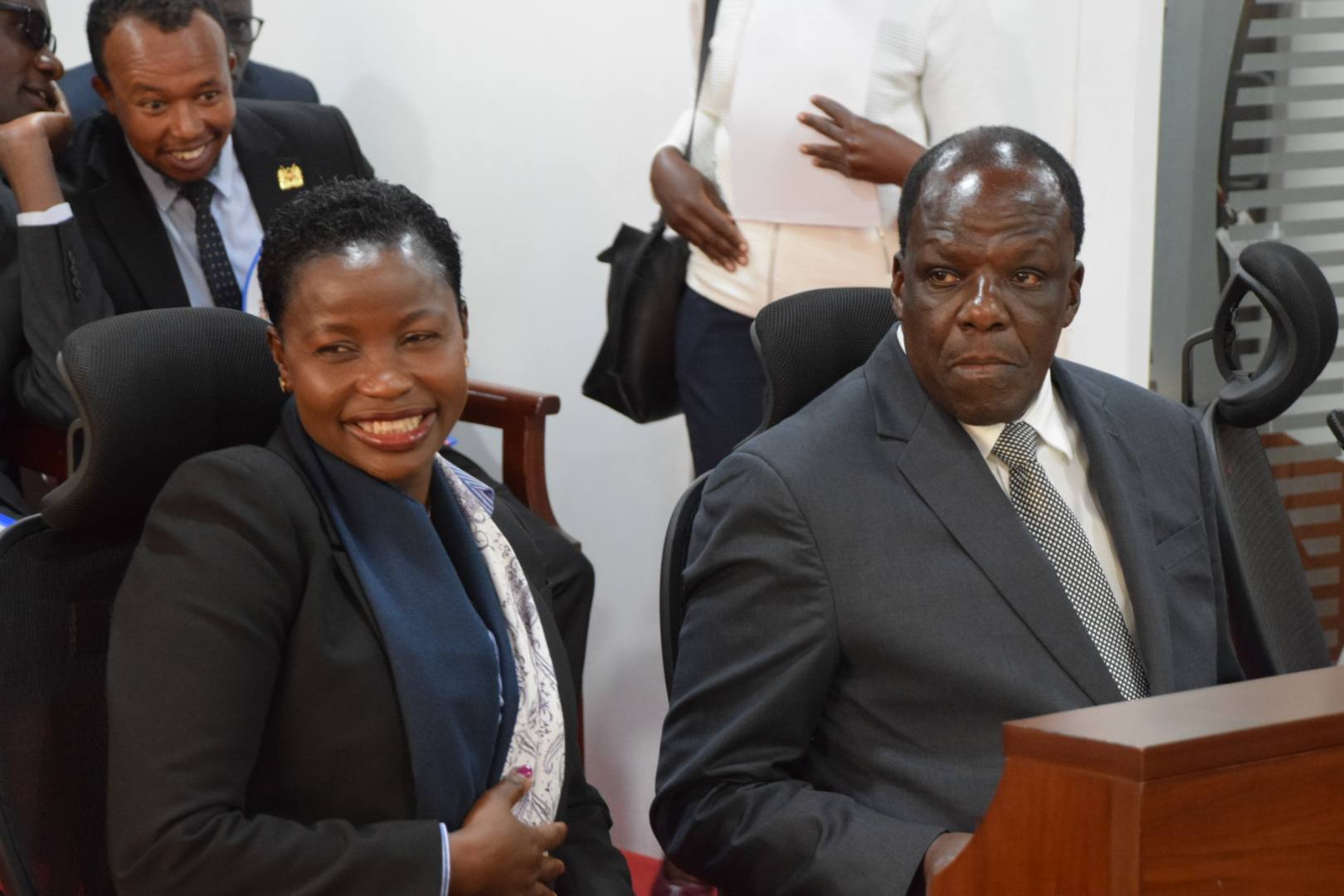
 State
Department for Micro, Small, and Medium Enterprises Development Principal
Secretary Susan Mang'eni and Cabinet Secretary for Co-operatives and MSMEs Wycliffe
Oparanya when they appeared before the Trade, Industry and Cooperatives
Committee /Douglas Okiddy
State
Department for Micro, Small, and Medium Enterprises Development Principal
Secretary Susan Mang'eni and Cabinet Secretary for Co-operatives and MSMEs Wycliffe
Oparanya when they appeared before the Trade, Industry and Cooperatives
Committee /Douglas OkiddyThe Co-operatives Ministry has vowed to seal loopholes allowing Kenyans to take multiple government empowerment loans at once.
This after it emerged that applicants have been taking up the youth fund, forming groups to access Nyota and, in some instances, go for the women fund, leaving many beneficiaries overburdened and unable to repay.
Micro, Small, and Medium Enterprises Development dockets also fall under the ministry headed by Cabinet Secretary Wycliffe Oparanya.
The CS said the government will harmonise affirmative action funds to curb the duplication, and form a single database for all empowerment loans.
The reforms target long-running programmes such as the Uwezo Fund, Youth Enterprise Development Fund and Women Enterprise Fund, which the ministry plans to merge into a single financing facility dubbed the Biashara Fund.
Oparanya told MPs that the current structure has made it easy for individuals to borrow from multiple funds simultaneously, creating repayment problems and weakening the sustainability of the schemes.
“The multiple dipping into these funds sometimes creates a problem of repayment. And the fact that they are not interlinked creates an even bigger problem,” he said.
He told the National Assembly’s Trade, Industry and Cooperatives Committee that harmonising the funds will standardise lending rules, improve data sharing between agencies and prevent beneficiaries from taking loans they cannot service.
The move comes at a time when the government is set to roll out its second phase of the NYOTA empowerment fund.
Members of the parliamentary committee urged the ministry to speed up the merger, saying the current system is inefficient and prone to misuse.
Committee chair Bernard Shinali questioned why more money was being allocated to individual funds when plans to merge them were already underway.
“You have been on record saying the funds will be merged. What is the status? Why allocate more money to the Uwezo Fund when there is a plan to merge it?” he asked.
Oparanya assured lawmakers the consolidation is still on course and will not disrupt ongoing support programmes for small businesses.
“We will not backtrack on consolidating the funds. This is the only way to ensure a more efficient, transparent and impactful financial support system,” he said.
MSMEs Principal Secretary Susan Mang’eni told MPs that borrowers often access multiple empowerment loans without coordination between agencies, leading to mounting debt and defaults.
Because the funds operate independently with different eligibility requirements and repayment terms, the ministry said many beneficiaries become overcommitted financially.
Linking the funds under a unified system would allow government agencies to track beneficiaries, align lending conditions and ensure borrowers take manageable loans.
“We are aware that the Cabinet has already provided guidance. Many of these entities operate under different legal frameworks—some established by Acts of Parliament and others by various regulations,” said PS Mang’eni.
“Discussions on harmonising these frameworks are ongoing. However, we have been instructed that, for now, all programmes will continue as they are. We cannot suspend services to beneficiaries while those arrangements are being worked out.”
She held that even if a merger occurs, the programmes themselves will not be suspended or affected, as only the governance structures will change.
A 2024 audit released last year warned that taxpayers were at risk of losing Sh28.4 billion due to loan defaults across five public lending schemes.
The funds affected included the Financial Inclusion (Hustler) Fund, Uwezo Fund, Commodities Fund, Women Enterprise Fund and the Youth Enterprise Development Fund.
Oparanya warned that the State Department for MSMEs Development faces a funding gap of Sh12.4 billion, while the State Department for Cooperatives has a shortfall of about Sh7.8 billion, which could slow key programmes.
Despite the challenges, the ministry insists reforms to the empowerment funds are critical to protecting borrowers, improving repayment rates and ensuring the sustainability of government-backed financing for small businesses.