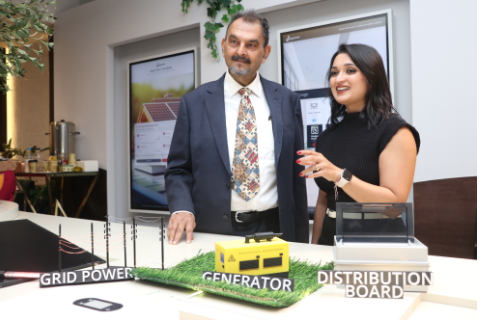
Solar firm, SpenoMatic Group, has opened an interactive centre in Nairobi, stepping up efforts to promote solar adoption amid rising electricity costs and growing demand for reliable power alternatives.
Located at Sarit Centre, the interactive centre is designed as a learning space where visitors can explore the vast potential of solar energy in Africa’s green transition.
It is open to the public – from students to young professionals, families, and senior citizens.
Through hands-on displays, practical demonstrations and expert guidance, visitors will learn how solar energy works, how it can reduce their household or business electricity bills and how it contributes to cutting carbon emissions and strengthening Kenya’s environmental energy solutions.
“This is a great opportunity to bring solar energy closer to everyday people,” said Nikita Surty of SpenoMatic Home Solutions.
“Solar power is no longer just a technical concept – it’s a practical, affordable and impactful solution for homes, businesses and communities. With this centre, we want to demystify solar energy show its real-life benefits and inspire more Kenyans to be part of the green energy transition.”
Surty says the interactive centre is meant to be both educational and inspiring.
According to her, Africa has some of the highest solar potential in the world, yet much of it remains untapped.
She says the centre allows visitors to see, touch, and understand how solar systems can transform lives – from lowering energy costs to improving energy security and protecting the environment for future generations.
Kenya’s energy landscape is undergoing a marked transformation as solar and other renewable sources gain ground amid rising electricity prices, climate concerns, and government policy pushes toward a cleaner energy future.
Recent government and independent data show solar uptake increasing rapidly, even as the country’s broader renewable transition continues to reshape its energy mix.
The country has long been a regional leader in renewable energy. As of June 2025, renewable sources accounted for approximately 80.5 per cent of the country’s total installed electricity capacity— a figure that includeshydropower, geothermal, wind and solar.
Solar energy alone made up about 14.1 per cent of this installed capacity, with a cumulative total of roughly 514 MW combining grid-connected and captive installations.
According to a recentInternational Energy Agency analysis, solar generation continued to expand in 2023–24, with solar contributing an increasing share of electricity production alongside geothermal, hydro and wind.
Solar power generation soared to a record 491.5 million kWh in 2023 — a 28 per cent jump from the previous year — thanks to new utility-scale plants such as the 40 MW Kesses Solar Farm and increased output from facilities in Malindi and Cedate.
This rise in solar activity comes as Kenya’s overall energy mix pushes toward 90 per cent or more from renewable sources, with geothermal energy alone contributing nearly half of generation and hydropower and wind are also significant sources
Beyond large projects, Kenya’s off-grid and rooftop solar market is booming. Falling costs for panels, inverters and batteries — including reductions in import taxes — have helped encourage homeowners, businesses and institutions to adopt solar solutions.
A typical solar system for a home or small business, for example, now costs roughly Sh180, 000–250,000 per kilowatt of capacity installed, according to local market estimates.
Commercial users already paying high grid tariffs — often Sh20–30 per kWh or roughly $0.18–0.22 per kWh— find solar more competitive; solar power can cost around Sh8–12 per kWh ($0.08–0.12) over the life of a system, offering significant savings over time.
While solar’s long-term generation costs are increasingly attractive, high upfront costs and financing barriers remain major challenges for many households and small enterprises.
Developers and policymakers are pressing for improved financing models, tax incentives and streamlined permitting to make solar even more accessible.
The government’s renewable energy goals reflect this momentum: policies aim for 100 per cent renewable electricity generation by 2030, supported by auctions, tariffs and incentives to expand solar and other clean energy projects nationwide.
Kenya’s combination of abundant sunshine — daily solar insolation levels of 4–6 kWh/m² — and growing solar infrastructure positions the nation for continued renewable expansion.
Experts forecast that solar growth could outpace other variable sources like wind through the latter half of the decade, helping Kenya meet rising electricity demand while reducing climate impacts and energy costs.