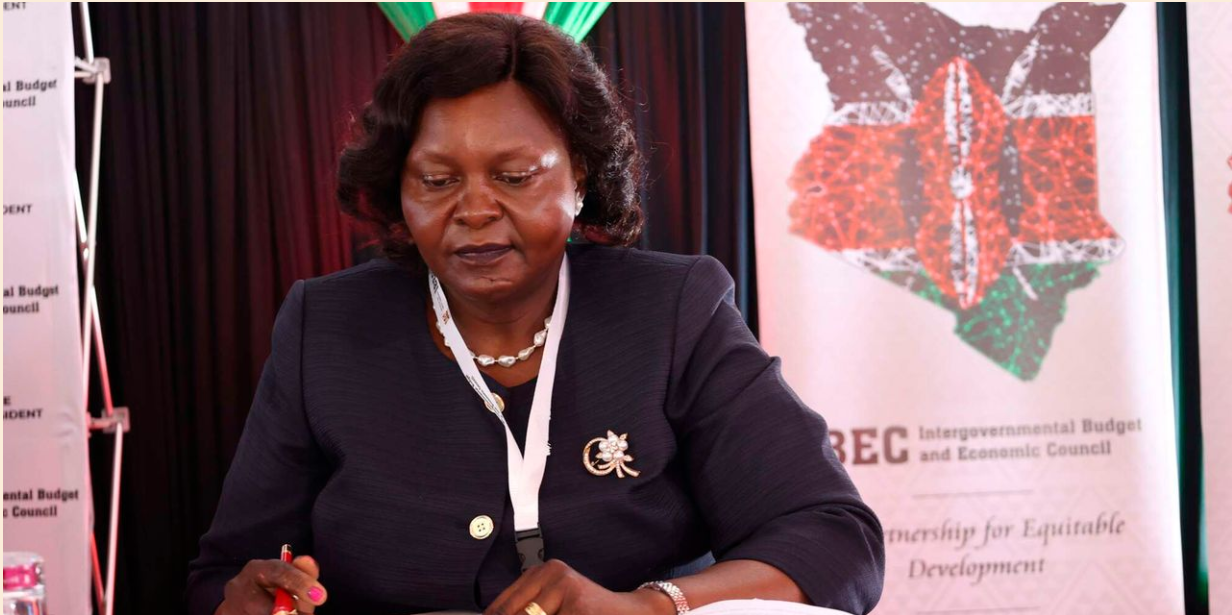
 Commission on Revenue Allocation chairperson Mary Wanyonyi Chebukati/FILE
Some county governments are resisting efforts by the Commission on Revenue Allocation to help them increase their own revenue, senators have heard.
The development comes even as Parliament considers a national law to streamline local revenue collection.
Appearing before the Senate Finance and Budget Committee, CRA officials said several counties have declined to grant the commission access to their revenue systems, frustrating attempts to seal loopholes and enhance collections.
“Some counties are resisting these efforts. They are not giving us access to systems,” the commission told the committee.
CRA chairperson Mary Chebukati said the agency, working with the World Bank and other partners, has developed OSR mapping and training guidelines to help counties tap into their full revenue potential without necessarily raising taxes.
The initiative seeks to address a wide gap between projected and actual collections.
Counties are expected to raise Sh216 billion annually from their own sources, but managed only Sh67.3 billion in the last financial year.
“Even the big counties you hear about, as much as they are collecting more, their systems are still not optimal,” Chebukati said.
“What we do is visit the counties, assess their systems, rank them, and then assist in addressing weak areas,” she added.
She attributed the underperformance to unrealistic revenue targets, heavy reliance on manual systems, and a lack of integration across revenue streams, which has created opportunities for pilferage and inefficiency.
According to CRA, some counties spend up to Sh8 to collect Sh3 due to poor systems and fragmented processes.
“This leads to budget deficits, negatively affecting implementation of planned activities and contributing to the accumulation of pending bills,” the commission said.
The commission has urged counties to expand their revenue bases instead of increasing tax rates.
Chebukati cited property rates as a major untapped stream, noting that many counties lack updated valuation rolls, making it difficult to levy and collect dues effectively.
“If they do not have valuation rolls, they are unable to charge property rates. We are supporting them in many aspects, including automation and policy development,” she said.
CRA has also developed public finance management policies to guide counties in enacting laws through their assemblies and identifying viable revenue streams.
Chebukati said automation and system integration would enable counties to link services and compliance, for example, blocking issuance of business licences to property owners who have not paid land rates.
“Most of the money we are losing is through pilferage and lack of system integration,” she added.
However, she noted that resistance from some counties may stem from fears that system audits could expose revenue leakages.
“Most of the money we are losing is through pilferage and the lack of system integration,” Chebukati said.
Chebukati and her team appeared before the committee chaired by Mandera Senator Ali Roba to give their views on the 2026 Budget Policy Statement.
The revelations came as senators signalled plans to introduce a national law to standardise OSR collection across all 47 counties.
Kakamega Senator Boni Khalwale said the absence of a uniform legal framework has led to fragmented systems and significant revenue losses.
“It is high time we enact a national law that binds all the counties. The current systems are fragmented,” Khalwale said.
Lawmakers argued that harmonised standards would improve transparency, enhance efficiency, and reduce over-reliance on equitable share from the national government.
Chebukati told the committee that counties have the capacity to raise far more revenue than they currently collect, which would significantly boost development.
“You can imagine if counties were collecting the full Sh216 billion. That would greatly support their development programmes,” she said.
She pointed to international examples, including Belgium and some Indian states, where sub-national governments generate substantial revenue and even support higher levels of government.
INSTANT ANALYSIS
The Commission on Revenue Allocation told the Senate that some counties are blocking access to revenue systems, undermining efforts to seal leakages and boost own-source revenue. Despite a potential Sh216 billion target, counties collected only Sh67.3 billion, largely due to manual systems, unrealistic targets, and weak integration. Senators now want a national law to standardize revenue collection. The standoff highlights deeper governance issues—fear of exposure, poor automation, and overreliance on national transfers. Without transparency and harmonised systems, countries will continue to lose billions, sustain budget deficits, and struggle to deliver services despite untapped revenue potential.