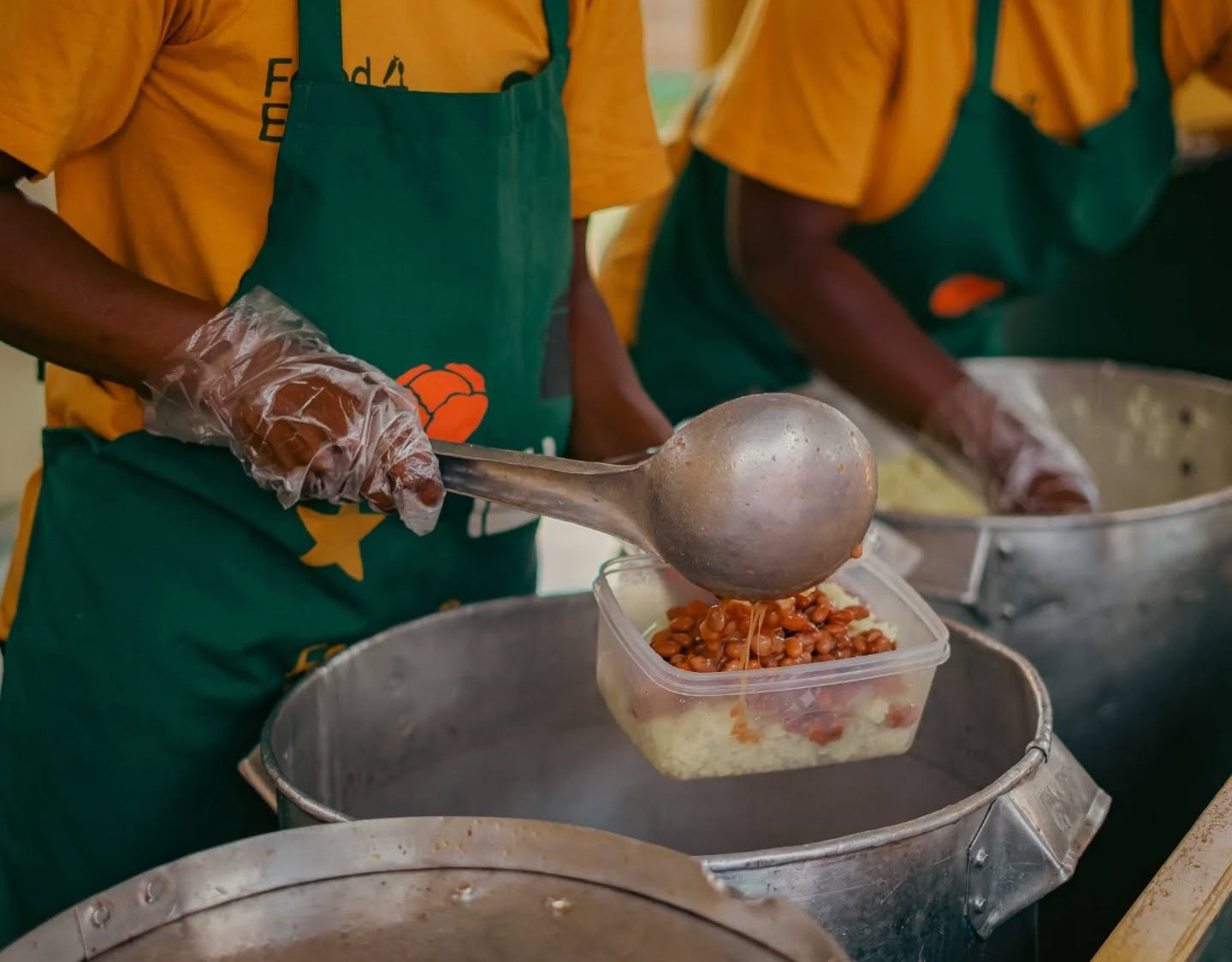
 Food4Education is looking to upscale feeding to reach one million school children in 18 months. /FOOD4EDUCATION
Quick question — what would Sh35 buy you? Probably not even a samosa, smoky or sausage.
That amount would not even afford you a plate of githeri for lunch at your favourite mama nitilie kibanda.
But Sh35 is what it costs to buy a hot, nutritious lunch for a needy pupil in Kenya, one prepared under hygienic conditions by Food4Education, a charitable organisation that runs a school feeding programme on donations.
The non-profit entity, which started in 2012 in a tin-structure kitchen in Ruiru, currently feeds 600,000 school pupils across 1,500 public primary schools.
It has now embarked on an ambitious mission to scale up and provide daily hot, affordable, nutritious lunches to one million pupils within the next 18 months.
As part of these efforts, Food4Education on Friday held a charity golf event at the Muthaiga Golf Club dubbed the 6685 Swing for Impact Golf Tournament to raise funds to feed 6,685 school children.
The event was attended by 160 golfers and about 150 social attendees, marking a milestone for the organisation as it deepens corporate partnerships and expands its support base.
The figure 6685 represents the total annual cost of feeding one pupil, calculated by multiplying Sh35 by the 191 school days in a calendar year.
"The funding gap is huge. We work with philanthropists and county governments to feed 600,000 kids, but reaching more kids is imperative because there are over 10 million of them," Food4Education founder and CEO Wawira Njiru said.
She said quantifying the whole amount needed to feed 10 million children would inadvertently discourage support because the amount would be huge (Sh66.85 billion), so their focus was on asking for support to feed one child per year.
"But if you think about it as for Sh6,685 I could feed a child for an entire year, that's what we are encouraging Kenyans to think about as individuals and how we can reach more children because of that."
The inaugural charity golf tournament brought together Kenya’s giant corporates committed to sustainable school feeding to raise funds and ensure that no child learns on an empty stomach.
Njiru described the initiative as a noble cause that has not only kept children in school but also increased enrolment and attendance.
She said the organisation has adopted a whole-of-society approach to fundraising by expanding its support base from parents and county governments to corporates to ensure it reaches as many children as possible.
They are currently partnering with 13 counties, eight of which are fully sponsored by philanthropists, while five, including Nairobi, Mombasa, Murang'a and Embu, chip in to meet the costs.
The food is prepared at central locations, then packed and transported to select schools by trucks.
"Our goal is first of all to partner with the counties that are not part of our partnership to increase our presence and work with those governments to feed more kids across the 47 counties. In the next year we are looking at five more counties to reach. Trying to reach more kids is our goal."
With an estimated 60 per cent of school children going without meals, Njiru said an estimated primary school population of 10 million leaves a big number of children not guaranteed a meal.
But beyond feeding the children, Njiru said the initiative is empowering local farmers and entrepreneurs through the supply of ingredients needed to prepare meals.
She said for the programme to run for a day, 12 tonnes of food products are sourced from smallholder farmers, guaranteeing them steady income for nine out of 12 months annually.
They also work with Jua Kali artisans for the supply of non-food items such as containers used to package the food for distribution.
"Working with Jua Kali artisans made me feel that school feeding is not just about feeding kids, it's a huge investment in the economy. So as the population grows, we are looking at this money that's being spent on school feeding also catalysing and creating job opportunities.
"Right now Food4Education creates job opportunities for 5,500 people. Expanding that is really critical, especially as the population grows."
Steve Okello, a golfer, said he was impressed by the school feeding initiative and opted to be part of the philanthropic community using the elite sport, an idea that culminated in the inaugural charity golf tournament.
"What came to mind was if Food4Education is doing this, how come I was not aware," he said, emphasising the need for Kenya's sporting fraternity to enhance visibility for the initiative through charity events.
He said such events would pool in more philanthropists due to their cascading effect, as CEOs and company owners have networks, most of whom are inclined towards bringing positive change to society.
"There needs to be ventures done for Food4Education which will increase the spotlight and showcase the normal work that they do for society and I felt that golf was a suitable avenue for that."
Other than local support, Food4Education also receives support from the US, including school children who volunteer to forego their meals for a day or two to donate towards the initiative.
Individuals can also donate by visiting the Food4Education website and clicking the Donate button.
Chief Financial Officer Stanley Njoroge said their aim is to catalyse all available revenue resource avenues to ensure they surpass the one million children target within 18 months, reach all the 10 million school children and even expand across Africa.
"We kind of want to coach other people so that we create an ecosystem of school feeding organisations. For a lot of our population, Sh35 per day is still quite high and in that case you have two things — partnership with government or philanthropy."
Approximately 50 million out of 90 million school-going children in Africa go to class hungry, with millions in Kenya at risk of, or experiencing, severe hunger daily, impacting their education, health and concentration.
In Kenya, about 1.6 million children in arid and semi-arid areas receive school meals, while around 8.4 million do not.
This crisis, driven by poverty, drought and high food costs, has prompted the government, along with initiatives like Food4Education, to expand feeding programmes to improve attendance by 8–10 per cent and performance by 20 per cent.
The Ministry of Education, while presenting its 2026 Budget Policy Statement to Parliament's Standing Committee on Education last week, raised the alarm over lack of budgeting for Early Childhood Development and Education by county governments.
The ministry said this risks clawing back the gains made in enhancing ECDE, particularly by discouraging enrolment, as some counties do not provide school meals while those that do serve non-standardised meals.
"The committee may propose the national government provides additional resources to support the ECDE school feeding programme," the ministry said.
Early childhood education is a fully devolved function whose responsibility lies squarely with county governments.
Against this backdrop of widening school feeding efforts by non-state actors, the ministry’s warning underscores the risk that gains made through philanthropy could be undermined if county governments fail to institutionalise and adequately fund school meals at the ECDE level.