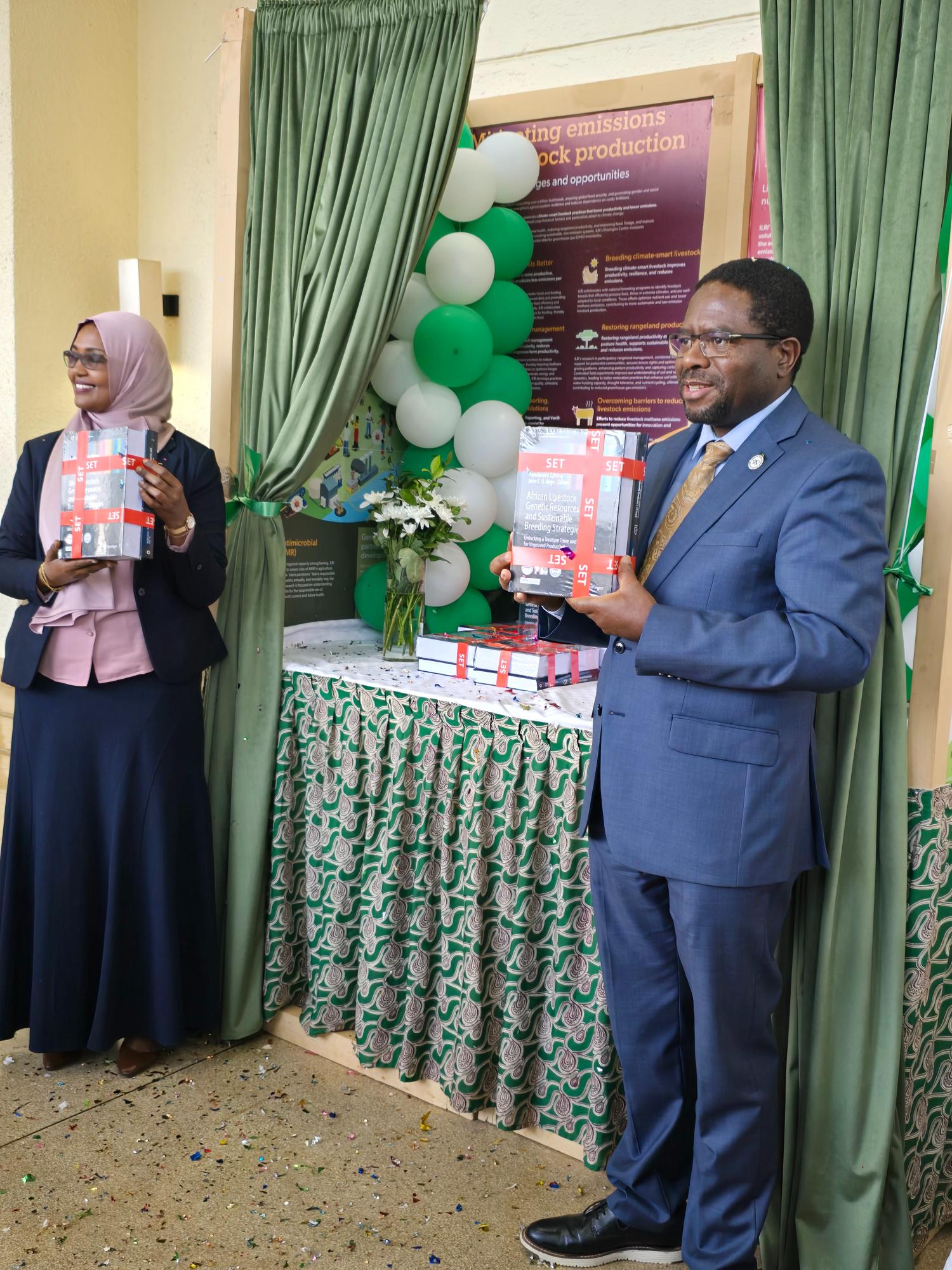
 Huyam Salih, Director of African Union Inter-African Bureau for Animal Resources (AU-IBAR) and
Appolinaire Djikeng, Director General of the International Livestock Research Institute (ILRI) during the launch of a
guidebook aimed at conserving Africa’s indigenous livestock genetic resources
and improving breeding practices./AGATHA NGOTHO.
Huyam Salih, Director of African Union Inter-African Bureau for Animal Resources (AU-IBAR) and
Appolinaire Djikeng, Director General of the International Livestock Research Institute (ILRI) during the launch of a
guidebook aimed at conserving Africa’s indigenous livestock genetic resources
and improving breeding practices./AGATHA NGOTHO. Scientists under the African Animal Breeding Network (AABNet), in partnership with other stakeholders, have launched a guidebook aimed at conserving Africa’s indigenous livestock genetic resources and improving breeding practices.
The book titled African Livestock Genetic Resources and Sustainable Breeding Strategies: Unlocking a Treasure Trove and Guide for Improved Productivity, brings together decades of research on livestock genetics, breeding, and adaptation strategies across the continent.
It was developed with support from the International Livestock Research Institute (ILRI), the Centre for Tropical Livestock Genetics and Health (CTLGH) and the African Union Inter-African Bureau for Animal Resources (AU-IBAR).
According to ILRI, Africa hosts about one-third of the world’s livestock and has some of the richest animal genetic diversity globally. The continent is home to 150–180 indigenous cattle breeds, 289 goat breeds, 126 poultry types and 94 dromedary breeds. It also has the second-highest diversity of indigenous sheep, rabbits, and donkeys.
These locally adapted breeds have evolved to survive heat, diseases, and feed shortages, making them essential for climate resilience and smallholder farming systems.
However, many indigenous breeds face extinction due to indiscriminate crossbreeding with exotic animals in pursuit of higher productivity. Experts warn that this is a risk to the unique genetic traits that enable local animals to thrive in harsh environments.
“Africa’s livestock genetic diversity is not just a heritage — it is a climate and development tool,” said Appolinaire Djikeng, Director General of ILRI. He noted that science-based breeding strategies can improve productivity, resilience and environmental sustainability.
Mizeck Chagunda, Director of the Centre for Tropical Livestock Genetics and Health (CTLGH) said local breeds form the backbone of climate-resilient agriculture and must be protected through targeted breeding programmes.
Dr Huyam Salih, Director of AU-IBAR, pointed out that conserving indigenous livestock genetic resources is critical for climate and development security.
According to Ed Rege, a co-editor, the book examines livestock used in Africa’s food systems, from large animals such as cattle, horses and donkeys to smaller species like rabbits.
“It explains how animals are bred, fed and managed, and how these practices interact with animal health. The publication also traces the evolution of livestock, examines current production systems and anticipates future needs,” he said.
Rege said the guide explores livestock products, breeding technologies and emerging innovations, including genomic tools and reproductive technologies. It also points out gaps in human capacity needed to keep pace with rapid technological change.
“It asks what Africa must do not just to catch up, but to run alongside others and sometimes even lead,” said the Chair of the AABNet Executive Committee.
The book also discusses fairness in access to genetic resources and benefit sharing, noting that African breeds often end up in foreign markets at low value while importing improved breeds can cost millions.
“You cannot protect what you have not documented,” Rege said, stressing that documenting livestock diversity is essential for conservation and fair use.
Rege noted that Africa is underutilizing its genetic resources while other regions benefit from them. He cited the Boran cattle breed, shared by Kenya and Ethiopia, which has been raised in Texas in the United States for decades after embryos and semen were exported.
International frameworks such as the Convention on Biological Diversity can help protect these resources, but documentation and policy action are necessary.
The publication provides evidence to guide policy, teaching and research, and helps identify knowledge gaps and priorities.
It recommends prioritizing adaptive breeds for climate resilience, aligning breeding goals with farmer needs and production systems, strengthening data systems and institutional capacity, integrating conservation with genetic improvement, and expanding use of genomic and reproductive technologies.
Rege described the book as long overdue, noting that African institutions have historically relied on foreign reference materials about their own livestock resources.
“This is just the beginning,” he said. “We have started a process that must continue.”
Experts warn that one of Africa’s biggest mistakes after independence was assuming exotic breeds were superior. Kenya led the importation of high-yield dairy breeds, contributing to the near disappearance of locally adapted types such as the Highlands Zebu.
“While exotic breeds can produce more milk, they require intensive feeding, disease control and financial investment. Locally adapted breeds such as Boran and Sahiwal often perform better under harsh conditions because they require fewer inputs and are more resilient,” he said.
“When you consider overall production and the realities of low-income farmers, our local breeds perform better,” Rege said, adding that the new guide provides a foundation for protecting Africa’s livestock heritage while building resilient, productive and climate-smart livestock systems for the future.