
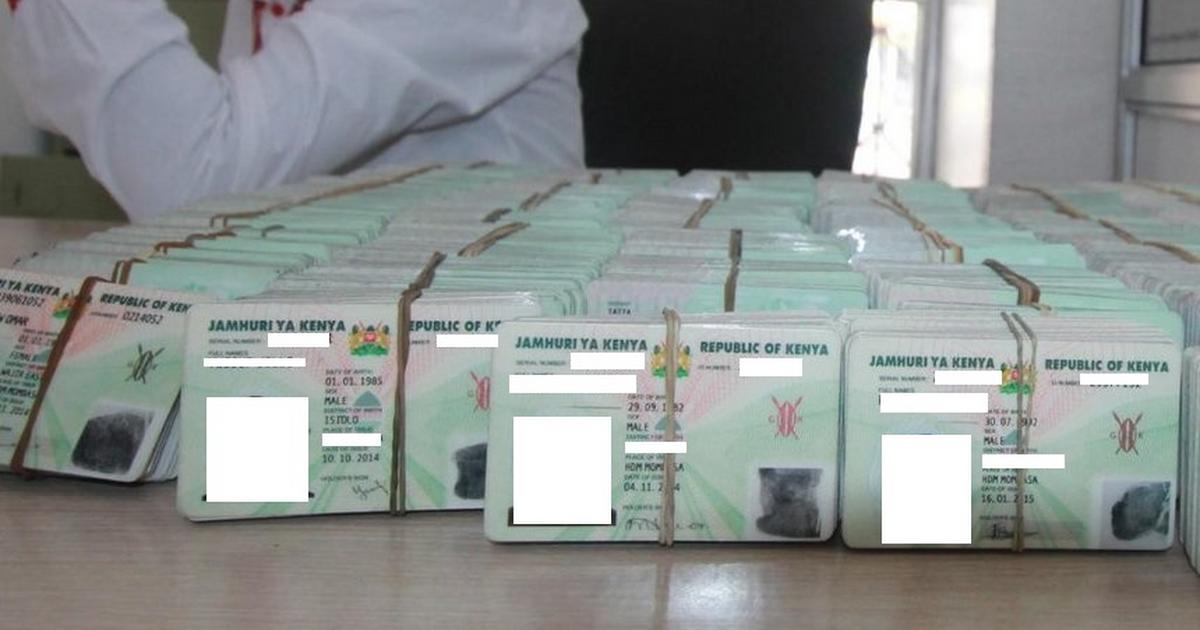
If its plan to issue more than 1.5 million IDs succeeds, it may be crucial in next year’s General Election should the electoral commission capitalise on the numbers to register them as voters.
Already, the opposition has raised concerns about “secret” moves by the electoral commission on voter data.
The IDs campaign, titled Usajili Mashinani, is being rolled out in 15 counties with low registration rates, including Baringo, Elgeyo Marakwet, Kajiado, Turkana and West Pokot.
The state aims to issue at least 100,000 IDs in each of the counties targeted. If achieved, it will translate to more than 1.5 million new registrations.
In addition to the mobile registration services, the state abolished the vetting of ID applicants, especially in the former Northern Frontier Districts, which has been attributed to low uptake of IDs in the region.
The government says the intensified mobile registration drive is part of a broader strategy to promote inclusion, equity and access to services, particularly for communities and regions that have historically been underserved.
“We are deliberately putting more focus on counties that were heavily affected by vetting challenges. That is why we are here in Marsabit today,” Immigration PS Dr Belio Kipsang said.
“These are communities that have been left behind for a long time due to distance, mobility, drought and historical exclusion.”
Dr Belio spoke during a sensitisation programme in January on the revised National Registration guidelines, targeting National Government Administrative Officers in Isiolo and Marsabit counties.
On February 3, Interior CS Kipchumba Murkomen launched the Usajili Mashinani mobile registration exercise for West Pokot and Baringo counties.
“It’s a major concern that more than 161,000 people in Baringo alone do not possess IDs, denying them crucial services and opportunity. It’s a calamity that there are people in Tiaty who are over 70 years old without IDs,” Murkomen said.
The Independent Electoral and Boundaries Commission is collaborating with state agencies, including the National Registration Bureau, to obtain data that will aid in crafting strategies to have more Kenyans enlist as voters.
The IEBC is mandated by the Constitution to register and keep the register of voters and holds continuous voter registration as well as mass voter registration.
Its collaboration with the NRB has raised eyebrows in opposition quarters. Democratic Party leader and ex-Attorney General Justin Muturi warned that the commission has a secret deal to share data for purposes of manipulating the voter register.
Most pastoralist counties are perceived to be leaning towards President William Ruto’s UDA. Any additional numbers in registration may boost his numbers for 2027, with most of the counties in the Northeast traditionally voting for a sitting government.
DP claims it has credible information of a deal between the
IEBC and the NRB under Office of the President on the sharing of data.
“The Democratic Party wishes to express grave concern over credible reports that the IEBC has entered into a secret Memorandum of Understanding with the Office of the President under the guise of a Data Sharing Framework,” Muturi said.
“We have further established that the acting CEO of IEBC [Moses] Sunkuli held meetings with officials of the NRB to discuss integration of voter data systems, including collaboration with private vendors, such as Smartmatic. These developments raise serious constitutional, legal and ethical concerns.”
However, IEBC says that according to the law, it is mandated to maintain an accurate and up-to-date voter register, while operating independently, free from external control.
“In fulfilling this constitutional and statutory mandate,
the commission is required to work with relevant government agencies that are
the lawful custodians of lawful and relevant data to the execution of its
mandate,” IEBC chairman Erastus Ethekon said.
Ethekon said data-sharing arrangements with both public and private institutions are conducted within strict legal frameworks to ensure identity verification, compliance and fraud prevention with partners being briefed once the process is in place.
“Therefore, the commission has engaged the State Department of Immigration and Citizen Services on various areas of collaboration,” he said.
“Including establishing a secure Application Programming Interface link with Integrated Population Registration System to ensure only legitimate ID and passport numbers are used.”
The IEBC is aiming to register at least 6.3 million new voters ahead of next year’s polls but the actual registrations may be low, at about 4 million, going by the average of new voters in the last three elections.
In 2022, IEBC records shows there were 22.12 million registered voters, which was an increase of about 3 million votes from the 2017 register that stood at 19.61 million.
In 2013 there were 14.3 million registered voters, meaning the commission achieved the highest record of new registrations at about 5 million new voters.