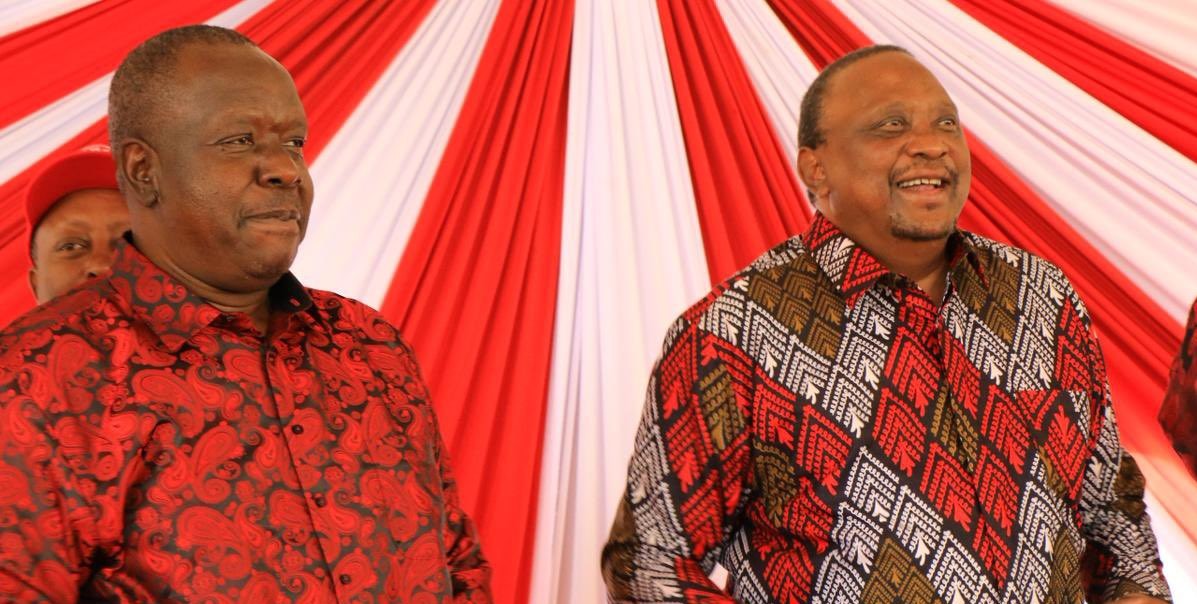
Former President Uhuru Kenyatta has been drawn to the centre of simmering factional battles within the united opposition seeking to unseat President William Ruto in 2027.
Uhuru now finds himself navigating a delicate political balance between former Interior Cabinet Secretary Fred Matiang’i and Wiper party leader Kalonzo Musyoka, who are locked in an intensifying contest for the opposition’s presidential flag bearer position.
Matiang’i, once a key figure during Uhuru’s administration and widely branded “Mr Fix It” for his tough, hands-on style, is currently associated with Uhuru’s Jubilee Party.
At the same time, Uhuru maintains close ties with Kalonzo, a long-time political ally whose loyalty has often aligned with his own.
Kalonzo backed former President Mwai Kibaki in 2008 when Raila Odinga was on the verge of taking power. Following the Kibaki–Kalonzo agreement, Uhuru became Deputy Prime Minister and Minister for Finance.
In 2022, Kalonzo again shelved his presidential ambitions in favour of Raila, a move made on Uhuru’s advice.
More recently, Uhuru elevated Kalonzo to the position of party leader of the Azimio la Umoja One Kenya Coalition, pending ratification by the Registrar of Political Parties.
Earlier this year, Uhuru and Kalonzo travelled together to Nigeria in a trip widely viewed as politically symbolic.
Insiders say Uhuru is finding it difficult to persuade either Matiang’i or Kalonzo to step aside for the other.
Tensions sharpened this week when Kalonzo's allies publicly criticised Matiang’i.
Kitui Senator Enoch Wambua insisted that Matiang’i must clarify his position, arguing that no one in the opposition is better suited for the top job than Kalonzo.
The remarks followed Matiang’i’s rejection of a proposed internal consensus formula for selecting a presidential flag bearer. Instead, he called for a “scientific” method to identify the most viable candidate.
He warned that “boardroom deals” risk fracturing the coalition, remarks widely interpreted as a direct challenge to Kalonzo’s perceived claim to the ticket.
“At his [Matiangi] level, he should perhaps have raised it within the coalition’s highest decision-making organ,” Wambua said, suggesting the disagreement could have been handled internally.
Matiang’i has maintained his position and challenged the media to organise presidential debates for opposition hopefuls.
“We are not looking for family leadership, we are looking for public leadership,” he stated.
The standoff has exposed the absence of an agreed nomination framework within the opposition, leaving the coalition vulnerable to personality-driven rivalries at a critical moment.
While Kalonzo is said to enjoy the backing of a majority of coalition principals, including former Deputy President Rigathi Gachagua, most opinion polls reportedly favour Matiang’i as the stronger presidential contender.
How Uhuru manages the situation without triggering a split remains unclear.
Beyond the Matiang’i–Kalonzo rivalry, Uhuru’s relationship with Gachagua has added another layer of complexity.
Gachagua and his allies have repeatedly expressed discomfort with Uhuru’s political manoeuvres.
“It is practically impossible for Jubilee and DCP to co-exist harmoniously in Mt Kenya,” DCP communications head Kenneth Njohi said last year.
Jubilee politician Ngunjiri Wambugu has also dismissed Gachagua’s political prospects in the region.
The exchanges point to a widening rift between two political camps competing for the same voter base in a region long regarded as a decisive factor in national elections.
Uhuru and Gachagua fell out ahead of the 2022 general election after the then Mathira MP backed Ruto’s presidential bid, while Uhuru supported Raila.
Uhuru’s perceived openness to backing Matiang’i alongside his continued support for Kalonzo from Eastern Kenya has unsettled some Mt Kenya leaders.
They argue that he is once again rallying the region behind leaders they consider outsiders, rather than consolidating support around Gachagua, who has declared interest in the presidency.
Naivasha MP Jayne Kihara publicly questioned Uhuru’s political direction.
“Those people who speak to Uhuru — and I don’t have a problem with Uhuru and Matiang’i — but Uhuru, we were told to follow you,” Kihara said.
“When your time came, you told us to support Ruto. Later in 2022, you told us to follow Raila. This time, you are telling us to follow Matiang’i. Do you have a problem with Kikuyus?” she asked.
Uhuru’s efforts to reorganise Azimio following Raila Odinga’s death have also faced resistance, particularly from Gachagua-allied MPs who have distanced themselves from the coalition.
Embakasi North MP James Gakuya said his faction would not join Azimio, arguing that a new political vehicle should be formed for the 2027 election.
“DCP has no place in Azimio. We cannot recognise it at all,” he said.
The pushback has raised questions about whether an Uhuru-led Azimio can still function as a viable umbrella for a united opposition.
Political analyst Kaburu Kinoti said Matiang’i’s reputation as a tough administrator could appeal to voters seeking a decisive challenger to President Ruto.
“Matiang’i is tough, and that is good, especially facing someone like President Ruto,” he said.
“Even if the opposition loses, they will be able to keep the government in check.”
Kinoti suggested that a Kalonzo–Matiang’i ticket could emerge as a compromise, citing their past ties with Uhuru and their regional bases.
However, he noted that such an arrangement would require careful negotiations and political concessions.
For now, Uhuru remains at the centre of a contest that could either consolidate the opposition or fracture it well before the 2027 race formally begins.