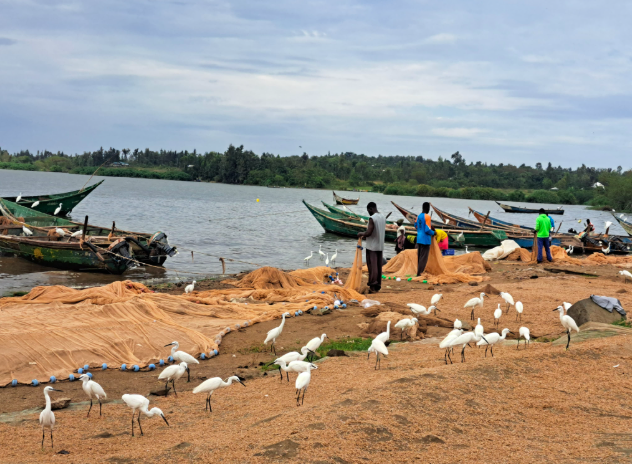
Fishermen preparing their nets/File
National government officials clashed with county government counterparts over who is mandated to license the multi-billion-shilling fisheries sector.
The dispute emerged on Friday in Nairobi during a public hearing on a new bill to manage the sector.
Members of the National Assembly's Blue Economy, Water and Irrigation Committee met officials from both the State Department for Blue Economy and Fisheries and the Council of Governors.
They were seeking views to fine-tune the Fisheries Management and Development Bill ahead of its report tabling in the House next week.
Committee chairperson Kangogo Bowen (Marakwet East) said fishermen had raised concerns over multiple licences.
"In Kilifi, the fishermen said there are multiple licences. We need to see how to have one licence," he said.
Key licences in fishing include artisanal inland and marine licences, vessel registration, commercial fishing permits, and fish trading and processing licences. Other permits cover ornamental fish, oyster collection, and recreational fishing.
Bowen said fishermen also complained about double licensing of vessels both at the national government and county level, and across counties.
Other areas of contention in the bill include the establishment, composition, funding, and regulation of Beach Management Units, regulation of fishing methods and gear, closed seasons, and the definition of breeding zones and protection of landing sites.
Additional issues raised include devolution of fishing management to counties, inter-county coordination, establishment of the Fisheries Tribunal, aquaculture regulation including caged farming, and regional and international obligations to establish clear fishing zones.
Bowen said the committee aims to make a law that will stand the test of time and help steer the sector. He attributed the clash between national and county governments to resource mobilisation efforts.
Kizito Wangalwa from the Council of Governors told the committee that the licensing regime does not exist in isolation.
“Trade licensing is a devolved function. Artisanal, aquaculture, ornamental and recreational fishing are all county government functions provided for under the Constitution,” he said.
Wangalwa said fisheries is a devolved function. He said aquaculture, which is undertaken on private land, falls under the jurisdiction of county governments.
He added that the national government should not follow fish once it has been removed from water. He said a number of fish ponds have been set up across counties as a result of the economic stimulus project rolled out by the national government.
Blue Economy and Fisheries PS Betsy Njagi said double licensing is wrong. “We can work together and harmonise the process,” she said.
Njagi said the national government has developed the sector, and the devolved units must match what has been done. She said the state has power over fish as a natural resource in public waters and that foreign vessels engaged in fishing are under its jurisdiction. She added there is a need to protect the country's resources.
The meeting was held at the Hilton Garden Inn along Mombasa Road.
MPs Kassim Tandaza (Matuga), William Kamket (Tiaty), Paul Nzengu (Mwingi North), Dorothy Muthoni (Nominated), George Gachagua (Ndaragwa), and Rozah Buyu (Kisumu West) were present.
The committee has been conducting public hearings since September and has visited Mombasa, Kwale, Kilifi, Lamu, Malindi, Kisumu, Siaya, Homa Bay, Migori, Turkana, Baringo, and Nakuru counties.
The bill seeks to provide a comprehensive legal and institutional framework for the management, development, exploitation, utilisation, and conservation of fisheries and aquatic resources in Kenya. It also aims to promote sustainable management, conservation, and utilisation of fisheries and aquatic resources and enhance food security and livelihoods through fisheries and aquaculture.