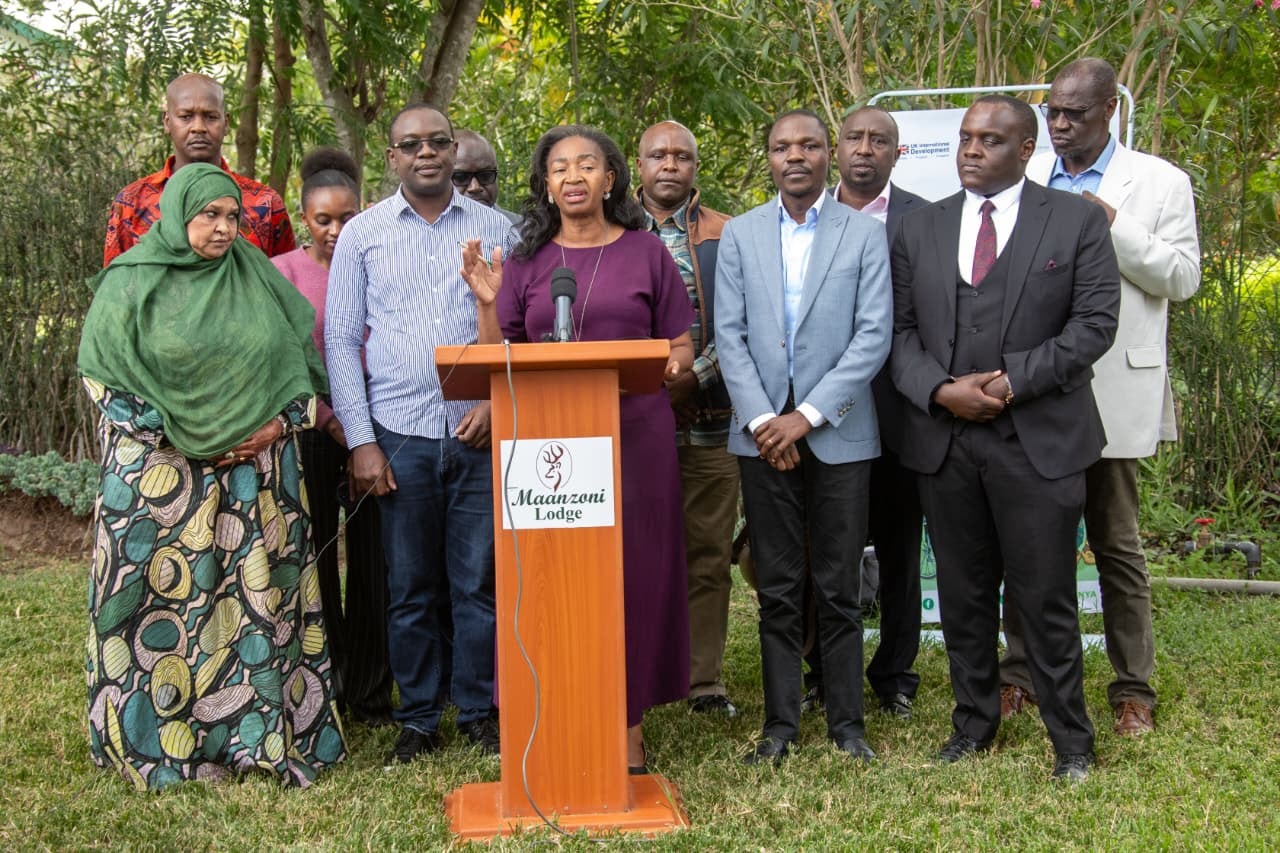
The Nadco team led by Dr Agnes Zani addresses the media at Maanzoni Lodge, Machakos county on Wednesday, December 3, 2025 /FILE
This article , which makes points readers may have encountered before, is by way of preparing to send a paper to th e Nadco committee in response to their public invitation to us all. My main focus is its proposals to amend the c onstitution.
A Prime Minister
I do not feel strongly about this. We have had the Prime Cabinet Secretary for the last few years without noticing much difference.
This would probably be the weakest “prime ministerial” position in the world. It is fundamentally like the position held by Mr Mudavadi: an opportunity for a President to give special recognition to a politician who has brought substantial benefits in terms of votes.
This person will not be anMP – unlike the PM in Uganda or Tanzania. This would surely make it difficult for our PM to be fully in charge of the legislative agenda of the government. In those countries, the PM is the “Leader of Government Business” in the Legislature.
Here, that role belongs to the Majority leader within the National Assembly. That person is best placed to work with the Speaker and the Minority leader to set the legislative timetable. The PM might instead have a role in liaising with ministries and the Attorney-General, whose office puts legislation into legal form, and then with the Majority leader.
While many provisions about Cabinet Secretaries would apply to the PM, the amendment does not describe this as a “Cabinet Secretary” position. However, an officer is not a member of the Cabinet unless Article 152 says so. Is the assumption that, like Mr Mudavadi, the PM would also have a ministerial portfolio?
Leader of the Opposition
This is even odder. The bill says the LOO would either be the best loser in the presidential election or would be nominated by a party or coalition (presumably the dominant non-government party or coalition in the National Assembly). The constitution cannot leave matters in such an uncertain state.
Again, the amendment would not put the LOO in Parliament after appointment.
A specific bill in the Nadco report would give the LOO functions including providing alternative policy agendas and “constructive criticism of government”, fostering co-operation between government and opposition and promoting good governance.
The best place for critique of government policies and proposals is Parliament. However, neither this person nor, presumably, his or her two deputy LOOs would be in Parliament. In Parliament, the relevant role is that of the Leader of the Minority, who is not guaranteed to be from the same party as the LOO.
There is no indication of how the two deputies are to be chosen. Are they supposed to be from different parties from the LOO and from each other?
This seems to be a generous package for the best loser, but with no guarantee that he or she would do anything useful. In a parliamentary system, the LOO works as an MP and, in addition, leads the opposition. Can we be sure that this LOO would not simply be a publicly paid agitator against the government? Can they be removed if they do not perform?
LOO's earnings
The Nadco Bill says that the salary of the LOO would be “a charge on the Consolidated Fund”. This means that it would be paid without the necessity for annual approval by Parliament.
The national debt is such a charge, as are the salaries of the president and deputy president, judges and holders of independent offices, but not MPs or CSs. Why should the LOO’s salary be treated this way?
The Bill would not make the LOO a “state officer”. The Salaries and Remuneration Commission would therefore not fix the salary. Who would?
I understand that some people believe these ideas would reduce post-election strife. What they appear to do is buy off potential promoters of strife in advance. The handshake is constitutionalised. I also wonder whether future “best losers” would be satisfied with the consolation prize of being LOO, or whether they would instead demand inclusion in government.
Arguably, this is a way of neutralising opposition and helping to support “two terms” – or worse. Although the LOO Bill does mention promoting understanding of the role of opposition in a democratic state, the overall effect may be to weaken it.
An alternative might be to allow people to stand for election to the National Assembly as well as for president. If the best loser won a parliamentary seat, he or she would have a job and a salary to fall back on. If supported by most non-government MPs, that person could become Leader of the Minority.
The two-thirds gender rule
The Nadco report proposes two approaches.
The first would import the county assembly model: additional women from party lists to achieve the gender objective. A new element is added: preference would be given to candidates who stood for election in a constituency and, within that group, to those who received the most votes.
This would require the repeal of section 34(9) of the Elections Act, which provides that “the party list shall not contain the name of a candidate nominated for an election”.
Every suggestion likely to be acceptable to existing MPs would significantly increase the size of the National Assembly. If the top-up approach had been adopted before 2022, there would now be 56 “list women” in Parliament, making a total of 405 members. This number should decline over time as more women are elected for constituencies.
The suggested alternative would double the number of county women representatives, with a top-up if necessary. This would permanently increase the size of the National Assembly. The role of women representatives is already unclear, and their existence distorts the relationship between votes cast and seats in Parliament. Twice as many would double that distortion.
Speaking personally (and many women may disagree with me), I would prefer to see the approach in the Katiba Institute 2018 case put into statutory form. At a minimum, this should require every party to nominate women candidates for at least one third of the constituencies it contests.
The challenge, of course, is to prevent parties from putting forward women only in unwinnable seats. I believe that, over time, more women will be nominated and more voters will support them. More special seats for women slow that process down.
EALA members
Finally, for now, the proposal to amend the constitution to recognise people who represent Kenya in international or regional agencies, notably the East African Legislative Assembly, is rather obscure. The report says that they are “not accorded the same stature” as MPs.
I agree that the public does not attach much importance to the role of an Eala member. This reflects the lack of prominence given to the East African Community in Kenya generally, including by government.
It also reflects, I suspect, a public sense that Eala members are not really about the people of Kenya but about Parliament favouring people from its own class. Recent members include Winnie, daughter of Raila Odinga, Kennedy, son of Kalonzo Musyoka and three former legislators.
If greater status is genuinely needed, it could be achieved by including Eala members in the Order of Precedence Bill (and enacting it) and equating them with MPs. A constitutional amendment would be required only if the intention were to make them “state officers”, which would be problematic because state officers’ salaries are fixed by the SR, whereas those of Eala members are set by the Assembly.
This proposal appears to fit within a broader pattern in the Nadco report: a focus on the interests of the political class, particularly in the areas discussed here.