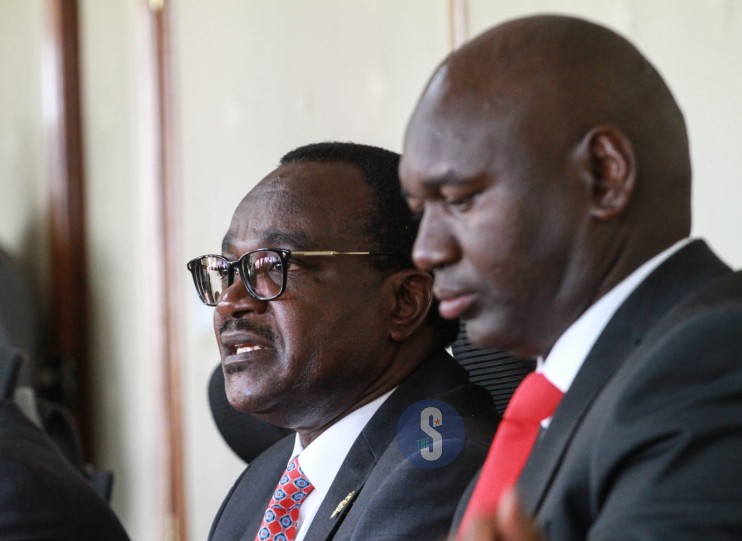
 Education CS Julius Ogamba and Basic Education PS Julius Bitok during the release of schools verification report at Jogoo House, Nairobi, February 12, 2026. /FILE
The Ministry of Education has lamented what they described as an unfair allocation of resources in the 2026-27 financial year, even as it acknowledged receiving the lion’s share of the proposed Sh4.7 trillion national budget.
In its 2026 Budget Policy Statement (BPS) and Medium-Term Expenditure Framework (MTEF) tabled before the National Assembly’s Standing Committee on Education, the ministry said the National Treasury has proposed allocating Sh767 billion to the sector, up from Sh702.7 billion in the 2025-26 fiscal year.
The amount is 26.8 per cent of the proposed Sh4.7 trillion total budget, a decline from the 27.6 per cent share of the Sh4.3 trillion budget in the 2025-26 financial year.
The ministry pointed out that this translates to a 9.1 percentage change in resource allocation, which is the lowest compared to the other priority sectors.
“Thus, from the face value, the sector seems to be getting significant resources, but when dissected further, a different scenario is evident,” the ministry said.
“This is an indication that despite the BPS 2026 identifying education as one of the priority sectors in 2026-27, this has not necessarily translated to more support in terms of resource allocation.”
The ministry argued that the perceived unfair resource distribution comes at a time when the sector is undertaking high-spending priority programmes.
It cited rising financial demands occasioned by the ongoing implementation of the Competency-Based Education (CBE), the student-centred funding model, restructuring of semi-autonomous government agencies (SAGAs), and amendments to education-related laws.
“The success of these reforms partly depends on the availability of resources to support their implementation,” the ministry said.
Under the MTEF, Health, National Security and Agriculture, Rural and Urban Development (ARUD) are earmarked to register the highest percentage change in resource allocation.
Health received Sh138 billion in 2025-26, accounting for a 5.4 per cent budget share. In 2026-27, the sector is earmarked to receive Sh167 billion, representing a 5.8 per cent budget share and a 21 percentage change in resource allocation.
In the 2025-26 budget, National Security received Sh254 billion, representing 10 per cent of the Sh4.3 trillion budget.
Treasury has proposed to increase this allocation to Sh300 billion in 2026-27, translating to a 10.5 per cent budget share and an 18.1 percentage change in resource allocation.
ARUD received Sh82 billion in 2025-26, representing a 3.2 per cent budget share. In 2026-27, the sector is earmarked to receive Sh97 billion, accounting for a 3.4 per cent share and an 18.3 percentage change in resource allocation.
Other sectors with high percentage changes in resource allocation in 2026-27 are Governance, Justice and Law at 16.6 per cent; Environment Protection, Water and Natural Resources at 11.5 per cent; Energy, Infrastructure and ICT at 11.2 per cent; Public Administration and International Relations at 10.2 per cent; and Social Protection, Culture and Recreation at 10.1 per cent.
Even so, the ministry commended the government’s consistency in increasing funding to priority interventions that support access to quality education.
It said a review of the past five budget ceilings indicates that the sector’s resource ceiling increased by more than 40 per cent, largely in response to increased enrolment and recurrent expenditure pressures.
“On average, during this five year period, the resource ceiling for the sector has been revolving between 76-78 per cent on the sector's resource requirement. The budget is mainly on the recurrent budget which is the major expenditure driver with TSC receiving more than 50 per cent of resources allocated.”
In the 2026 Budget Policy Statement, Treasury has proposed an allocation of Sh422 billion to the Teachers Service Commission in the 2026-27 financial year, an increase from Sh387.18 billion allocated last year.
Basic Education has been allocated Sh134.77 billion, up from Sh127.91 billion in the previous financial year.
Technical and Vocational Education and Training (TVET) is earmarked to receive Sh47 billion, compared to Sh43.24 billion last year.
Higher education has been allocated Sh160 billion, up from Sh143.73 billion, while innovation is proposed to receive Sh2.4 billion, up from Sh993 million allocated in the previous financial year.
When narrowed down to the three broad categories, Treasury has proposed to apportion the lion's share of the Sh4.7 trillion budget to the national government at Sh2.8 trillion (60.5 per cent); Consolidated fund Sh1.45 trillion (30.6 per cent) and county governments Sh420 billion (8.9 per cent).
The Executive will take the biggest share of national government's budget of Sh2.78 trillion, Parliament Sh49 billion while Judiciary will receive Sh30 billion.