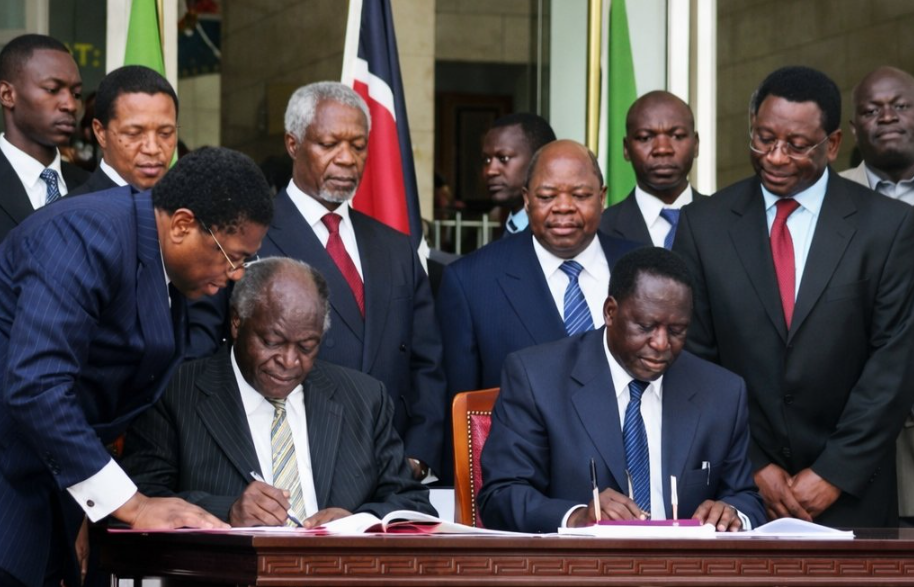
 The late President Mwai Kibaki and the late former Prime Minister Raila Odinga sign the National Accord for creation of a grand coalition government on February 28, 2008. /FILE
The late former Prime Minister Raila Odinga was held in high esteem by many and in disdain by some owing to his bare-knuckled approach to politics.
Though his sudden death on October 15, 2025 came before he could fulfil his lifelong dream of winning the presidency after five failed attempts, Raila left behind a rich legacy rooted in unwavering belief in democracy and human rights advocacy.
Known for taking hardline stances during political duels, the enigma as he was popularly known occasionally surprised allies and foes alike by making concessions even at moments when remaining uncompromising would have given him the upper hand.
One such moment came in 2008 at the height of post-election violence following the disputed 2007 presidential election, which he claimed was rigged in favour of the incumbent, Mwai Kibaki.
Despite pushback from some allies, Raila agreed to participate in an African Union-facilitated mediation process led by a Panel of Eminent African Personalities comprising former UN secretary general Kofi Annan (chairman), former Tanzania President Benjamin Mkapa and Graca Machel, a key mediator in African conflict resolution.
The arbitration team brought the Party of National Unity (PNU) and the Orange Democratic Movement (ODM) into the Kenya National Dialogue and Reconciliation forum for dialogue and mediation.
The overall goal was to achieve sustainable peace, stability and justice through the rule of law and respect for human rights.
The high number of people killed and displaced from their homes underscored the urgency of ending the crisis.
After about six weeks of negotiations that began on January 29, the parties signed the National Accord and Reconciliation Act on February 28, 2008, agreeing to share power. The deal formerly ended the violence.
The PNU and ODM sides agreed to a four-point agenda:
- Immediate action to stop the violence and restore fundamental rights and liberties.
- Immediate measures to address the humanitarian crisis and promote healing and reconciliation.
- Resolution of the political crisis.
- Long-term reforms, including constitutional, legal and institutional changes as well as land reforms.
The process also focused on tackling poverty and inequality, addressing regional development imbalances, unemployment particularly among the youth, consolidating national cohesion and unity, and confronting transparency, accountability and impunity.
The promulgation of the current constitution in August 2010 remains the biggest achievement of the truce, marking a new milestone in Kenya’s reform journey spanning over two decades.
The constitution established a sound framework for a progressive state, complete with new institutions such as the Independent Electoral and Boundaries Commission (IEBC).
It raised public optimism regarding respect for fundamental rights and freedoms and created hope for a political culture anchored in the rule of law.
March 9 handshake and the birth of the BBI
On March 9, 2018, Raila again engineered a political truce aimed at healing national divisions following the contentious 2017 election.
He had contested the outcome at the Supreme Court, leading to the nullification of Uhuru Kenyatta’s victory.
The court found the election was not conducted in accordance with the constitution, citing massive “irregularities and illegalities” in the transmission of results by the IEBC.
It ruled that the process was neither transparent nor verifiable, marking the first time a presidential election had been overturned in Africa.
Raila boycotted the repeat poll held on November 26 that year, demanding an overhaul of the IEBC and replacement of suppliers of equipment used to transmit results.
As leader of the National Super Alliance (NASA), he rallied supporters to hold weekly protests to force concessions from the government.
Faced with a severe post-election crisis, Uhuru agreed to the March 9, 2018 “handshake” on the steps of Harambee House, aimed at fostering national unity and peace and allowing him to focus on his development agenda.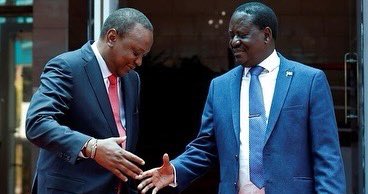 Former President Uhuru Kenyatta and the late former Prime Minister Raila Odinga shake hands at Harambee House on March 9, 2018. /FILE
The truce birthed the Building Bridges Initiative (BBI), effectively halting months of protests and economic disruption.
The BBI task force was mandated to address nine broad issues to foster national unity, including ethnic antagonism, inclusivity, divisive elections, corruption, shared prosperity and the balance between rights and responsibilities.
The 2020 BBI report proposed far-reaching constitutional amendments, including expansion of the Executive to reintroduce a Prime Minister and two deputies, creation of the Leader of Official Opposition position, increasing the National Assembly from 349 to 360 members with 70 new constituencies, raising county allocations from 15 per cent to 35 per cent, establishing a Judiciary Ombudsman, restructuring the National Police Service and introducing youth-focused economic incentives.
Although the two principals and allies described the proposals as transformative, the BBI process faced legal challenges and was declared unconstitutional by the High Court and Court of Appeal.
In 2022, the Supreme Court ultimately stopped the initiative.
High Court judges ruled that President Uhuru Kenyatta violated the constitution—specifically Chapter Six on leadership and integrity—by initiating and promoting a process that went against the established procedures.
They defined the BBI as "a presidential initiative guised as a popular initiative".
NADCO report
In August 2023, Raila engineered another political dialogue after months of street protests following the August 2022 presidential election, which he claimed was rigged in favour of President William Ruto.
The National Dialogue Committee (NADCO) was formed to address contentious political issues raised by Raila and his team, including the cost of living, electoral injustices and governance reforms.
The 10-member team was tasked with finding a political compromise to avert further impasse amid escalating violent protests.
Its mandate included auditing the 2022 election, addressing the cost of living, considering constitutional amendments for new offices such as Prime Minister and Leader of Opposition, and reforming the IEBC.
After more than two months, the committee submitted its final report on November 25, 2023, recommending several reforms and constitutional amendments for implementation between 2024 and 2026.
Implementation, however, appeared to stall or move sluggishly.
March 7, 2025 handshake with Ruto
In June 2024, tax measures proposed in the Finance Bill 2024 triggered what became known as the Gen Z protests.
The proposals introduced what many described as punitive taxes, even on essential goods such as bread, sanitary pads and mobile transactions, amid a high cost-of-living crisis.
Protesters also accused the government of corruption, high public debt and police brutality.
Despite the government dropping some controversial clauses, demonstrations expanded to demand systemic political change and resignations of officials.
The crisis forced Ruto to reach out to Raila, culminating in the signing of a “handshake” on March 7, 2025 to form a broad-based government aimed at enhancing political stability, addressing economic challenges and fostering unity.
The pact, which saw ODM members join the Cabinet, was anchored on a 10-point agenda largely associated with the NADCO report, including full implementation of its recommendations, inclusivity in budgetary allocations and appointments, strengthening devolution, youth economic investment, leadership and integrity reforms, protection of the right to peaceful assembly, audit of the national debt, intensified anti-corruption measures, reduction of public wastage and protection of sovereignty, rule of law and press freedom.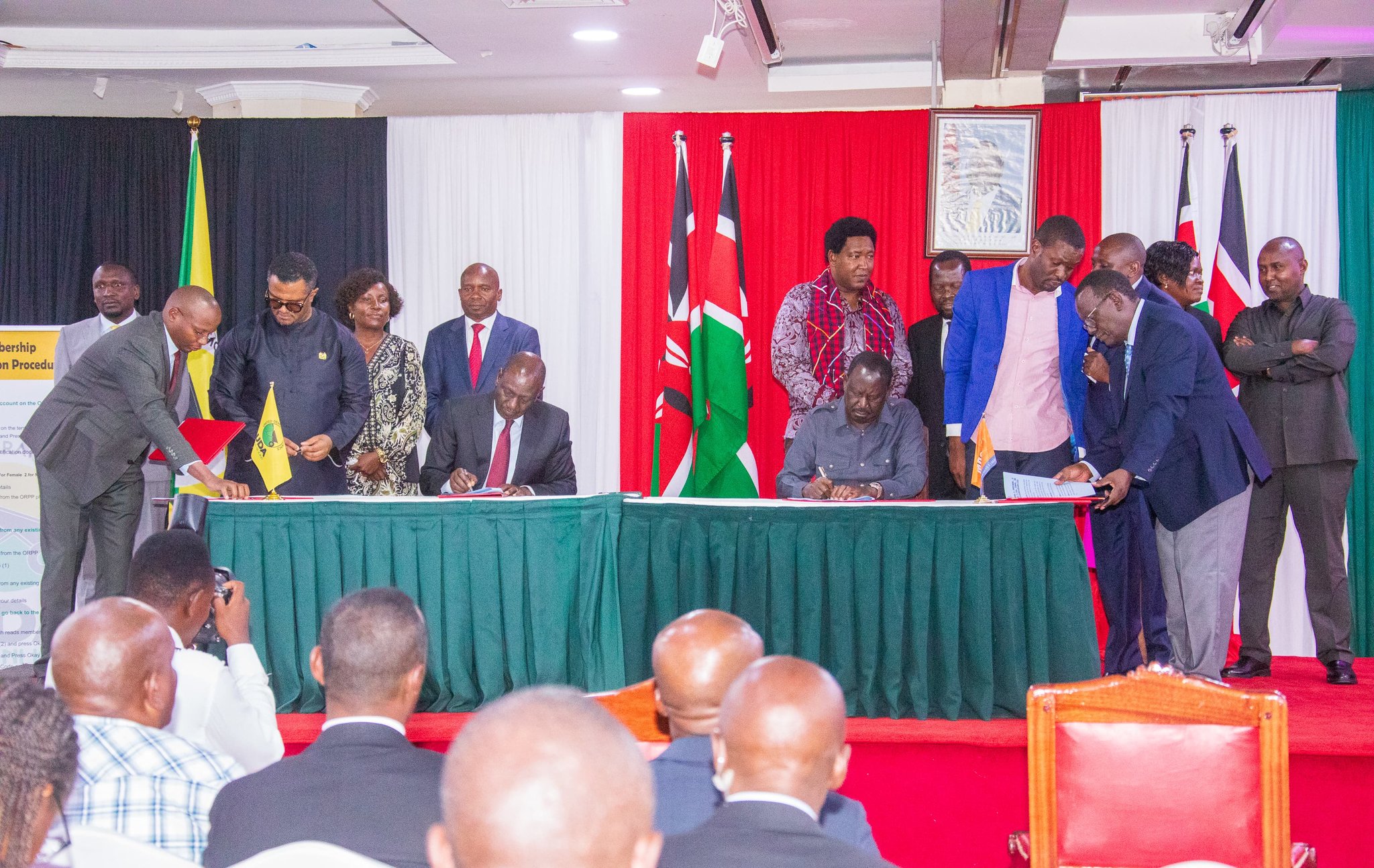 Raila Odinga signs 10-point working cooperation between ODM and President William Ruto's UDA at KICC on March 7, 2025. /FILE
Following Raila’s death, divisions emerged within ODM over the contents of the deal.
A faction led by secretary general Edwin Sifuna insisted that support for Ruto’s 2027 re-election bid was not part of the agreement.
Sifuna was removed as ODM secretary general on February 11, 2026 by the party’s National Executive Committee and Busia Woman Representative Catherine Omanyo installed in his place.
Although his ouster was suspended by the court, the move deepened animosity between factions and cast uncertainty over implementation of the handshake deal.
A five-member team chaired by former nominated senator Agnes Zani is overseeing implementation and is racing to submit its final report by March 7, 2026, the first anniversary of the pact.
Meanwhile, tensions between the Sifuna-led “Linda Mwananchi” wing and the “Linda Ground” faction led by Oburu Oginga have intensified.
The two camps held parallel rallies on February 15, with the Sifuna faction meeting in Kitengela, Kajiado county, and Oburu’s camp gathering at Tononoka Grounds in Mombasa.
The Kitengela rally, attended by leaders including Siaya Governor James Orengo, Embakasi East MP Babu Owino and deputy party leader Godfrey Osotsi, was disrupted by police who fired teargas into the crowd. One man was allegedly shot dead.
Across successive administrations, Raila’s handshakes — controversial yet consequential — repeatedly turned moments of national rupture into platforms for institutional reform, leaving a legacy that continues to shape Kenya’s political trajectory.
The emergence of rifts even within his own political juggernaut, points to the integral role he played as a stablising factor even during heated political rivalries.