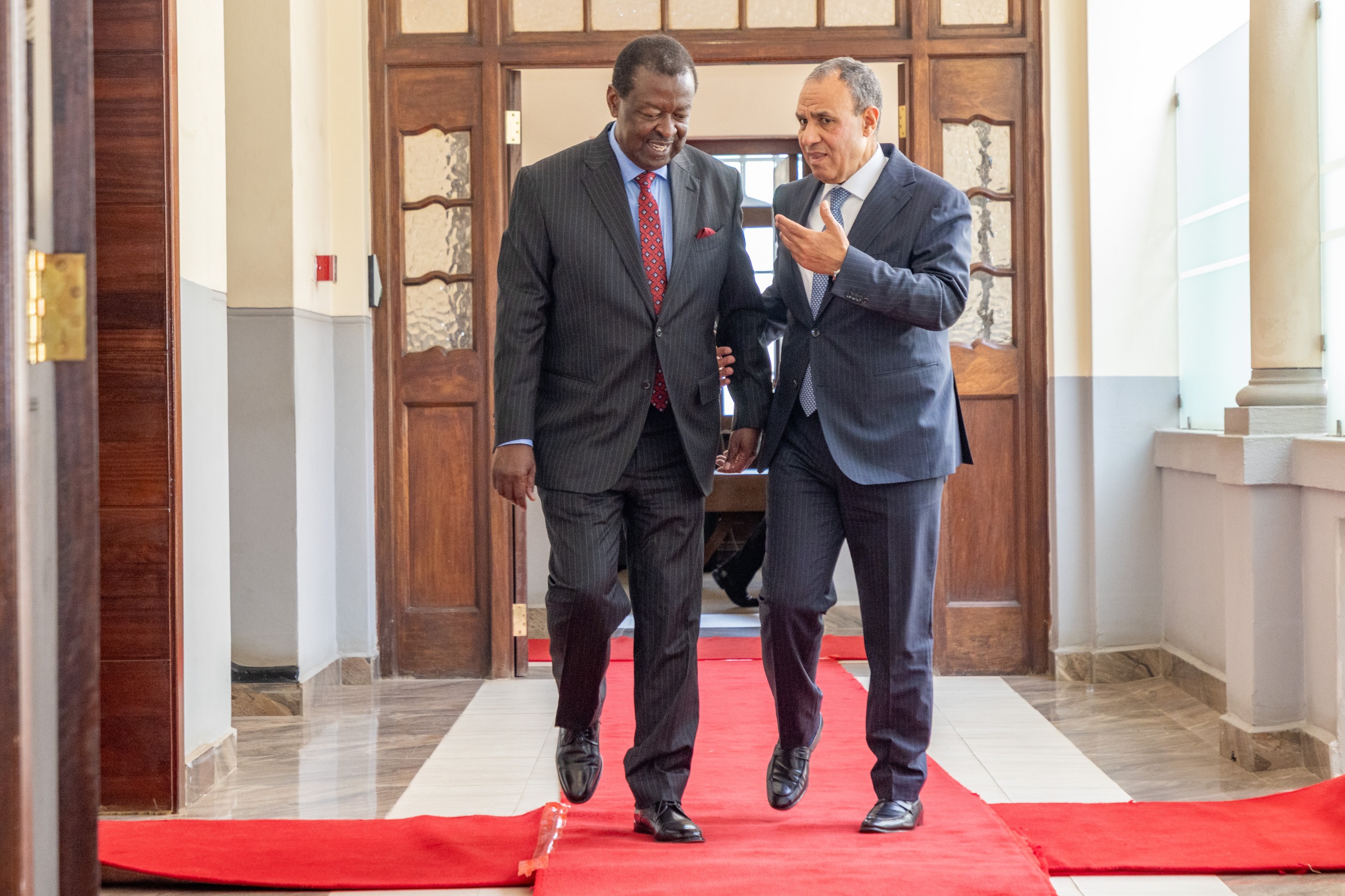
 PCS and Foreign Affairs CS Musalia Mudavadi and Egyptian Foreign Minister Badr Abdelatty at Railways Headquarters office on February 16, 2026
Egypt has stepped up its diplomatic charm offensive, placing Kenya at the centre of a renewed push to consolidate support in the dispute with Ethiopia over the Grand Ethiopian Renaissance Dam.
Egyptian Foreign Minister Badr Abdelatty on Monday announced Kenya will be prioritised under its new $100 million (about Sh12.9 billion) Nile Development Fund aimed at financing dam and water infrastructure projects across Nile Basin states.
The announcement came as Cairo intensified its appeal for African backing against what it terms Ethiopia’s “unilateral” actions on the Nile.
“Egypt launched a new fund—the Nile Development Fund—for financing and mobilising international financing for infrastructure in the Nile Basin countries, including dam projects, with an initial contribution of $100 million,” Abdelatty said.
“In line with our historic relations, Kenya is accorded priority to benefit from this fund to finance the implementation of specific dam projects here in Kenya.”
The Egyptian minister said the initiative would support integrated water resources management, including irrigation expansion, potable water systems, drainage networks, water harvesting dams and the sinking of wells in arid areas.
The projects will be implemented through technical collaboration between the two states’ water ministries.
Beyond water cooperation, Abdelatty proposed the establishment of a joint maritime line linking Egyptian Red Sea ports with Kenyan ports on the Indian Ocean to facilitate trade and natural resource development.
He also delivered a special message from President Abdel Fattah el-Sisi to President William Ruto and confirmed a state visit by el-Sisi to Kenya is scheduled later this year.
Egypt’s diplomatic outreach underscores the high stakes surrounding the Grand Ethiopian Renaissance Dam (Gerd), a multibillion-dollar hydroelectric dam on the Blue Nile that Addis Ababa says is critical to its development ambitions.
Abdelatty’s visit came just a day after Mudavadi attended a meeting of Nile Basin countries in Addis Ababa.
The meeting, chaired by Ethiopia Foreign Minister Gedion Hessebon, discussed regional water security and “equitable sharing and sustainable management of regional water resources”.
It brought together Foreign ministers from Burundi, Rwanda, South Sudan, Tanzania and Uganda, signalling Addis Ababa’s continued engagement with upstream states.
Launched in September last year, Ethiopia argues the dam will generate much-needed power for national electrification and economic development.
However, Egypt insists the filling and operation of the dam without a legally binding agreement threaten its water security. It depends on the Nile for more than 90 per cent of its freshwater needs.
Cairo maintains the project violates established principles of international law governing transboundary rivers, including prior notification and the obligation not to cause significant harm.
Tensions have periodically flared, with negotiations involving Sudan also stalling over the years. Ethiopia has rejected claims of unilateralism, arguing it has engaged in talks and that the dam poses no significant risk downstream.
It is against this backdrop that Kenya finds itself navigating a delicate geopolitical terrain involving two of its close regional allies.
Foreign Affairs CS Musalia Mudavadi, in the joint presser on Monday, reaffirmed Nairobi’s long-held principle that no country should be left worse off in the utilisation of shared water resources.
“We continue to advocate for Africa-led, inclusive and dialogue-based approaches within the Nile Basin Initiative framework,” he said.
“Kenya acknowledges Egypt’s position as articulated during the 33rd Nile Council of Ministers in Bujumbura in December 2025, which calls for dialogue, cooperation and mutual respect, and stands ready to serve as an impartial facilitator to advance cooperative and sustainable Nile Basin management.”
Mudavadi also welcomed Egypt’s initial $7 million (about Sh903 million) pledge towards high-impact projects — a figure Abdelatty indicated had been adjusted upwards — as well as Cairo’s offer of targeted capacity support in diplomacy, security, agriculture and religious leadership.
Abdelatty’s visit also follows a protest by Cairo following President Ruto’s attendance at the Gerd in September last year.
Egypt’s Ambassador to Kenya, Hatem Hosni, at the time said Cairo was “frustrated” that Kenya was the only Nile Basin country represented at the event.
Egypt viewed Ruto’s presence as lending legitimacy to the dam’s commissioning at a time when negotiations remain unresolved.
Cairo said the attendance by Djibouti and Somalia was inconsequential as they are not Nile Basin states, making Kenya’s participation significant.
During the launch, Ruto called for restraint and renewed dialogue among Ethiopia, Egypt and Sudan.
“Kenya reaffirms its support for equitable use of shared waters and encourages Ethiopia, Egypt and Sudan to continue trilateral talks in good faith. Dialogue and compromise remain the surest path to a fair agreement that safeguards prosperity and stability for all,” he said.
Ruto also signalled Kenya’s interest in deepening energy cooperation with Addis Ababa, including a potential power purchase agreement to off-take surplus electricity generated by the Gerd.
Nairobi maintains strong bilateral ties with Cairo and Addis Ababa and has positioned itself as a regional mediator on the matter.
Calling for dialogue, cooperation and mutual respect, Mudavadi said Kenya stands ready to serve as an impartial facilitator to advance cooperative and sustainable Nile Basin management.
“We continue to advocate for Africa-led, inclusive and dialogue-based approaches within the Nile Basin Initiative framework,” Mudavadi said.
In response, Abdelatty commended Kenya’s “leading role” in promoting dialogue among the Nile Basin countries.
“Mudavadi promised me that Kenya will continue being a bridge for dialogue, for cooperation, refraining from unilateralism and respecting international law,” he said.