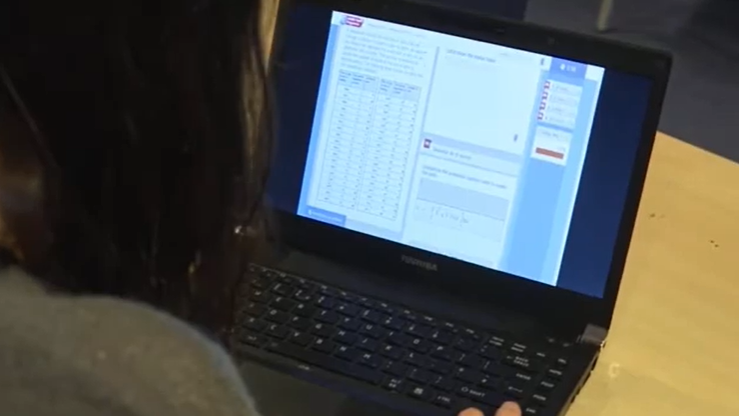
 Automated marking enables instant and detailed feedback, helping learners understand their performance immediately.
The Kenya National Examinations Council (KNEC) has initiated the gradual rollout of electronic assessment, marking a significant departure from the traditional manual marking of examination papers.
The shift forms part of ongoing education sector reforms as the country transitions from the 40-year-old 8-4-4 system to the 2-6-3-3-3 Competency Based Education (CBE) model.
It is also aligned with a broader reform agenda that includes the introduction of electronic certificates as Kenya moves to align learner testing and assessment with global best practices.
KNEC chief executive officer David Njegere has said e-assessment will be implemented across primary, junior and senior schools.
The approach is widely used to reduce logistical challenges associated with paper-based tests, enabling faster release of results and more engaging assessment methods.
However, the transition carries significant financial implications due to infrastructure demands and rising learner populations.
E-assessment, or electronic assessment, uses digital technology for the full, end-to-end process of creating, delivering and marking examinations.
It supports both formative and summative tests and offers immediate and more accurate feedback.
Formative assessments are ongoing checks, such as quizzes and discussions conducted during instruction to monitor student progress and provide immediate feedback.
Summative assessments, in contrast, are high-stakes evaluations comprising final examinations or projects conducted at the end of a unit to measure student proficiency and determine final grades.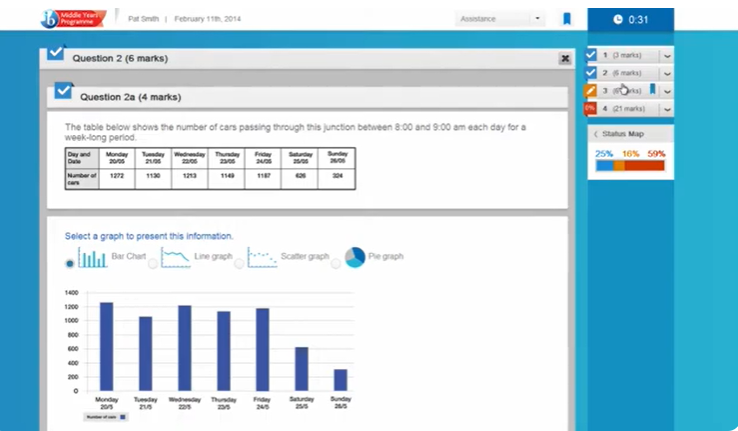 E-assessment supports both formative and summative tests and offers immediate and more accurate feedback.
How e-assessment works
The process begins with examinations being delivered through secure software accessed via a browser or dedicated player, which may lock down the user’s device to prevent cheating.
To safeguard integrity, browser-locking tools, webcam monitoring and online proctoring are typically used.
Automated marking enables instant and detailed feedback, helping learners understand their performance immediately.
Beyond multiple-choice questions, e-assessments may incorporate drag-and-drop tasks, data analysis, simulations, video analysis and text entry.
During the assessment, a candidate is permitted to change their answer to a question at any time before the allocated examination time lapses.
Although marking of tests is conducted internally, the deployed browser is externally moderated to guard against malpractices, including inputting responses after the allocated time has expired.
Successful implementation requires reliable hardware, including laptops or tablets, stable internet access and, in most cases, a rehearsal to ensure systems function properly.
According to KNEC, during the rehearsal the centre manager, ICT tutor and supervisor jointly inspect the institution’s ICT facilities and guide candidates through the requirements for administering e-assessment.
These include an adequate number of digital learning programme devices that are fully charged and in good working condition.
Learners may in some cases be required to bring their own devices.
The Kenya National Assessments Council (conduct and management of e-assessments) Rules, 2024 require that licensed and updated software, including operating systems, assessment platforms, security tools and other relevant applications, be installed and properly configured on devices.
Institutions must also have a dedicated offline server capable of handling e-assessment activities, with sufficient capacity for data storage, processing and backup without relying on internet connectivity.
The server must be configured with robust security protocols to protect assessment data from unauthorised access, ensuring the integrity and confidentiality of the examination process.
Stable internet connectivity is mandatory to facilitate the downloading of assessment materials, uploading of results and communication with external stakeholders.
A backup internet connection is required to guarantee continuity in the event of primary connection failure.
Institutions must also establish a secure network environment with controlled access to assessment-related data and resources, supported by firewalls, virtual private networks (VPNs) and access control lists (ACLs).
An uninterrupted power supply (UPS) is required to mitigate disruptions caused by power outages.
An ICT tutor must remain on call throughout the assessment period to provide technical assistance at the examination centre.
However, the tutor is not permitted to interact directly with candidates unless in the presence of a KNEC-deployed supervisor overseeing administration of the assessment.
KNEC will deploy one invigilator for every 20 candidates, and the invigilator must not supervise a subject they teach.
One supervisor will be appointed for at least 200 candidates and will work closely with the ICT tutor.
The rules further state that a candidate found engaging in any form of malpractice, including using unauthorised resources or accessing other internet browsers for answers, commits an assessment irregularity and shall be disqualified from continuing with the examination.
Section 32 of the Kenya National Examinations Council Act provides that where such an individual is found when they have already taken the assessment, the results shall be cancelled.
A candidate aggrieved by the decision may apply to the KNEC chief executive officer for a review within 14 days from the date the decision was made.
Should they be dissatisfied with the review decision, they may appeal to the Tribunal established under the Education Tribunal Act, 2024.
“A person, learner or candidate dissatisfied by decision of the Tribunal may within 14 days from the date of the decision appeal to the High Court,” the Kenya National Assessments Council (conduct and management of e-assessments) Rules, 2024 state.
To further minimise malpractices, candidates must maintain a sitting arrangement of 1.22 metres apart in accordance with KNEC regulations.