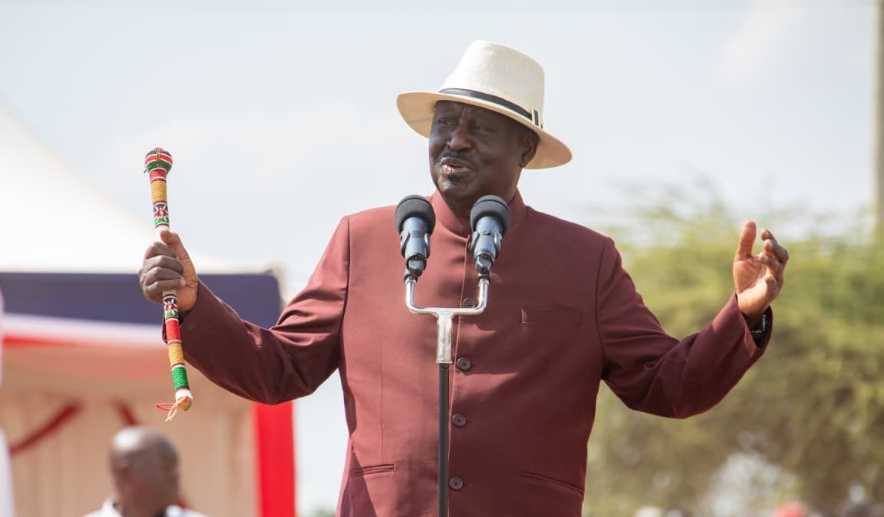
 Former ODM leader Raila Odinga. /ODM
The repeal of Section 2A of the Constitution in December 1991 ended one-party rule in Kenya and opened the gates for competitive politics.
What followed was a turbulent but defining chapter in the country’s history — the second liberation — which dismantled 26 years of de facto dominance by the Kenya African National Union (KANU) and ushered in a new era of opposition politics.
In that ferment, parties were born not merely as electoral vehicles but as instruments of resistance.
The most prominent among them was the Forum for the Restoration of Democracy (FORD), formed in August 1991 as a pressure group by opposition leaders. It quickly became the primary platform for challenging President Daniel Moi’s grip on power.
Yet, just months before the 1992 General Election, leadership wrangles split the movement in two.
The faction led by Jaramogi Oginga Odinga retained the name Ford–Kenya, while the alliance of Kenneth Matiba and Martin Shikuku adopted Ford–Asili.
The split fractured what had been a formidable challenge to KANU and set a pattern that would repeat itself in Kenya’s multiparty journey: parties built around powerful personalities struggled to survive internal contests for succession.
Alongside FORD, other opposition outfits emerged in the early 1990s.
The Democratic Party of Kenya (DP), founded by Mwai Kibaki in December 1991, drew substantial support from the Mt Kenya region.
The Kenya Social Congress (KSC) led by George Anyona, the Kenya National Democratic Alliance (KENDA) under Mukaru Ng'ang'a, as well as Safina and Shirikisho Party of Kenya, were also part of the expanding opposition landscape.
As multiparty democracy matured, coalitions became the dominant strategy.
The watershed moment came in 2002 with the formation of the National Rainbow Coalition (NARC), which united disparate opposition parties and defeated KANU, propelling Kibaki to the presidency. Yet even that historic alliance proved fragile.
After internal disagreements, the coalition’s 14-plus constituent parties fragmented, many gravitating towards the Orange Democratic Movement (ODM) and the Party of National Unity (PNU).
The trajectory of these once-dominant parties reveals a recurring pattern. KANU, the party under whose banner Jomo Kenyatta became Prime Minister in 1963 and which sustained Daniel arap Moi in power from 1978 to 2002, today holds only a handful of seats in the National Assembly.
Its influence has narrowed significantly, with much of its visibility concentrated in Baringo County under the stewardship of Gideon Moi.
Ford–Kenya, once a key pillar of opposition politics, similarly commands limited parliamentary presence today despite being led by National Assembly Speaker Moses Wetang’ula.
Ford–Asili, following the deaths of Matiba and Shikuku, effectively faded from the national stage.
PNU, which secured Kibaki’s re-election in 2007, did not entirely disappear but gradually evolved into a more regionally focused outfit, with its influence largely centred in Meru under former Governor Peter Munya.
The story is comparable to that of the Jubilee Party, which transitioned from a dominant governing party to a regional formation following the retirement of Uhuru Kenyatta, even as it seeks to regain ground ahead of 2027.
Against this historical backdrop, ODM now finds itself at a critical juncture.
Since the death of former Prime Minister Raila Odinga in October 2025, fissures have surfaced within a party that for nearly two decades marshalled formidable opposition support and came close to capturing the presidency in four elections between 2007 and 2022. ODM’s identity, messaging and grassroots mobilisation were closely intertwined with Raila’s persona.
His absence has triggered a contest over direction, strategy and control.
The immediate flashpoint came with the removal of Nairobi Senator Edwin Sifuna as ODM secretary general after he opposed the party’s decision to back President William Ruto’s re-election in 2027.
Sifuna now leads a splinter faction that includes Embakasi East MP Babu Owino, Siaya Governor James Orengo and Vihiga Senator Geoffrey Osotsi.
Although replaced by Busia Woman Representative Catherine Omanyo following a National Executive Council resolution, Sifuna maintains that he remains the substantive secretary general by virtue of a ruling from the Political Parties Tribunal.
The dispute has unfolded in parallel rallies and public declarations.
“They have the party but we have the members,” Owino declared at a Sifuna-led Linda Mwananchi rally in Kintegela.
Meanwhile, at the Tononoka Grounds in Mombasa during a Linda Ground event, Raila’s elder brother Oburu Oginga, who assumed leadership after the former premier’s demise, struck a defiant tone.
“Raila left us in the broad-based government and in the broad-based government I have been given a mandate by my party to proceed and negotiate with our partners. Forward ever backward never!”
Oburu also announced the formation of a negotiation team as the party moves to formalise a pre-election arrangement with Ruto’s United Democratic Alliance (UDA).
"I’m soon forming a very strong team of negotiators and our role is only to monitor its implementation," he announced.
The spectacle is reminiscent of FORD’s fragmentation in the early 1990s following Oginga Odinga's death, when competing centres of authority eroded a united front.
The critical question now is whether ODM can institutionalise itself beyond the charisma and political capital of its founder or whether it will follow the well-worn path of personality-driven parties that falter after their architects exit the scene.
Kenya’s multiparty history suggests that survival beyond a founder requires more than loyal supporters and symbolic capital.
It demands coherent internal democracy, credible succession frameworks and a shared ideological compass.
Without these, parties often retreat into regional strongholds or splinter into irrelevance.
ODM stands at that crossroads. Its internal contest is not merely about leadership positions but about whether it can transition from a movement defined by Raila’s political persona into a durable institution capable of renewal.
Whether it breaks the decades-long pattern that has seen Kenya’s major parties weaken or wither after their founders’ deaths may well shape the country’s political landscape in the years ahead.