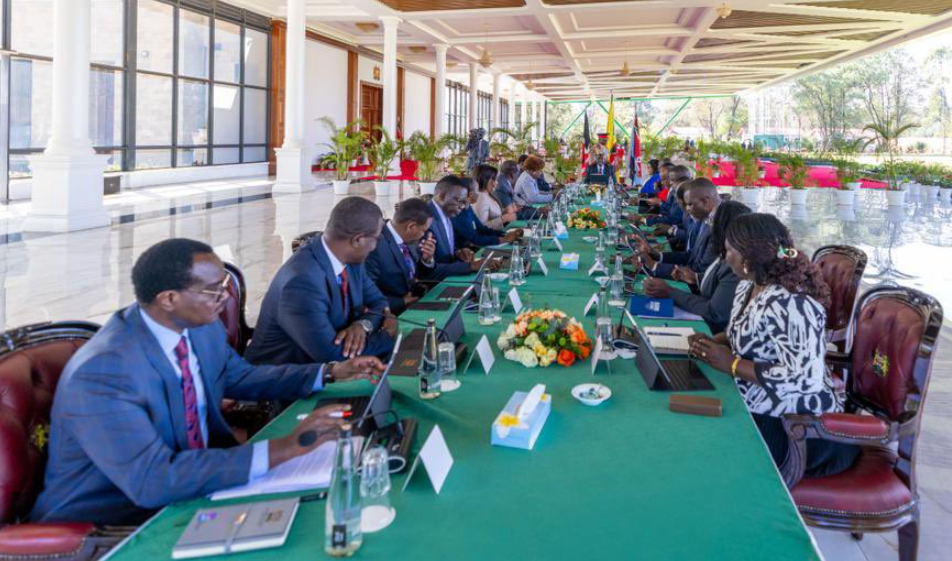
 Cabinet meeting chaired by President William Ruto at State House, Nairobi, February 10, 2026. /PCS
The Cabinet has approved the consolidation of multiple higher education financing models into a single entity, signalling a policy shift expected to strengthen financial support for university and TVET students.
The Cabinet adopted the Tertiary Education Placement and Funding Bill, 2024, merging the Higher Education Loans Board (Helb), the Universities Fund, the TVET Funding Board and the Kenya Universities and Colleges Central Placement Service (KUCCPS) into a single authority.
The move is aimed at eliminating overlapping functions, achieving savings and creating an all-in-one student placement, scholarships, loans and career guidance centre.
The merger followed recommendations by the Presidential Working Party on Education Reform (PWPER) contained in its report presented to President William Ruto in June 2023.
The Bill is among seven pieces of legislation the Cabinet adopted on February 10 and forwarded to Parliament for debate, setting in motion reforms aimed at aligning governance, curriculum, assessment, financing, teacher training and qualifications with the constitution and Competency-Based Education (CBE) and training framework.
The Cabinet also adopted the Kenya National Qualifications Framework (Amendment) Bill, 2024, which clarifies the mandate of the Kenya National Qualifications Authority and resolves overlaps with sector regulators.
Under the new framework, the authority will focus on setting national qualifications standards while accreditation and equivalence of qualifications remain with respective regulators.
Also adopted is the Basic Education Bill, 2024, which aligns the system with the CBE, clarifies national and county roles, strengthens quality assurance, rationalises school governance and introduces coordinated administration of bursaries and scholarships.
The Cabinet also approved the Kenya National Educational Assessments Bill, 2025, which rebrands the Kenya National Examination Council (KNEC) into the Kenya National Educational Assessments Council (KNEAC).
The KNEAC will oversee all national assessments, a timely move considering the examination-centric 8-4-4 system will be completely phased out in 2027.
The Kenya Institute of Curriculum Development (Amendment) Bill, 2024, limits the institute’s mandate to basic and teacher education and restructures its board to eliminate overlaps.
The Education Administrative Tribunal Bill, 2024, establishes a mechanism for resolving education-related disputes while the Pre-Service Education and In-Service Training in Basic Education Bill, 2025, addresses teacher preparation and professional development.
Under the new framework, curriculum development for TVETs will move to the TVET Curriculum Development, Assessment and Certification Authority (CDAAC).
The Cabinet, which described the Bills as a comprehensive overhaul of Kenya’s education sector, said the pieces of legislation would eliminate decades of bureaucratic duplication, overlaps, and inefficiencies.
Stakeholders welcomed the policy shift, noting that it will improve coordination, reduce operational costs, and eliminate administrative duplication, which has for long increased the financial burden on students and led to inequitable, slow or inaccurate disbursement of funds.
The views reflect what PWPER highlighted in its findings: “There exist ambiguities, inconsistencies, and constraints in various legislation that create loopholes for multiple allocation of funds to the same beneficiaries at the expense of others.”
“It was further observed that the existence of several bodies and government agencies with overlapping mandates contributes to multiplicity of standards and qualifications, leading to wastage and inefficiencies,” the team noted.
PWPER noted in its report that the majority of stakeholders pointed out that teachers were inadequately trained on CBE, while parallel roles and structures by the Teachers Service Commission (TSC) and the Ministry of Education (MoE) jeopardised quality assurance and efficiency.
In its final report in June 2023, which followed two interim reports in December 2022 and March 2023, the PWPER, chaired by Prof Raphael Munavu, said its recommendations followed oral and written submissions from Kenyans across all counties and the diaspora.
The team said that in making its recommendations, it considered the country’s economic position and future outlook and outlined an implementation strategy that would deliver the national goals of education and enable the country to realise the much-needed societal transformation.
“It is our conviction that implementation of the recommendations will place Kenya on the right trajectory to address the challenges and goals of the 21st Century and beyond, focused on best practice across the globe,” the team said.