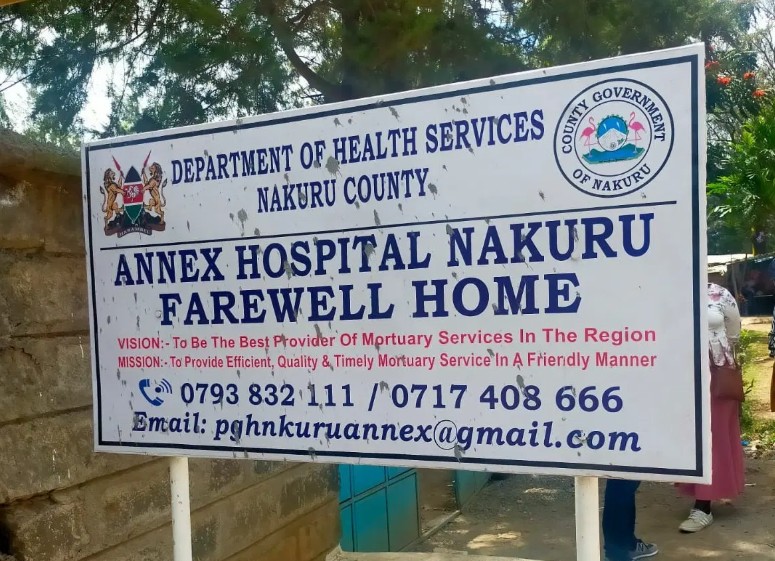
Nakuru County will dispose of 27 unclaimed bodies from the Nakuru County public mortuary within twenty-one days if they are not collected.
The devolved unit has further released a list of the unclaimed bodies, indicating the exact place of death and date as well as the cause of the death.
A notice issued by County Health Public Health Officer Waithera Mwangi indicated that the corpses had been unclaimed for over three months, affecting services at the facilities.
"The following 22 adults and 5 infants' unclaimed bodies are at the Public Mortuary (Annex funeral home). Interested members of the public are asked to identify and collect the bodies within 21 days; failure to which Nakuru County will seek authority for disposal," the public notice added
According to the list released by the public health officer, some of the unclaimed bodies had identities by the time of collection, while others did not have thus remain unknown. Some of the corpses marked as unknown were recovered by police without any form of identification documentation.
The County Government said a court order will be first sought so as to allow them to dispose of the corpses if no one will claim them, pursuant to the Public Health Act, Cap 242 [Subsidiary; public health (public mortuaries) rules, 1991].
Mwangi stated that the devolved unit had exhausted all the available mechanisms to trace their next of kin without success.
“If next of kin are not traced, the disposal will be done after the expiry of twenty-one (21) days from the date of this letter at the Nakuru South Cemetery,” the notice read in part.
Every few months, mortuaries run public notices of the disposal of unclaimed bodies. Upon expiry of the notice, the bodies are buried in public cemeteries or in mass graves without the knowledge of their loved ones.
Unfortunately, the bodies are buried with no rites.
The disposal is carried out to create room and to avoid overstretching the facilities where the bodies are preserved.
The Public Health Act (Cap 242) mortuary rule stipulates that no person shall keep the dead in a morgue for more than 10 days. If a body remains unclaimed for 21 days, the hospital is allowed to dispose of it as long as they have court orders and have given a 14-day public notice.
The statement released also revealed that the causes of death for the deceased are suicide, road accidents, murder, drowning, shooting, natural death, sudden death, abortion and mob injustice.
Few cases have been indicated to be that of natural death.
Every year 200 to 300 unclaimed bodies lie in Nakuru County morgues.
Some of the reasons why families fail to claim their deceased relatives' remains include lack of money to bury them, cultural myths and lack of land for burial or sometimes they are unaware that their loved ones are lying in a mortuary unknown.
According to the Public Health Act 242, (Public Mortuaries) any person who keeps the dead in a public morgue for more than 10 days shall pay to the Medical Officer of Health a penalty of one hundred shillings for each day the body remains uncollected.
Medical schools with legal backing and permission from the Ministry of Health are allowed by the Anatomy Act Cap 249 to obtain unclaimed bodies for medical studies.
Ms Mwangi said Nakuru is incurring significant costs in preserving uncollected bodies, sometimes up to four months.
According to a counselling psychologist Ochieng Okuku, the reason there are many unclaimed bodies is that most families don’t know that their loved ones have died.
“Often, there is a breakdown in communication. The relatives haven't spoken to the victim in a long time and assume they are alive yet their kin's body is somewhere in a mortuary,” he said.
He added that most unclaimed bodies are mostly of unknown people whose causes of death are unnatural.
“It is difficult to track down families of victims who die unnatural deaths and the police cannot identify the fingerprints of the deceased,” he said.
Police play a critical role in identifying fingerprints of the deceased.
A postmortem is conducted by a coroner after the family is made aware, after which they can claim the body.
Investigation of sudden and unexplained death takes many forms. In Kenya this has mostly been through a public inquest established under Sections 385-387 of the Criminal Procedure Code.
In 2017, Parliament enacted the National Coroners’ Service Act, providing the framework for the investigation of reported deaths.
But implementation of the National Coroners Service Act, 2017 has been delayed by a legal bottleneck over which cabinet secretary should name the coroner-general and determine the terms of the Coroners’ Service.
The Act transferred the investigation of unnatural and violent deaths, including those in police custody and prison, from the police to the coroner-general, an independent office whose occupant is competitively appointed by the cabinet secretary responsible for matters relating to justice upon recommendation by the Public Service Commission.