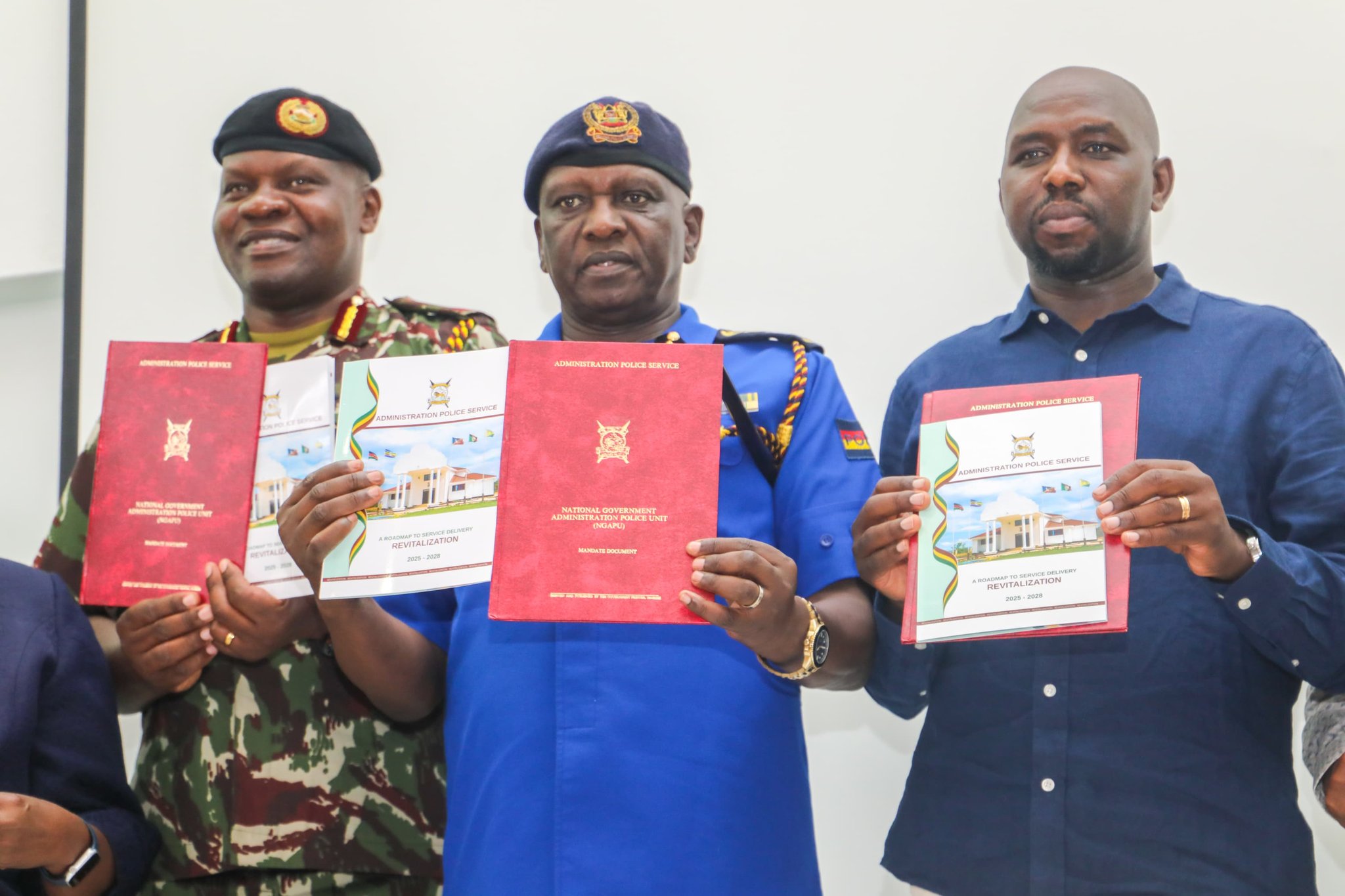
Published through amendments to the National Police Service Standing Orders, Ngapu places a specialised police structure directly in support of national government administrative officers across the country.
From regions to counties, subcounties and wards, the unit is designed to work closely with chiefs, assistant chiefs and national government officials in carrying out what the law describes as lawful duties.
Interior CS Kipchumba Murkomen on Thursday said the government had begun developing Ngapu’s standard operating procedures, providing step-by-step instructions for the unit’s functions.
But critics say the timing and design of the unit raise eyebrows as the country prepares for the 2027 General Election.
The functions outlined in the Gazette notice indicate the unit will, among other roles, support national government administrative officers in enforcing laws and provide security to government officers.
It will also secure public functions and community gatherings, assist in conflict management and peace building, collaborate with other law enforcement agencies and respond to incidents as first responders.
It will also enforce lawful orders as directed by the Deputy Inspector General of the Administration Police Service.
The structure runs from a commandant at the top to regional unit officers, county unit officers, subcounty officers and ward or division unit officers.
Each level is directly linked to the administration police command structure but operationally tied to national government administrators on the ground.
For observers, with the history of incumbents being accused of using National Government Administration Officers during campaigns and elections, this close linkage raises alarm.
LSK president Faith Odhiambo acknowledges that one of the powers vested in the Inspector General under Section 10 of the National Police Service Act is organizing the Service at national level into various formations, units or components.
In executing this mandate, Odhiambo said, the IG is bound by constitutional principles of governance and the objects of NPS under Article 244 of the Constitution and the NPS Act.
“The establishment of Ngapu has been touted as being for the purposes of supporting National Government Administrative Officers such as Chiefs in the discharge of their mandate. What is not clear is the lapse, if any, that existed under the previous setup where NGAOs were supported by officers from the APS,” she noted.
Odhiambo added that the establishment of the unit does not create any new command structure that would interfere with the Police Service as it is.
“However, the operational costs and potential social impact and balance of public interest from establishing NGAPU ought to have taken precedence in the decision to set up the unit,” she said.
In this regard, the LSK boss said it is important for Kenyans to remain keen in observing the true purpose and intention of the establishment of the unit, as it must be consistent with facilitating the discharge of the functions of the Police.
“It must not give room to any control of officers by the Executive under the guise of executing directives of NGAOs; even though they may support functions, they must remain independent and autonomous as required by the Constitution,” she said.
Governance activist Ndungu Wainaina warns that the move resembles a return to a system Kenyans rejected during the constitutional review process.
“The people of Kenya rejected provincial administration during 2010 constitutional review due to its colonial, centralised and repressive nature,” he said.
“They replaced it with a democratic devolved system of governance. Under Ruto, provincial administration has been enhanced and expanded.”
An activist who did not want to be named said concerns over the use of the unit in elections are justified, citing recent cases of police being used to harass and attack opposition leaders.
He also recalled the alleged use of Administration Police for “political work” in the 2007-08 electoral violence.
Governance commentator Alex Kathurima echoed Wainaina’s concerns, saying the gazettement is not just about policy.
“It's about the re-engineering of the Kenyan state into a centralised, executive-heavy system, where the ruling party is the only viable path to power and resources,” he said.
“There was no public participation, which is a common habit in this government.”
Consumer Federation of Kenya secretary general Stephen Mutoro has also raised concerns about the outfit, terming it more political than security-based.
“Call it security if you want, but this looks like the formalisation of a political enforcement unit,” he warned.
Critics also argue that the architecture of the unit appears to embed police officers within the administrative chain that was deliberately weakened by the 2010 Constitution.
Under the Constitution, policing was meant to be insulated from direct control by administrative officers, with the service being independent.
Chiefs and county commissioners retained coordination roles but not command over police operations. The new unit appears to formalise daily operational support between the two.
“This unit is being created in a country that is heading into an election cycle,” political analyst Dennis Mwangi added.
“It gives administrative officers structured police backing in villages, wards and subcounties. That is where elections are won or lost.”
Civil society groups also point to the clause requiring ward or division unit officers to provide assistance to national government administrative officers without undue delay or reservation when requested.
They argue that this provision could blur the line between lawful security operations and political control at the grassroots.
Critics also argue that the structure mirrors the old provincial administration security arrangement, where chiefs worked hand in hand with police to enforce state directives at the local level.
That system was heavily criticised during the constitutional review for enabling political repression and intimidation.
The gazettement comes two months after President William Ruto met 15,000 chiefs and assistant chiefs at State House, where he promised 3,000 vehicles and tablets.