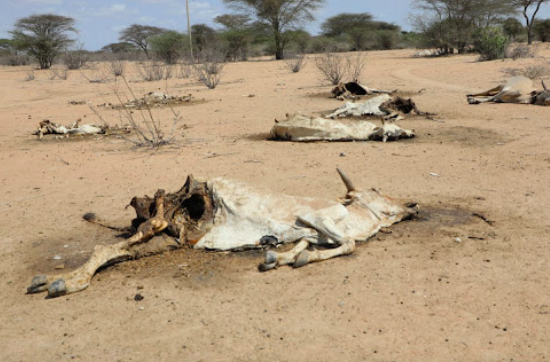
Carcasses of livestock/FILE
The Kenya Wildlife Service (KWS) has announced a raft of measures to prevent wildlife deaths as the drought worsens.
Director general Erustus Kanga said the measures are aimed at ensuring the availability of water and pasture.
“We will be undertaking a number of water infrastructure projects in areas such as Kilifi, Taita Taveta, Kwale, Isiolo, Tana River, Marsabit, Turkana, Garissa, Wajir, Mandera, Tharaka Nithi and Meru,” Kanga said.
The government has said it will spend Sh4 billion every month to procure food and non-food items, livestock feed and water as part of ongoing drought response measures.
The funds will support people, livestock and wildlife in affected areas.
In addition to the monthly allocation, the government has asked development partners to contribute an additional Sh2 billion, saying the combined funding would strengthen the response.
Kanga said feed supplements will be provided to livestock near parks such as Tsavo East National Park, Tsavo West National Park, Meru National Park, Kora National Park and Sibiloi National Park.
Water trucking will be carried out in Mandera, Wajir, Garissa, Turkana, Marsabit, Taita Taveta and Kwale.
Kanga said the interventions are short term due to budget constraints. Boreholes will be drilled and existing ones repaired.
Wildlife populations in the country have been growing. The latest national census report shows that Kenya’s iconic species are thriving, with the elephant population rising to 42,072.
The 2021 report recorded 36,280 elephants, reflecting an annual growth rate of 3.99 per cent.
The 2025 National Wildlife Census report shows the rhino population now stands at 2,102. This includes 1,059 black rhinos, 1,041 white rhinos and two northern white rhinos.
However, the 2022 drought had a severe impact on wildlife. On November 5, 2022, the Wildlife Research and Training Institute released a report showing that several iconic species had died due to lack of water and pasture.
The report recorded the deaths of 512 wildebeest, 381 common zebras, 205 elephants, 49 Grevy’s zebras and 51 buffaloes.
Kanga said boreholes are being drilled in Kajiado, Taita Taveta, Wajir, Kilifi, Marsabit and Turkana.
He identified human–wildlife conflict hotspots as Lamu, Taita Taveta, Kwale, Kajiado, Laikipia and Meru. Patrols by the problem animal management unit have been intensified.
“The animal management unit is well equipped and working 24 hours,” he said.
Kanga said the service is also using helicopters to drive elephants away from farms.
Other interventions include the use of predator lights, the installation of new electric fences and the repair of existing ones.
To prevent wildfires, communities have been put on high alert.
“Communities have been warned that lighting cigarettes or small fires can be disastrous during the dry season,” Kanga said.
He added that the fire response team has also been placed on high alert to respond to emergencies, with support from partners.
Fire suppression will be carried out in Aberdare National Park, Mount Kenya National Park, Lake Nakuru National Park and Chyulu Hills National Park.
The Kenya Meteorological Department has forecast that limited pasture and water in ASAL areas may lead to resource-based conflicts between pastoralists and farmers.
Water availability for human and livestock use is expected to decline further, especially in arid and semi-arid areas.
Human–wildlife conflict cases are likely to increase as animals migrate in search of water and pasture. Wildlife deaths may also rise in conservancies due to shortages.
Kenya has numerous protected areas covering about 12.34 per cent of its landmass.
These include 24 terrestrial national parks, 29 terrestrial national reserves, four marine parks, six marine national reserves, eight national sanctuaries and 234 forest reserves.
Government data on human–wildlife conflict incidents over a 15-year period, from 2009 to 2024, shows a total of 57,006 reported cases.
The number of incidents has fluctuated. There were 2,409 cases in 2009, rising to 3,186 in 2011 before dropping to 1,930 in 2013. Incidents increased again to 3,431 in 2015 and 3,412 in 2016.
A sharp rise was recorded in later years, with 3,698 incidents in 2020, 3,176 in 2021, 4,950 in 2022 and a peak of 8,272 in 2023. In 2024, 7,883 incidents were recorded.
Crop destruction is the most common type of conflict, accounting for 32,480 cases. Livestock predation follows with 15,940 incidents.
Between 2022 and 2024, elephants were involved in the highest number of incidents, with 17,917 cases. Most related to crop destruction (7,556), as well as 149 human injuries and 121 deaths.
Hyenas were involved in 3,109 incidents over the same period, largely linked to livestock predation (2,480).
A three-year geographical analysis shows that Taita Taveta recorded the highest number of incidents, at 6,293. Other counties in the top ten were Laikipia (4,479), Kajiado (3,196), Meru (1,451), Marsabit (1,373), Nakuru (1,136), Kilifi (1,041), Kitui (1,037), Kwale (948) and Isiolo (897).