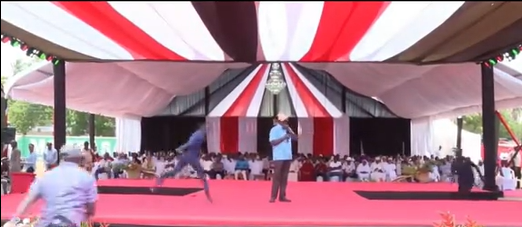
 Man running towards President William Ruto during the Nyota event in Mombasa/SCREENGRAB
World leaders operate under continuous, layered protection because their office carries risks that extend beyond personal safety. Any lapse can threaten not only a life but also the stability of the state.
From Washington’s specialised Secret Service to Kenya’s elite formations, security for a head of state is designed to be uncompromising.
Officers work in shifts, control crowds, secure venues and coordinate intelligence to neutralise threats before they reach the principal.
Protecting a head of state is considered essential to prevent power vacuums, political chaos or broader security threats.
In many African contexts, threats have been linked to suspected foreign or economic interests, but even lone actors without violent intent remain unpredictable and potentially dangerous.
It is against this backdrop that two recent incidents involving President William Ruto raised concern after members of the public breached security cordons within days of each other.
Both individuals were later found harmless and motivated by excitement rather than malice. Analysts, however, said the breaches exposed vulnerabilities that should never occur around a sitting president.
Security analyst George Musamali said the presidency cannot treat any threat lightly.
“We have what we call threats and risks, we analyse to see if this threat leads to a risk? But when it comes to the presidency, all threats are a risk. It should not have been left to happen,” Musamali said.
Musamali, a former GSU officer, explained that presidential protection typically involves several layers under a joint operational command. He said before reaching the president, an individual must pass the outer cordon and the inner cordon.
He added that political optics sometimes influence how tightly those layers are enforced during public engagements.
“This is a political occasion, and the principal might want to look like he's friendly,” he said. “When somebody is planning an attack on the President, he does surveillance, and he’s watching his move. So you should not compromise the security of the President for political expediency.”
“That one was a dangerous situation; it should never have been left to happen. Never! You don’t take chances with the President’s security.”
The most recent breach occurred on Thursday, February 12, at Wajir Stadium, where the President presided over the National Youth Opportunities Towards Advancement (Nyota) capital disbursement programme attended by thousands of young people.
The President paused his speech as security aides wrestled a young man who had suddenly burst onto the podium.
"And I will want to know what the young man wants so I can sort it out," the President said, remaining calm.
The man later told the media he had no ill motive and only wanted counsel from the President, as he plans to run for an MCA seat in the 2027 elections.
"I had waited since noon, and that was the moment he was summarising his speech. There was no otherwise. I only wanted to greet him and share my ambition for the 2027 elections," he said. He admitted that he did not realise his actions posed a serious security threat.
Six days earlier, a similar incident occurred at the Jomo Kenyatta Showground in Mombasa, where another young man rushed towards the presidential dais. On that occasion, the President asked him to wait at the VIP section until after the function.
"You will have to wait a bit, let me finish with these ones first then I will be with you," the President said.
The President’s composed reactions in both cases reinforced his approachability. However, Musamali said such openness, while politically appealing, can unintentionally signal exploitable gaps.
Police have moved to review the incidents. Inspector General of Police Douglas Kanja ordered an immediate inquiry, forming a team to investigate the circumstances.
In a statement on Thursday, the National Police Service said the team was directed to complete the inquiry within three days.
“The National Police Service wishes to reassure the public that it remains steadfast in its commitment to serve and protect,” the statement, signed by NPS spokesperson Muchiri Nyaga, said.
Though neither incident caused harm, the episodes have renewed debate on presidential security and the balance between political symbolism and risk management.
For Musamali, the principle remains simple: proximity equals risk, and risk around a head of state should not be normalised.