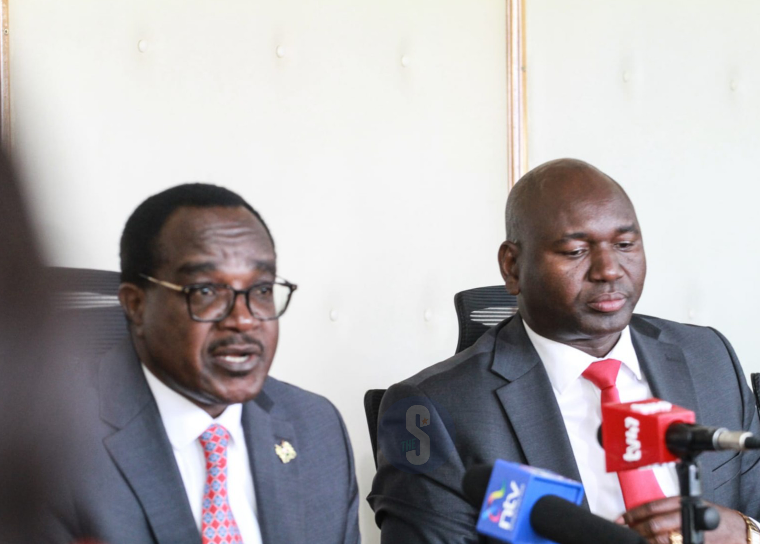
 Education CS Julius Ogamba and Basic Education PS Julius Bitok during the release of school data verification report at Jogoo House, Nairobi, on February 12, 2026. /ENOS TECHE
The government saved Sh912 million in capitation payments to would-be ghost students in public primary and secondary schools during the third term of 2025.
The payments were avoided after a nationwide forensic audit, launched on September 1, 2025, by the Ministry of Education, uncovered a scheme in which some school heads and principals had inflated enrolments on the National Education Management Information System (NEMIS).
The ministry allocates capitation for free primary, junior, secondary, and special needs education strictly based on learner numbers recorded in NEMIS.
Speaking while releasing the audit report on Thursday evening, Education Cabinet Secretary Julius Ogamba said the audit found discrepancies between NEMIS data and the enrolment figures submitted by school heads.
The majority of unauthenticated learner records were in public primary schools, where NEMIS showed 5,833,175 learners, but the verification exercise found only 4,947,271.
This meant the government had been paying capitation for 885,904 non-existent pupils.
The audit also identified 87,730 inflated enrolments in secondary schools, bringing the total number of ghost learners to 973,634.
“The total amount spent and we were able to retain because of this verification exercise amounted to Sh912 million, and this is inclusive across the board,” Ogamba said at the ministry headquarters, Jogoo House, Nairobi.
The withheld funds include allocations for 10 secondary and 17 primary schools that were non-operational due to insecurity, lack of learners, community relocation, or administrative closure.
These schools had not been reported to the ministry and continued to appear in NEMIS.
Ogamba attributed the discrepancies to school administrators and subcounty directors of education. He said inaccurate data entry and weak oversight arose from failure to correct or report inconsistencies promptly.
“Heads of institutions are the custodians of school data and are personally responsible for the accuracy, completeness and timeliness of all learner records entered into the system. Any deliberate falsification, inflation or misrepresentation of enrolment data constitutes gross misconduct and a breach of public trust,” Ogamba said.
“Similarly, Subcounty Directors of Education are responsible for oversight, supervision and validation of schools within their jurisdiction. Where discrepancies occurred and were ignored, condoned or failed to be escalated, administrative responsibility arises,” he added.
The CS said the findings are serious and warned that heads of institutions could face dismissal where culpability is established.
He confirmed the ministry had forwarded the audit report to the Teachers Service Commission (TSC) and the Directorate of Criminal Investigations (DCI) for further action.
The audit flagged 14 school heads who either failed or refused to submit student enrolment data for verification, and 20 others whose schools had the highest enrolment variances, ranging from 500 to 2,300 learners.
Action will also be taken against 28 Subcounty Directors of Education and Quality Assurance and Standards officers where investigations establish systemic failures or supervisory lapses.
“These include officers who failed to report non-operational schools in their respective areas of jurisdiction. This is not an exercise we are doing in futility. If culpability is established, there will be administrative action including being sacked,” Ogamba said, adding that criminal liability will follow if loss of funds is proven.
“This is why we have submitted the report to the DCI for them to follow the money so it's no longer what used to happen where you hear that something like that has taken place for six years and no action has been taken.”
The audit also revealed under-reporting of 543,250 students in junior schools. NEMIS recorded 2,430,398 learners, but verification found 4,947,271 students enrolled across all public junior schools.
“They are getting capitation, we do not hold capitation to the extent of disenfranchising the students. What we are doing is just ensuring that we have the right data and we are releasing money to people who exist,” Ogamba explained.
He added that where schools delay entering student data on NEMIS, the ministry releases 50 per cent of capitation, with the balance disbursed after verification.
Capitation has been stopped for unverified learners and will only resume once verification is complete.
The 27 non-operational schools will also face formal closure or deregistration in accordance with existing laws and regulations.