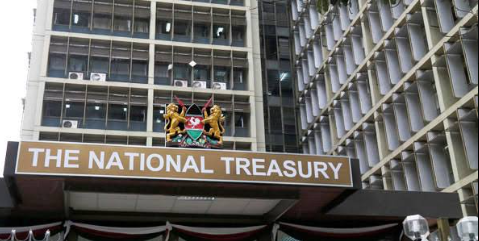
 National Treasury Building
 President William Ruto’s administration
is under fire over Sh118 billion in spending, amid claims the Treasury is
exploiting emergency fund laws to channel unbudgeted resources to state
agencies.
Treasury has now moved to Parliament, formally seeking its approval, months after the funds were withdrawn and spent under what should be emergency expenditure.
However, critics say the move reeks of impunity and is a blatant violation of the constitution, as the cash was spent under normal recurrent expenditure.
Some opposition MPs have alleged the money is being used to bankroll political campaigns.
Article 223 of the Constitution allows the government to access funds in advance in cases of urgent and unforeseen need.
MPs are now demanding a detailed breakdown of the spending, questioning the urgency and whether the withdrawals met the constitutional threshold of ‘unforeseen and unavoidable’ expenses.
Controller of Budget Margaret Nyakang'o had also raised the red flag on the same issue.
Opposition lawmakers warned against what they termed the growing reliance on Article 223, cautioning that it risks undermining Parliament’s power of the purse.
“That expenditure should be put in the budget. The House [National Assembly] is highly compromised; there was no emergency during the period,” Maanzo argued.
He insisted the Executive must not use the provision as a backdoor to bypass the normal budget approval process, claiming such funds could be used in the ongoing campaigns.
In total, the state has requested for additional Sh182.1
billion from Parliament to fund various programmes and projects.
However, Sh117.4 billion has already been spent.
“I lay the following paper from the National Treasury: approval of additional funding under Article 223 of the Constitution relating to the financial year 2025-26 from the National Treasury,” Deputy Majority leader Naomi Waqo said.
The law requires the National Assembly to seek approval for any spending under Article 223 of the Constitution within two months after the first withdrawal.
Diana Gichengo, executive director of the Institute for Social Accountability (Tisa), said the request for additional funding by the Treasury in a supplementary appropriation points to the need for fiscal discipline.
She said they notified Treasury at the beginning of this budget that the deficit they had projected was ambitious and needed to be revised, only for it to grow.
"What is that money being used for? If it is for drought, what’s the urgency because we are able to forecast?” Gichengo asked.
She said their analysis showed some of the offices that had depleted their budgets were those of the President and his deputy.
“As we apply for the supplementary, we are yet to fully disburse capitation to the education. This is what had created the current debt crisis we are in,” Gichengo said.
The Tisa boss further said it begs the question if the proposed Safaricom divestiture is among the reasons they are seeking the extra cash.
“We need to abolish supplementary budget because right now the money they have requested for, where is the public participation? We are increasing a deficit. Why would they imagine we have more money to spend? Why not reorganise the priorities of government?” Gichengo posed.
“It is an issue of budget indiscipline and outright impunity…and it is unfortunate that Parliament has decided to be lapdog instead of a watchdog.”
Treasury on Tuesday presented for approval its first spending under Article 223, barely six months after the last budget was passed and at a time the ministry is expected to table its first supplementary budget.
Some of the biggest beneficiaries include the National Police Service (NPS), the State Department for Special Programmes, the Ministry of Education, Affordable Housing Project (AHP).
Out of the Sh182.1 billion requested, Sh129.2billion is to finance recurrent expenditure while Sh52.9 billion is for development expenditure.
According to the document, the Executive Office of the President is seeking an additional Sh900 million to pay for verified pending bills as well as take care of multiagency and tribunal costs.
The Office of the Deputy President, on the hand, sought an additional of Sh750 million.
The NPS requested for an additional Sh2.3 billion, out of which Sh2 billion is for police medical insurance and group life while Sh300 million is for operations and maintenance.
The National
Treasury sought Sh2.1 billion, of which Sh1.8 billion is to finance the AHP.
The State Department for Medical Services requested for Sh8 billion to finance the Covid-19 Health Emergency Response Project and Curative and Reproductive Maternal Newborn Child Adolescent Health.
The state also requested Sh9 billion to combat drought under the state department for special programmes.
The monies was to be channelled towards the provision of emergency relief such as food, medicines, blankets, cash grants and tents.
From the records, the Education ministry sought Sh3.1 billion to fund various development projects.
State Department for Higher Education requested Sh3.8 billion to be used as first instalment of the outstanding arrears for university lecturers as per the 2017-21 Collective Bargaining Agreement.
The National Intelligence Service, according to the documents, requested an additional Sh1 billion, while the Office of the Registrar of Political Parties sought Sh200 million for registration, regulation and funding of political parties.
The State Department for Social Protection and Senior Citizens Affairs is requesting for Sh3.7 billion to finance cash transfer beneficiary insurance premiums for indigents.
According to the documents, the Ministry of Cooperatives requested Sh2 billion more to, among others, mop up of excess milk, stabilisation of raw milk and timely payment of arrears to farmers.
Water ministry sought an additional Sh1.7 billion, out of which Sh117.8 million is set to finance Thwake Multi-Purpose Water Development programme.
The ministry also intends to use Sh1.6 billion for water resources management.
The request comes at a time Auditor General Nancy Gathungu and CoB Nyakang’o have insisted that Article 223 should only be applied in unforeseen circumstances.
“There is no guideline in place on how unapproved withdrawals from the Consolidated Fund under Article 223 should be dealt with. The Public Finance Management Act, 2012, should therefore be amended to provide guidelines on the action to be taken where expenditure incurred under Article 223 is not approved by the National Assembly,” Gathungu said last year.