Nairobi Securities Exchange (NSE) hopes to ride on the new partnership with Safaricom to eliminate hurdles in the purchase of shares and push market participants from a million to over 30 million.
This was revealed on Tuesday when the telco unveiled the Ziidi Trader, a new service that allows M-Pesa users to buy and sell shares listed on NSE directly from the mobile money app.
The product integrates equity trading into the M-Pesa Financial Services menu, eliminating the need for you to have a separate CDS account number, a stockbroker paper-based on-boarding, or identity verification beyond existing mobile money credentials.
Instead, as soon as you have an M‑Pesa account, Ziidi Trader becomes an option in the app menu.
Safaricom has integrated on-boarding, trading, tracking, and settlement into a seamless flow. The app gives live prices, allowing users to decide how much to invest, confirm the order, and—just like a payment—have the M-Pesa wallet debited.
Users don’t get a CDS account in their names under Ziidi Trader. Instead, trades from many customers are pooled into an account operated by Safaricom in partnership with licenced brokers like Kestrel Capital. It means the broker holds the actual share certificates, and Ziidi Trader keeps an internal ledger that shows how much of each stock M-Pesa users own.
The NSE recorded its highest daily retail trade volume on Friday, with transactions routed through Safaricom’s Ziidi Trader accounting for roughly 7,500 of the 14,000 trades executed.
The surge, just days after the platform’s pilot began on Thursday, offered an early indication of how deeply integrating stock trading into M-Pesa could alter market participation patterns almost overnight.
Data from the bourse shows that deals via Ziidi Trader accounted for two per cent of total trade at NSE during the pilot phase.
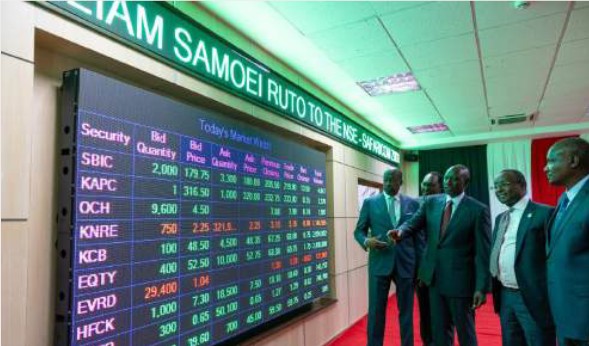
Speaking at the launch President William Ruto hailed the initiative as transformative, saying it will democratise capital markets, allowing those at the bottom of the economic pyramid to grow wealth in capital markets.
"This platform represents a decisive turning point in how citizens engage with the stock exchange. It opens the doors of market participation wider than ever before, dismantling long-standing barriers that have locked out many willing investors and bringing opportunity closer to all citizens," Ruto said.
He added that through the seamless integration of stock trading into the M- PESA platform, millions of Kenyans, especially youth and women, will gain simple, affordable, and convenient access to investments in shares, bonds, and other products listed on NSE, placing the tools of ownership and growth directly in their hands.
"I challenged the capital markets to democratise access through innovation and technology. Today, I am pleased to note that this challenge has been answered. The Safaricom Ziidi Trader clearly demonstrates what becomes possible when private sector innovation aligns with public purpose and national vision."
Users can simply opt in, select the listed companies they want to invest in, and execute the trades using their M-Pesa balances. It includes watch lists, price alerts, and portfolio tracking.
The launch marks Safaricom’s most ambitious push into wealth management, extending its reach beyond payments and savings into active investing.
Ziidi Trader targets the long-standing friction that has limited retail participation in the NSE, including high brokerage minimums, slow on-boarding, and unfamiliar market processes.
Transactions settle directly through M-Pesa, compressing what has traditionally been a multi-step process into a single interface.
By contrast, CDSC’s Dosikaa app preserves conventional ownership structures, underscoring Ziidi’s strategic choice to prioritise speed and mass-market accessibility over traditional market formality.
With nearly 40 million M-Pesa active users in Kenya, the Ziidi Trader already has a ready mass market to tap into.
Current trading costs range between about 1.8 per cent and 2.5 per cent, while Ziidi Trader is expected to offer rates of around 1.5 per cent, banking on higher trading volumes.
Safaricom has partnered with Kestrel Capital as the sole executing broker, centralising order flow through a single intermediary.
Although the country has more than a million registered CDS accounts, less than 200,000 are active on a monthly basis, with trading volumes remaining thin as the market has struggled to attract younger and lower-income investors.
Nairobi Securities Exchange chairman, Kiprono Kittony, said that Ziidi Trader places equity trading alongside everyday financial actions such as bill payments and airtime purchases. The proximity lowers psychological and practical barriers, potentially converting passive savers into active market participants.
“Ziidi Trader is the most serious attempt yet to redesign how ordinary Kenyans are allowed to enter the capital markets — not through institutions, paperwork and intermediaries, but through the same consumer interface that already mediates everyday economic life.”
The product builds on Safaricom’s Ziidi Money Market Fund, launched in 2025, which drew significant inflows by using the same opt-in simplicity.
Safaricom’s chief finance officer, Dilip Pal, who represented the firm’s CEO, Peter Ndegwa, said that by integrating NSE trading into the M-Pesa ecosystem, Ziidi Trader simplifies the investment journey, allowing customers to buy and sell shares, monitor their portfolios and access market insights seamlessly within the M-Pesa App.