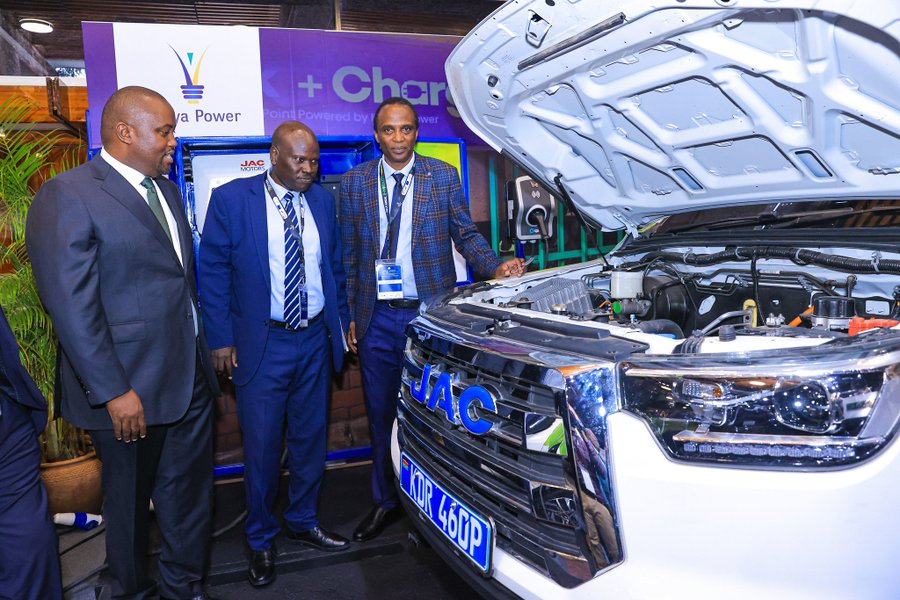
 (L-R) Energy Principal Secretary, Alex Wachira, Kenya Power’s Managing Director & CEO, Dr. (Eng.) Joseph Siror and Kenya Power’s Transport Manager, David Mugambi at a past E-Mobility Conference and Exhibition./KENYA POWER
Kenya’s shift towards electric mobility is driving a dramatic increase in electricity consumption, according to data from Kenya Power.
In 2025, the electric mobility (e-mobility) industry consumed 8,433,437 units (kWh) of electricity, a 188% rise from 2,922,692 units in 2024.
The surge has translated into significant revenue growth for Kenya Power. Earnings from EV charging jumped from Sh64,843,181 in 2024 to Sh190,800,016 in 2025, an increase of Sh125,956,835.
“E-mobility is one of the key areas the Company is focused on under our green agenda, which seeks to power livelihoods and support our communities with solutions that reduce carbon emissions,” said Kenya Power Managing Director and CEO, Dr. (Eng.) Joseph Siror.
“Already, over 90% of the energy we procure and dispatch is sourced from renewable sources. To complement this milestone, we are actively driving the uptake of e-mobility and e-cooking solutions.”
The growing electricity demand comes alongside government efforts to encourage electric vehicle adoption. On February 3, 2026, the National Electric Mobility Policy was launched to provide a framework for faster EV adoption through supportive regulations and fiscal incentives.
Measures introduced through the Finance Bill 2025 include zero-rating of VAT on electric buses, electric bicycles, electric motorcycles, and lithium-ion batteries.
Excise duty on electric bicycles, motorcycles, and lithium-ion batteries was also reduced to zero.
Siror described the policy as a “timely and important step in accelerating EV uptake in Kenya.”
He added that Kenya Power would continue supporting the transition by “strengthening grid readiness and expanding charging infrastructure in line with the sector’s growth.”
The company has also introduced an e-mobility electricity tariff, approved by the Energy and Petroleum Regulatory Authority (EPRA) in March 2023.
So far, 205 customers have been enrolled. Under this tariff, electricity is charged at Sh16 per unit during peak hours and Sh8 per unit off-peak.
“To demonstrate our commitment to electric mobility, we have already installed five EV chargers across our offices at Stima Plaza, Donholm, Ruaraka, Electricity House (Nairobi) and Ragati,” Dr Siror said.
“We are at various stages of setting up additional EV chargers in Voi, Mombasa, Nyeri, Nakuru and Eldoret.”
The EV chargers are not only meant for the company’s fleet and public use. They also provide critical data for planning electricity supply and infrastructure investment to support the growing sector.
As of 2025, Kenya had registered over 35,000 electric vehicles, mostly two-wheelers. Kenya Power itself has 11 electric vehicles and 30 electric bikes, with plans to expand to 20 vehicles and 100 bikes by the end of 2026.
Industry projections indicate that with continued policy support and incentives, EV deployments could increase significantly by 2040.
To further boost adoption, Kenya Power has been engaging stakeholders across the e-mobility industry. The company has hosted the E-mobility Stakeholders’ Conference for the past three years, aiming to catalyse dialogue, partnerships, and actionable strategies that position Kenya as a regional leader in sustainable transport.
The rise in electricity consumption for EV charging reflects a broader trend of green energy adoption in Kenya. With supportive policies, growing infrastructure, and a strong focus on renewable energy, the country is steadily advancing its vision for a cleaner, low-carbon transport sector.