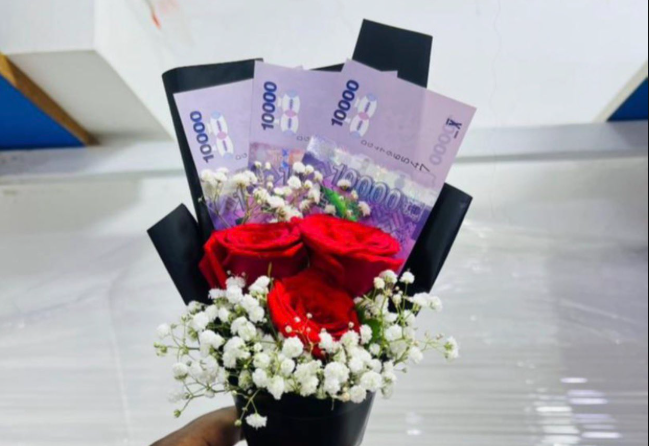
The Bank of Uganda has joined its East African neighbours in cautioning the public against using currency banknotes for decorative and celebratory purposes, a practice that authorities say compromises the integrity of national money and disrupts cash systems.
In a public statement, the central bank warned that florists, designers, gifting stylists, and their clients should avoid incorporating Uganda Shilling notes and coins into bouquets or other creations for social events and gifting ceremonies.
The alert follows similar notices issued earlier this year by the Central Bank of Kenya and the National Bank of Rwanda.
“The public is cautioned against any practice that mutilates, defaces, or compromises the integrity of Uganda Shilling currency,” the Bank of Uganda said.
“This mainly involves the use of brand-new banknotes that are stuck together using glue, cello-tape, pins, clips, and other adhesives or fasteners as part of floral bouquets for various social events and gifting ceremonies.”
The Bank explained that such handling damages the utility of banknotes, making them unusable in cash processing and distribution equipment such as automated teller machines and cash counting machines, which are critical for the nation’s cash distribution system.
It noted that the practice results in premature withdrawal of banknotes from circulation, imposing avoidable costs on the public.
While the Bank of Uganda does not object to the use of cash as gifts, it emphasised that the exchange should follow standard practices of currency use.
“Bank of Uganda is committed to safeguarding the integrity of the national currency in circulation to fulfil its functionality as a medium of exchange, and store of value,” the statement added.
Kenneth Egesa, the Bank’s Director of Communications and Public Relations, said members of the public should exercise caution.
The warning comes on the heels of similar advisories in the region. On February 2, the Central Bank of Kenya issued a notice urging citizens to stop using Kenya Shilling notes for decorative purposes.
According to the CBK, banknotes folded, rolled, glued, taped, stapled, or pinned for ornamental arrangements compromise currency integrity and reduce their usability in ATMs and cash-handling equipment.
“The use of adhesives, pins, staples, and similar materials damages banknotes and interferes with the efficient operation of cash-handling and processing equipment,” the Kenyan central bank said.
The CBK added that such practices force premature withdrawal of banknotes, generating unnecessary costs for the public.
While acknowledging that cash gifts are acceptable, the Bank emphasised that currency should never be altered, damaged, or defaced.
Rwanda’s National Bank followed suit on February 6, citing continued observation of banknotes being incorporated into bouquets, floral arrangements, and decorative creations.
The NBR stated that this practice, common among florists, event decorators, and gifting stylists, affects the quality of Rwandan Franc notes and hinders their use in cash-handling and processing machinery.
“These are critical components of the national cash distribution system,” the NBR said, adding that damaged notes require early replacement, leading to avoidable costs.
Experts say the regional caution reflects growing awareness of the impact of non-standard uses of banknotes on cash circulation.
Economists note that while giving money as a gift is culturally accepted, misuse of currency in decorative arrangements directly affects the efficiency of banking systems and increases operational costs.
The Bank of Uganda’s statement underscores a regional push to preserve the durability and reliability of national currency.
As East African nations increasingly integrate financial systems, the caution aims to harmonise currency handling practices and ensure smooth functioning of ATMs, cash counters, and other automated banking services.
With Uganda now joining Kenya and Rwanda in the advisory, authorities are appealing to the public to respect the physical integrity of currency.
The central message from all three countries is clear: cash is best used for transactions and gifts in its intended form, not as material for decorative art.