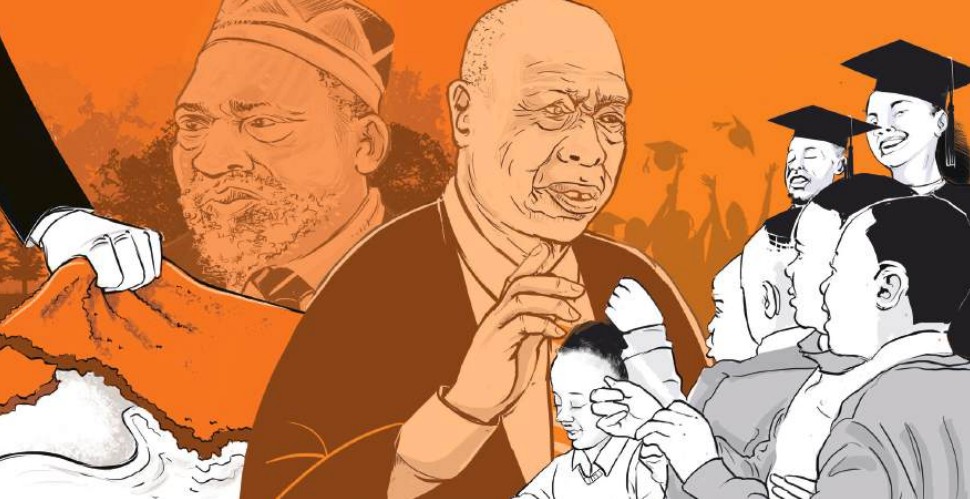
Kenyan media commentators, whether veterans who have been at it for many years, or newcomers trying their luck, tend to be rather vicious in their assessments of former presidents.
You will read, for example, that founding president Jomo Kenyatta was, first and foremost, an insatiable land-grabber. Such a view overlooks the many reports of the time, in the most prestigious international magazines, that Kenya in the 1960s and 70s was regarded as a model of political stability and respectable economic growth.
You will read of Jomo Kenyatta’s successor, Daniel Moi, as having been an iron-fisted dictator, whose tyrannical rule was only sustained by his eagerness to confine all and any critics to the infamous “Nyayo House torture chambers”. Rarely is any mention made of the rapid expansion of education opportunities, all the way from primary schools to universities, during the Moi era.
I will leave out presidents Mwai Kibaki and Uhuru Kenyatta for now, as their deeds, good or bad, are recent enough for most readers to have some idea what these are.
William Shakespeare, in his play Julius Caesar, put it very succinctly when he had one of the major characters, Caesar’s friend Mark Anthony, say at his funeral oration over the assassinated Caesar’s dead body: “The evil that men do lives after them; the good is often interred with their bones”.
The point I wish to argue here, though, is that a strong case can be made that the excesses of most Kenyan presidents are more or less imposed on them by the circumstances within which they rule.
I am not saying that these men were heaven-born saints, or even just resolute patriots, who yearned to see the lot of ordinary men and women improved.
Obviously, they were just typically ambitious politicians, whose first priority was to stay in power by whatever means necessary.
My point, though, is that this determination to stay in power required them to address at least some of the demands that had been placed on them by their regional supporters. And so, it can be argued that the perfectly understandable focus of a serving president trying to appease regional voters is a good part of what got us into so much trouble.
First, consider the issue of land ownership.
In Fiji, an island in the South Pacific, the constitution specifies the right of every native Fijian to ownership of land.
In Kenya, we do not take it quite that far. But our national obsession with land ownership is well known.
Then, second, there is the average Kenyan family’s most fiery ambition, which is to have at least one child who has graduated from university.
Out of these two Kenyan passions – land ownership and university education – arose the pressure on President Daniel Moi, first, to “dish out” parcels of land to whoever got close enough to him to ask. And second, to set up regional universities.
The result of this second source of pressure is that we now have a more than adequate supply of skilled human resources, with the only problem being that the government cannot hire all of the people Kenya needs, especially in the education and health sectors.
But most Kenyan families would not have it otherwise. Giving their children a university education remains a key priority.
But when it comes to accelerated (and often unprocedural) land allocations, we have seen some very unusual outcomes.
When the land around Lake Naivasha, for example, was being recklessly allocated during the Moi era, well-informed environmentalists warned in vain that the lake needed an unusually expansive riparian area (empty land adjacent to the water) as colonial era records showed that every few decades virtually all the Rift Valley lakes would overflow their banks.
So, it was essential to leave the Lake Naivasha riparian land in its pristine state.
But when politicians as well as businesspeople looked at that wide stretch of empty land surrounding the lake, all they saw was land suitable for allocation.
Horticulture greenhouses, modest residential properties, and even palatial homes were soon to be seen on what had clearly been gazetted as Lake Naivasha Riparian Land.
All those developments are at present – at least partially – under water.