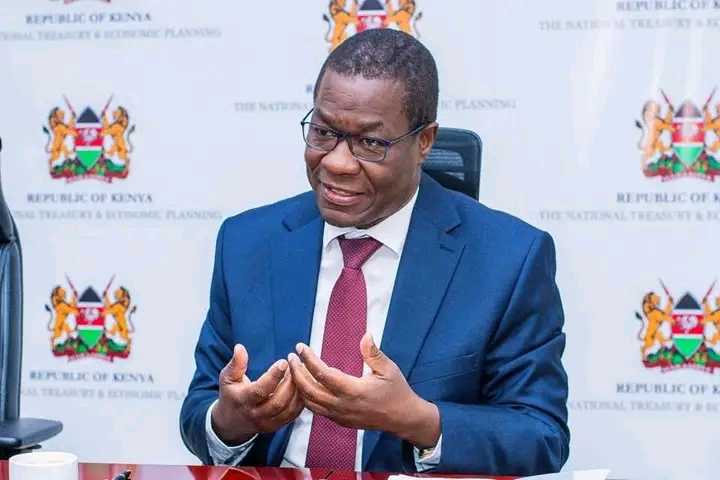
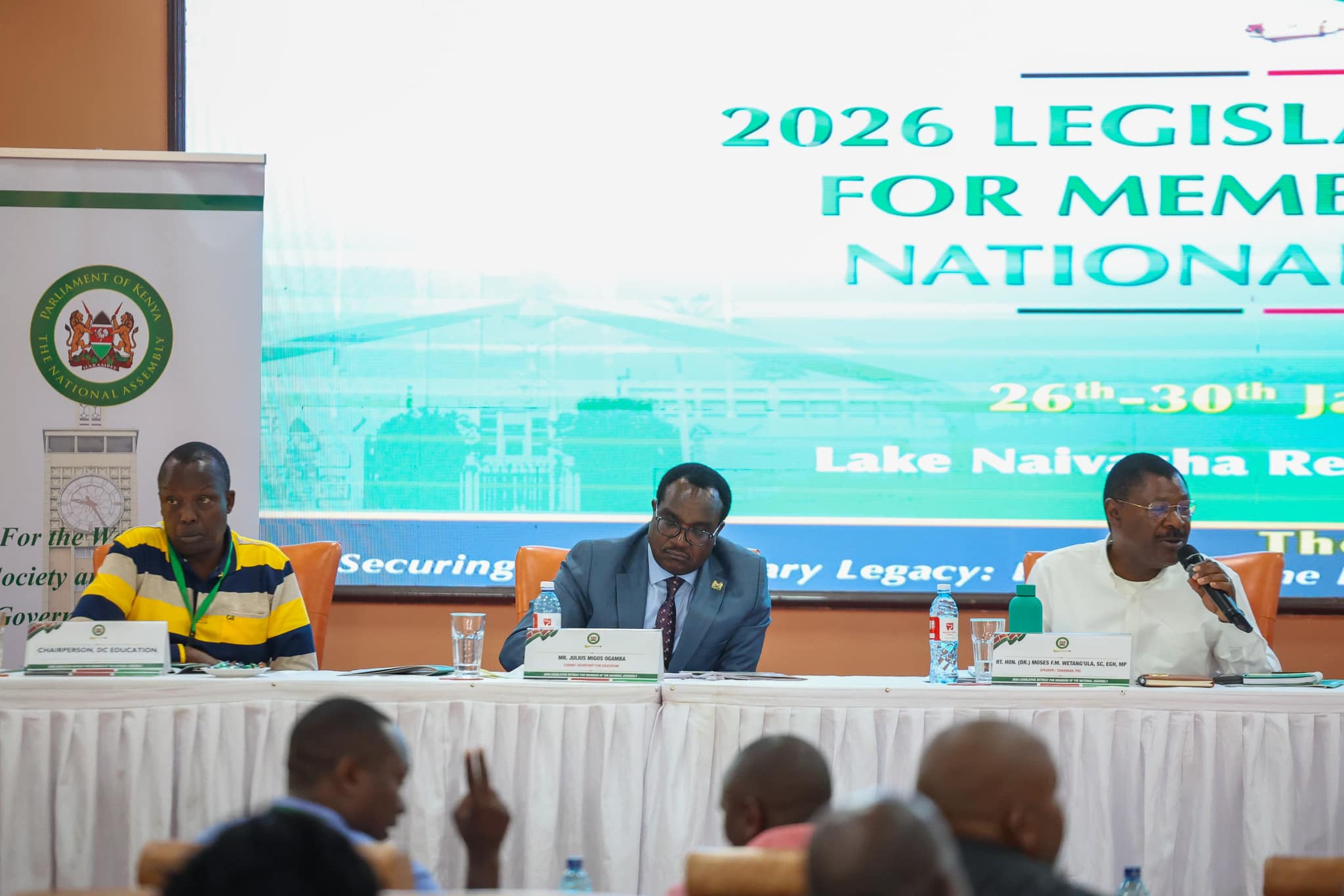
 National Assembly Speaker Moses Wetang'ula (R) chairs the legislative retreat in Naivasha on January 28, 2026. /PARLIAMENT
The National Assembly Committee on Education has been tasked to convene an urgent meeting to address mounting concerns raised by Members of Parliament over the rocky rollout of the Competency-Based Education system, as the pioneer Grade 9 cohort transitions to Senior school amid glaring operational and funding gaps.
MPs attending last week’s legislative retreat in Naivasha painted a picture of an education system under strain, citing skewed infrastructure funding, widening inequalities in the rollout of CBE and delayed capitation that has left many schools struggling to prepare adequately for the shift to Grade 10.
While briefing legislators on the transition status, Education Cabinet Secretary Julius Ogamba acknowledged inconsistencies in infrastructure development across regions but said the ministry was working to correct the imbalance and ensure schools were ready to host learners under the new structure.
He said the ministry was racing against time to construct 1,600 laboratories in 1,452 schools countrywide by June this year, a key requirement for the practical learning model under CBE.
However, MPs demanded greater transparency in the use of the Education Infrastructure Fund financing the projects, arguing that some marginalised areas appeared to have been left behind.
“In the Northern Frontier, it’s NG-CDF that is entirely funding school infrastructure. You said 1,600 laboratories are benefitting from the Infrastructure Fund, publish that list on your website,” Mandera North MP Bashir Abdullahi demanded.
“We are seeing a clear deficit in marginalised areas. What will the ministry do to correct this imbalance?” Kilifi North MP Owen Baya asked.
Ogamba told the House that the transition to Senior school had crossed the 98 per cent mark, with multi-agency efforts ongoing to mop up the remainder of learners in line with the government’s target of 100 per cent transition.
Despite the progress, lawmakers said enrolment alone did not reflect the realities on the ground.
Several MPs reported that parents were being compelled to purchase uniforms from designated suppliers at inflated prices, effectively introducing hidden costs in what is meant to be a publicly supported education system.
National Assembly Majority Leader Kimani Ichung’wah described lunch fees and uniform purchases as the epitome of corruption in schools and accused inspectors of failing to enforce ministry policy.
“The CS has the power to gazette school fees. The ministry must gazette the amount to be charged on school feeding programmes and how much parents should pay for school uniforms,” Ichung’wah said, warning against the politicisation of education matters.
“Why are we forcing teachers to change uniforms to feed the corruption cartels distributing uniforms?” he asked, challenging Basic Education PS Julius Bitok to visit schools to obtain a true picture of the challenges on the ground.
The Kikuyu MP also faulted the Teachers Service Commission (TSC) over what he termed irrational deployment of staff, saying some schools with fewer learners had excess teachers while severely understaffed institutions continued to struggle.
“TSC is not doing the right thing on rationalisation. Why should we have a school with 1,000 teachers and a neighbouring school with less than 100 teachers?” he asked.
Ichung’wah said teachers posted to schools likely to be shut down due to low enrolment should instead be seconded to understaffed institutions to bridge the deficit and ensure continuity of learning.
While chairing the session, Speaker Moses Wetang’ula acknowledged that government policy bars schools from sending learners home over fees or uniforms but said weak enforcement at the grassroots level could be undermining the intent of the directive.
“You can have a policy in Nairobi, but do we have officers on the ground implementing it?” he asked.
Ogamba further unsettled lawmakers by admitting that although the ministry runs a structured capitation programme, it lacks reliable data to determine the actual cost of educating each child from primary through university.
He said the current benchmarks — Sh1,420 per pupil under Free Primary Education, Sh15,042 for Junior school and Sh22,244 for Senior school — were developed by a taskforce and were now outdated.
He added that the existence of multiple bursary schemes run by counties, contributions in harambees and NG-CDF would require fresh analysis to establish the true cost of education per learner and streamline support.
Wetang’ula said the concerns raised were weighty and directed House leadership and the Education committee to convene urgently to craft solutions that would guarantee seamless learning nationwide.
“I challenge you, CS Migos, to establish guidelines for consolidating duplicated education bursaries into a single central basket for efficient distribution to the intended beneficiaries,” the Speaker said.
Beyond basic education, scrutiny has also extended to tertiary institutions. The Public Investments Committee on Governance and Education flagged governance gaps, financial mismanagement and inclusivity concerns in several Technical and Vocational Education and Training institutions.
While commending some for compliance and good practice, the committee said reports from the Office of the Auditor General revealed unresolved issues including land ownership disputes, lack of ethnic diversity in recruitment and unutilised HELB loans and bursaries amounting to millions.
In one case, Sh22 million remained idle after funds were disbursed late to students who had already cleared their fees.
The committee directed that the money be refunded to allow other beneficiaries to access support and called for an audit to ensure such funds are efficiently reallocated.
Church leaders have also weighed in. Speaking separately on Sunday after delivering his sermon at Nyeri Catholic Cathedral, Archbishop Anthony Muheria described the transition of Grade 9 learners to Senior school as “chaotic and erratic”, saying some schools had gone for weeks without learning since reporting began on January 12.
“We are robbing the future of these same children while in Grade 7 stayed for a year without learning and now in Grade 10 and still not learning,” he said.
Muheria criticised the non-grading of Kenya Sign Language for some candidates in the 2025 KCSE examination, calling it “a scar” on the education system.
Although KSL is examined, the results were excluded from mean grade computation for some candidates under regulations that restrict its consideration to learners with hearing impairments.
“These three issues are really a scar because we have not had the courage to face the problematic systemic presentation of the CBE. CBE can be a very good education system but it seems we have not thought it through and we are always knee-jerking, one person making declaration and another one making another,” he said.
He added that some schools, particularly C1 institutions, were overloaded with up to 2,000 Grade 10 learners while others grappled with low enrolment, creating fresh inequities in placement.
“We have students who have been taken to the national schools with 45 points and others with great points of 60 and above been placed to some of the other poorer schools. This is a lack of justice.”
The archbishop said the disparities must be addressed to prevent a system where some schools thrive while others are allowed to collapse.
Ogamba has previously hinted that schools that receive no learners or only negligible numbers of Grade 10 students may be shut or merged to allow more efficient utilisation of available resources and teachers, underscoring the sweeping changes still facing the education sector as CBE takes root.
Secondary schools without Grade 10 learners will automatically cease to exist as learning centres once Form Three and Form Four classes, the last cohort of the 8-4-4, exit at the end of 2027.