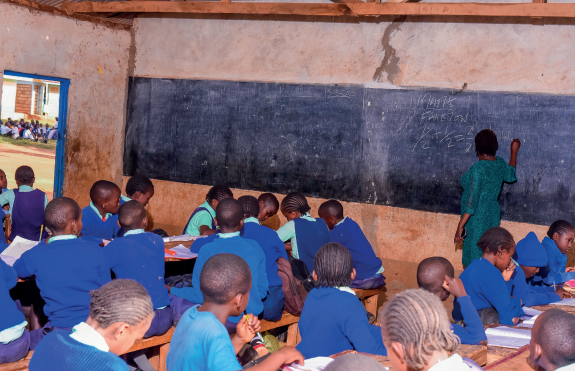
 Men are marginally more positive than women about education quality under CBE /INFOTRAK
As Kenya’s education system undergoes its most far-reaching reform in decades, new survey data reveals that public opinion on Competency-Based Education (CBE) is sharply divided along regional, gender, and age lines, with multiple experiences shaping perceptions of the system.
According to an opinion poll by Infotrak, 49 per cent of Kenyans believe the overall quality of education has improved since CBE was introduced, while 33 per cent say it has worsened. A marginal 18 per cent feel it has remained the same.
The survey coincides with the pioneer cohort of CBE learners transitioning to Grade 10, marking the start of their three-year senior secondary phase, which concludes in Grade 12.
Infotrak conducted the poll between December 2025 and January 2026 using Computer Assisted Telephone Interviews with 1,000 adults aged 18 and above from all 47 counties and eight regions.
The survey carries a margin of error of ±3.1 per cent at a 95 per cent confidence level and achieved a 99 per cent response rate. Results were weighted to reflect national demographics based on the 2019 Census.
The findings reflect perceptions rather than classroom outcomes, but the data reveals clear demographic patterns in public opinion.
Regional divide
Support for CBE is highest in North Eastern Kenya, where 78 per cent rate education quality as improved since the system was introduced nine years ago. Western follows at 60 per cent, Rift Valley at 54 per cent, and Nyanza at 52 per cent.
Nairobi and Eastern counties show more mixed views, with 42 per cent and 43 per cent, respectively, saying education has improved.
Disapproval is most pronounced at the Coast, where 50 per cent say quality has worsened, followed by Central (39 per cent) and Eastern (38 per cent). Analysts suggest these disparities reflect uneven access to information, resources, and CBE implementation capacity.
Gender differences are less pronounced. Men are slightly more positive than women (50 per cent vs. 48 per cent) regarding education quality under CBE, while women are marginally more likely to see outcomes as worse (34 per cent vs. 32 per cent of men).
This mirrors concerns raised during the transition to senior secondary school, particularly around cost pressures and clarity of assessment, which often affect caregivers more directly.
Age produces the clearest differences in perception. Younger adults, especially those aged 18–26 and 27–35, are more likely to view CBE positively, reflecting greater familiarity with continuous assessment and skills-based learning.
Fifty-three per cent of respondents aged 18–26 believe CBE has improved education quality, followed by 50 per cent of those aged 36–45.
Older respondents, particularly those over 46, are more sceptical. Among those aged 55 and above, 39 per cent rate education quality as worse.
This generational gap also extends to attitudes toward the CBE grading system, which replaces numerical scores with categories such as Exceeds Expectation, Approaching Expectation, and Below Expectation.
Overall, 45 per cent of respondents express dissatisfaction with the grading approach, compared with 38 per cent who are satisfied. Satisfaction is highest in North Eastern (80 per cent) and Western (46 per cent) regions, while Coast (55 per cent), Eastern (50 per cent), and Nairobi (49 per cent) report stronger dissatisfaction. Opposition rises steadily with age, highlighting discomfort with a system that departs from the exam-centric 8-4-4 model.
The Infotrak data suggests that perceptions are closely linked to challenges faced during the transition to senior secondary school. High costs, including school fees and uniforms, are cited by 39 per cent of respondents as the biggest hurdle nationwide, followed by lack of adequate guidance on the new system (19 per cent) and inability to pay school fees (13 per cent).
These pressures are particularly acute in regions and age groups with higher levels of CBE disapproval, suggesting that day-to-day challenges shape public perception more than theory.
While the survey also explored views on making secondary school uniforms optional, the debate appears peripheral to broader opinions on CBE. Overall, 63 per cent opposed the proposal, with Nyanza leading at 73 per cent and Rift Valley showing some support at 51 per cent. More females (67 per cent) opposed the proposal compared to males (60 per cent), and opposition was consistent across age groups.
CBE was launched in 2017 to replace the 40-year-old 8-4-4 system, which now has two years remaining before it is fully phased out.