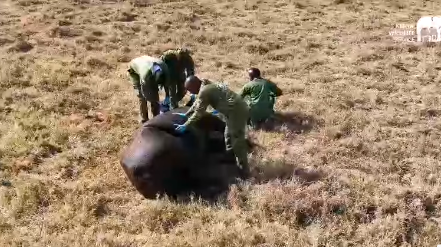
Screengrab of the KWS veterinary team administering treatment to an injured male black rhino called Ewaton/KWS
A black male rhino that was seriously injured following a fierce territorial fight in the Nakuru National Park has been treated and released back to its habitat.
The Kenya Wildlife Service said an intense territorial clash on Monday left Ewaton with serious injuries in his eye and mouth, putting his survival at risk.
KWS immediately dispatched its air wing response team that reached the injured rhino and administered treatment.
“Ewaton responded well, has stabilised and safely returned to his territory. This is rapid response in action, protecting Kenya’s wildlife when every minute matters. We wish Ewaton a quick recovery,” KWS said.
Rhino's are extremely territorial and often engage in deadly fights to defend their spaces.
The 2025 National Wildlife Census report by the Wildlife Research and Training Institute shows that the rhino population in the country is now 2,102; 1,059 black rhinos, 1,041 white rhinos, and two northern white rhinos.
This means there is an annual change of four per cent.
Wildlife scientists have been grappling with how to contain black rhinos as their populations have increased beyond ecological carrying capacity in some key sanctuaries.
Rhino sanctuaries must have intense security to curb the risk of poaching. Such spaces should also allow rhinos to demonstrate their natural behaviours, including migration between territories and genetically diverse breeding.
The increasing populations of rhinos, especially the black ones, are now giving scientists sleepless nights.
In black rhino sanctuaries, territorial fights are becoming a big challenge.
In the wild, rhinos, especially black ones, are extremely territorial.
Males in particular will fight other males found in their territory, often inflicting injuries on each other.
Fierce fights in some cases lead to death.
Due to changes in wildlife habitat dynamics over time, coupled with climate change-related factors, scientists are racing against time to review the ecological carrying capacity protocol.
A report by WRTI for the period ending December 31, 2022, showed that Tsavo West National Park (Ngulia Rhino Sanctuary) had 134 black rhinos, while the maximum productivity carrying capacity is 45, leaving a surplus of 89.
The sanctuary has since been expanded.
Now covering 3,200 square kilometres, it is the largest sanctuary for rhinos in the world and a major step forward for wildlife conservation, climate resilience, and nature-based economic growth.
The WRTI report showed that Ol Pejeta Conservancy had 166 black rhinos, while the maximum productivity capacity is 90, leaving a surplus of 76.
Nairobi National Park had 98 black rhinos against a maximum productivity capacity of 44, leaving a surplus of 54.
Lake Nakuru National Park had a population of 89 black rhinos against a maximum capacity of 50.
Lewa (Borana Landscape) had a black rhino population of 133 against a maximum capacity of 92.
Meru National Park had a black rhino population of 36 against a maximum capacity of 32.
Ruma National Park, however, had a population of 22 black rhinos against a maximum capacity of 62.
Sera Community Conservancy had a population of 21 against a maximum capacity of 40.
The black rhino suffered a catastrophic decline across Africa in the 1970s and 1980s, both in numbers and in the extent of its range.
Numbers plummeted from an estimated 65,000 in 1970 to fewer than 2,500 by 1992 due to poaching.
The black rhino dropped in numbers in Kenya from an estimated 20,000 in 1970 to under 400 animals by 1987.