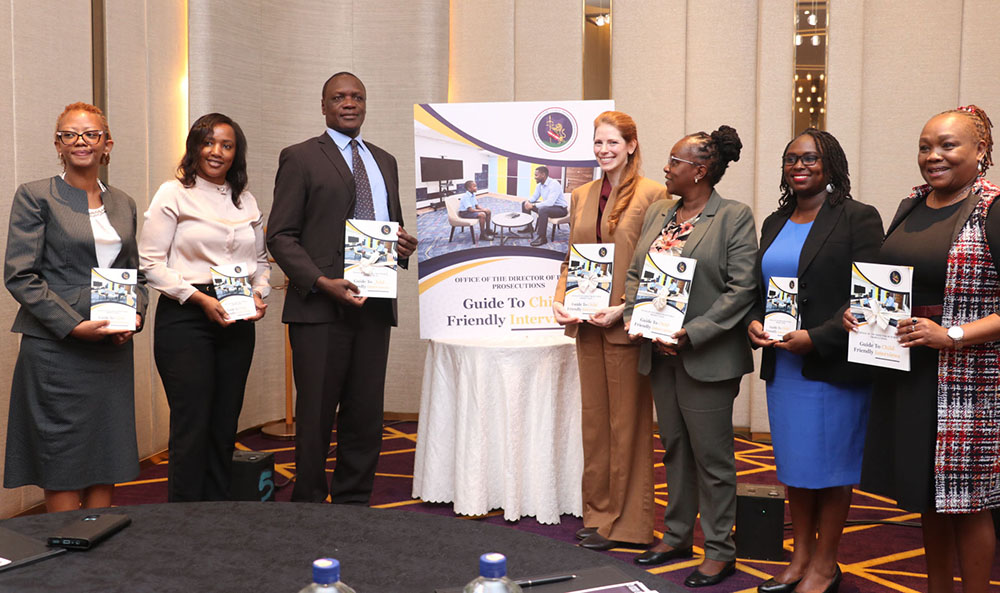
 Principal prosecution counsel Linda Ndambiri, LSK representative Ruth Nyaberi, secretary prosecution services Alloys Kemo, Lawyer Without Borders' Jessica Ryckman, Witness Protection Agency CEO Jedidah Waruhiu, Children Services deputy director Ruth Njuguna and Deputy Director of Public Prosecutions Jacinta Nyamosi during the launch of the guide to child friendly interviews at Glee hotel, Nairobi on January 28, 2026 /LEAH MUKANGAI
For many children, the justice system can be as frightening as the trauma that brought them into it.
On Wednesday, the Office of the Director of Public Prosecutions took a significant step towards changing that reality with the launch of the Guide to Child-Friendly Interviews. The manual is aimed at reshaping how young victims, witnesses and children in conflict with the law are engaged.
Developed in partnership with Lawyers Without Borders, the guide is designed to equip prosecutors and first responders with specialised skills to gather reliable evidence without inflicting further psychological harm on vulnerable children.
It recognises that justice for children begins not in the courtroom, but in the first conversation they have with the system.
Speaking at the launch in Nairobi, Deputy Director of Public Prosecutions Jacinta Nyamosi underscored the responsibility carried by those who first interact with children.
“The people who are handling the children—be it the prosecutor, the investigator, the children’s services, or the Witness Protection Agency—are the first responders,” she said.
“This tool places us in a space where we are all able to know how to handle children in our own way, while remembering that prosecutors and investigators have different personalities.”
The guide confronts a hard truth: a child’s ability to give truthful, coherent information is often shaped by fear, stigma and their social environment.
Nyamosi said evidence can only be as strong as the sense of safety a child feels.
“Have they acclimatised to the situation? How do you get that evidence from the child?” she asked.
“Protecting that evidence is vital because you need it to get justice for that child.”
Structured around four key stages—preparation, the interview process, use of technology and post-interview procedures—the guide promotes a trauma-informed approach that places the child’s emotional well-being at the centre of justice.
It encourages safe, calm environments where children can speak freely, without pressure or intimidation.
A central pillar of the framework is the adoption of technology-enabled child-friendly rooms, allowing interviews to be video-recorded. This reduces the need for children to repeatedly recount traumatic experiences, a process that often leads to re-traumatisation.
In remarks delivered on her behalf, Children’s Services PS Carren Ageng’o highlighted the urgency of such reforms, noting that children make up half of Kenya’s population.
She said children who come into contact with the law may be victims of physical, sexual or emotional abuse, or may require care and protection due to trafficking, displacement or neglect. Others are drawn in simply as witnesses to crime.
“The ODPP Guide to Child-Friendly Interviewing will fill a felt gap in the child justice sector,” the PS said, emphasising that interviewers must be trauma-informed, child-sensitive and protective.
The guide advocates for neutral, age-appropriate language and explicitly discourages leading questions.
Interviewers are urged to allow children to give free narrative accounts in environments that feel safe and respectful.
Grounded in the Constitution of Kenya and the Children Act, 2022, the guide reinforces a human-centred justice system that prioritises dignity over procedure.
Nyamosi closed with a simple but powerful reminder. “When you’ve received the information you need,” she said, “it is very important to remember to thank that child. Take time to thank them.”