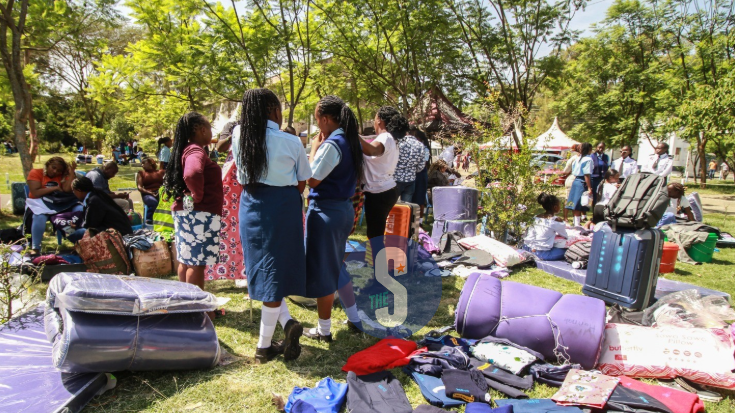
 Parents present their daughters for enrollement in Grade 10 at Moi Girsl High School, Nairobi, January 13, 2026. /FILE
The high cost of education has emerged as the biggest hurdle for households as Grade 9 learners transition to senior secondary school, a new national survey by Infotrak Research & Consulting Limited suggests.
The study, released on Thursday, found that 39 per cent of respondents cited a combination of school fees and the cost of uniforms as the most pressing challenge facing families as the pioneer cohort of the Competency-Based Education (CBE) system moves into Grade 10.
From this group, 13 per cent said the lack of school fees alone was the single biggest obstacle as the 1.13 million learners enrolled for senior school.
Respondents were asked: “What challenges, if any, do you think learners or parents are facing during this transition to senior secondary?”
Beyond the cost burden, 19 per cent pointed to a lack of adequate information or guidance on the new system, while an equal proportion said they did not know what challenges learners or parents were facing.
Uncertainty about student placement was cited by four per cent of respondents.
Smaller proportions, at two per cent each, mentioned inadequate learning materials, psychological stress or anxiety, and inadequate learning facilities, infrastructure and teachers.
The poll was conducted between December 2025 and January 2026 and was sponsored and financed by Infotrak Research & Consulting Limited.
It used quantitative interviews carried out through Computer Assisted Telephone Interviews (CATI).
The achieved sample size was 1,000 respondents aged 18 years and above, with the sampling frame guided by the 2019 national census.
According to Infotrak, the survey had a margin of error of ±3.10 per cent at a 95 per cent degree of confidence.
It covered all 47 counties and the eight regions of Kenya, with the distribution of the sample proportionately allocated across regions to ensure national representativeness.
Despite the challenges identified during the Grade 10 transition, the survey suggests a generally positive assessment of the education system under the new framework.
Nearly half of Kenyans, representing 49 per cent of respondents, said the quality of education in the country has improved since the introduction of the CBE.
Another 18 per cent said the quality has remained more or less the same, while 34 per cent said it has worsened. Regional differences were pronounced.
A majority of respondents who felt the quality of education has improved were from the Northeastern region, at 78 per cent. In contrast, the Coast region recorded the highest proportion of respondents who said education quality has worsened, at 50 per cent.
The survey also sought views on the CBC grading system, which uses the categories Exceeds Expectation, Meets Expectation, Approaching Expectation and Below Expectation.
Asked whether they were satisfied or dissatisfied with the system, 45 per cent of respondents said they were not satisfied, 38 per cent said they were satisfied, while 17 per cent said they did not know. Again, regional variation stood out.
Northeastern recorded the highest satisfaction levels, with 80 per cent approval, compared to the Coast, where 55 per cent said they were not satisfied with the grading system.
By gender, opinions were evenly split, with 38 per cent of both males and females saying they were satisfied.
There was near parity among those who said they were not satisfied, at 45 per cent for males and 44 per cent for females, as well as among those who said they did not know, at 17 per cent and 18 per cent respectively.
On the contentious issue of school uniforms, respondents were asked whether the government should do away with uniform requirements for secondary schools.
The proposal attracted overwhelming disapproval, with 63 per cent saying no, compared to 36 per cent who said yes, while three per cent said they did not know.
Rift Valley recorded more respondents supporting the scrapping of school uniforms at 51 per cent compared to 40 per cent who were against.
When aggregated by gender, views were again closely aligned, although a higher proportion of females, at 67 per cent, opposed the idea compared to 60 per cent of males.
However, more males, at 39 per cent, supported scrapping uniforms compared to 30 per cent of females.