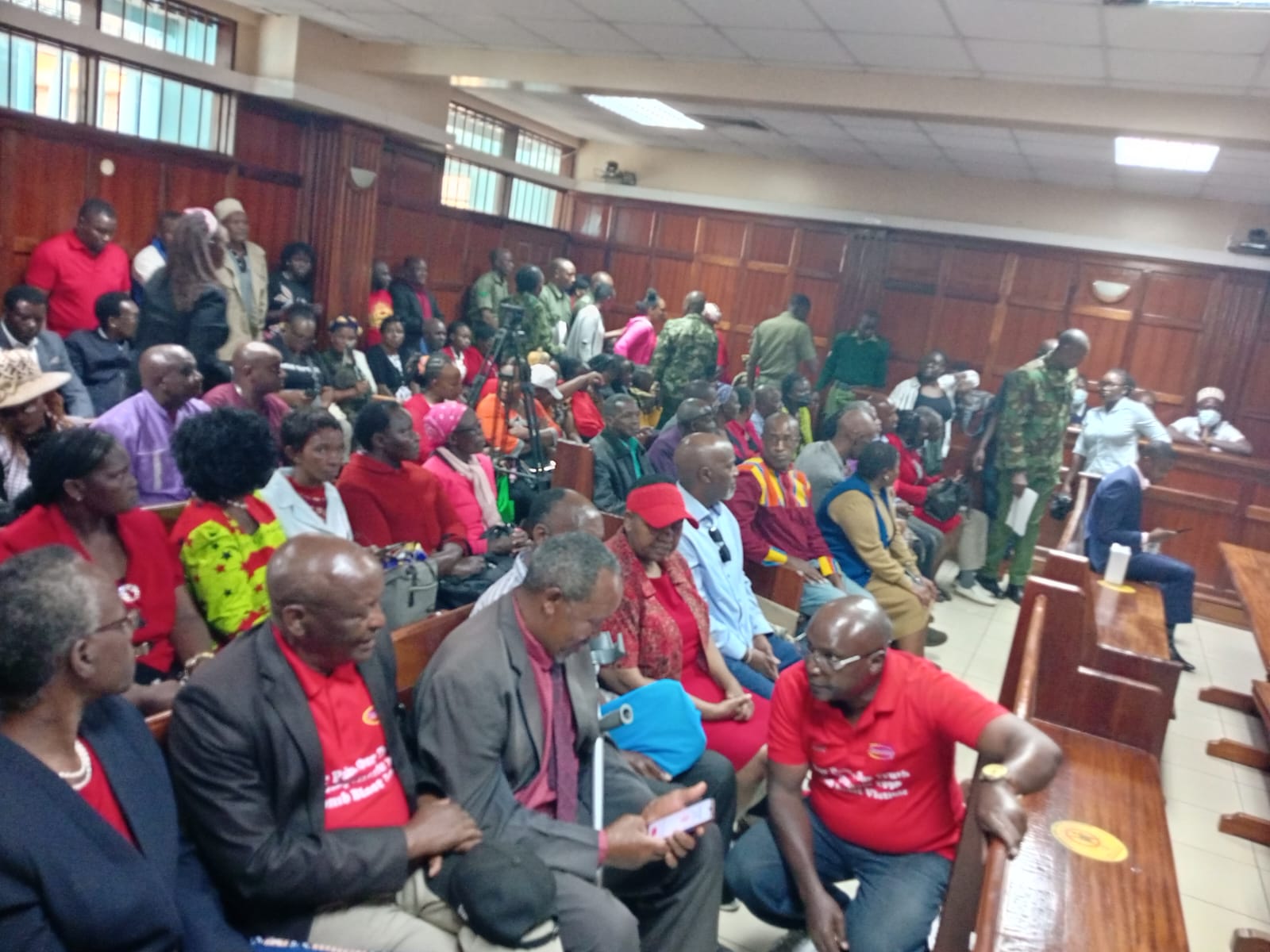
 Victims and survivors of 1998 bomb blast appear at Milimani High Court awaiting court verdict on their compensation case/JAMES GICHIGI
Emotions ran high at the Milimani Constitutional Court as survivors and families of the 1998 Nairobi bomb blast gathered once again.
They are hoping the long-delayed compensation ruling will finally bring justice and closure after decades of waiting.
On the early morning of Wednesday, January 28, 2026, the courtroom and its corridors filled with anxious survivors, bereaved relatives and members of the public, many arriving well ahead of the scheduled sitting at 10 am.
The group—largely made up of middle-aged and elderly victims—waited quietly, some seated on benches, others standing along the corridors, all watching the clock as they anticipated the court’s next move.
For many, the day symbolised the possibility of closure after more than two decades of legal battles, adjournments and emotional strain.
The mood in court was tense but hopeful, with hushed conversations punctuated by long silences as victims waited for the matter to be called out.
Some wore red T-shirts bearing the message: “Our pain, our truth — compensate 1998 bomb blast victims.”
The ruling relates to a compensation petition by Kituo Sheria alongside other petitioners, arising from the bombing of the United States Embassy in Nairobi, which killed more than 213 people and injured over 4,000 others.
Most of the victims were civilians—office workers, students and pedestrians—caught in the blast as they went about their daily routines.
A setback in the case had occurred in November 2025, when the court deferred the judgment that had been scheduled for November 6, 2025.
On that day, a large crowd of survivors, relatives and members of the public had similarly gathered at the Milimani Constitutional Court, hopeful that the protracted matter was nearing its conclusion.
Justice Lawrence Mugambi, however, told the courtroom that he required more time to review the extensive case record, describing the court file as voluminous and complex.
“The file has been with me, but I could not cope. It is huge. I need sufficient time to go through the documents thoroughly,” Justice Mugambi said at the time.
He explained that issuing a judgment without carefully reviewing the entire record would risk an unjust outcome, adding that he preferred to delay rather than deliver a rushed decision.
“If I give you a date now, it will be in January. Come then, and it will be ready as I will have had enough time,” he told the victims and their families.
The court subsequently set January 2026 as the new judgment date, effectively pushing the matter into the next legal term.
The November deferral was met with disappointment, particularly because it came just months after survivors and families marked the 27th anniversary of the bombing in August 2025, renewing calls for an expedited conclusion to the case.
While acknowledging the emotional toll of the delays, Justice Mugambi maintained that the postponement was necessary to ensure a fair, thorough and well-reasoned determination.
As of Wednesday morning, the victims remain in limbo—once again gathered in court, still waiting for a verdict in a case that has spanned nearly three decades.