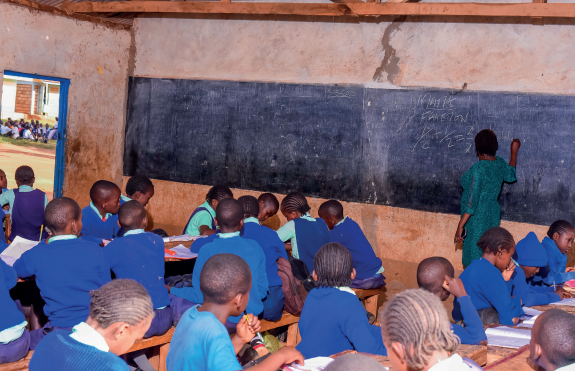
 Nationally, 6 in every 100 children aged between 4 and 17 years are out of school. /FLANA
Arid and semi-arid lands counties account for the largest share of children who are not enrolled in school in Kenya, underscoring deep regional inequalities in access to basic education, according to a new national survey.
The 2025 Foundational Literacy and Numeracy Assessment (FLANA) report shows that, nationally, 6 in every 100 children aged between 4 and 17 years — equivalent to 5.8 per cent — are out of school.
While this national figure may appear modest, the survey reveals stark disparities across age groups, gender and counties, with Asal regions disproportionately affected.
Data from the report, published by education advocacy group Usawa Agenda, indicates that the highest proportion of out-of-school children is among those of pre-primary age.
The survey shows that 16 in 100 children aged 4–5 years, representing 33.2 per cent, are out of school.
Among children of primary school-going age, between 6 and 12 years, 4 in 100 — accounting for 36.2 per cent — are not enrolled.
Adolescents aged 13–17 years make up 30.6 per cent of the out-of-school population.
Across all three age cohorts, the survey finds that boys are more likely to be out of school than girls at the national level.
On average, 6.2 per cent of boys are out of school compared to 5.4 per cent of girls.
However, this national trend masks a different reality in the most affected counties, where girls are disproportionately excluded from education.
The report further shows that children aged 4–5 years account for the largest share of those who have never enrolled in school, at 14.5 per cent.
In contrast, the highest dropout rates are recorded among children aged 13–17 years, pointing to challenges in retention as learners progress through the education system.
Regionally, the burden of out-of-school children is heavily concentrated in 10 counties, most of them classified as Asal areas.
Garissa county tops the list, with 27.3 per cent of children aged 4–17 years out of school — meaning 27 out of every 100 children are not enrolled.
“A child of school age in Garissa county has a 73 per cent chance of being in school compared to his or her counterpart in Murang’a county, who has a 99 per cent chance of being in school,” the report notes, highlighting the scale of inequality between counties.
Mandera follows Garissa closely, with 20.9 per cent of children across the three age cohorts — 4–5, 6–12 and 13–17 years — out of school, translating to 21 out of every 100 children.
Turkana records 18.2 per cent, while Marsabit stands at 17.1 per cent. Wajir has 13.9 per cent of children out of school, followed by Samburu at 11.9 per cent, Isiolo at 11.2 per cent, West Pokot at 10.4 per cent, Tana River at 7.6 per cent and Kajiado at 5.9 per cent.
The disparities are most pronounced among children of pre-primary age. According to the survey, a child aged 4–5 years in Garissa county is more than four times as likely to be out of school compared to peers in other parts of the country.
In this age bracket alone, 62.4 per cent of children in Garissa are out of school. When compared with counties that have near-universal enrolment, the gap is even more striking.
The report shows that a child aged 4–5 years in Garissa county is 64 times more likely to be out of school than a child of the same age in Murang’a county.
While boys are generally more likely to be out of school nationally, the report notes a reversal of this trend in the most affected regions.
The same 10 counties that host the highest number of out-of-school children are also home to more out-of-school girls than boys.
“In most Asal counties and refugee communities, however, there are more girls of school age out of school than boys. Garissa county has the highest overall percentage of children of school age who are out of school and the highest percentage of girls of school age who are out of school,” the report states.
The FLANA survey was based on a robust national sample. Its sample size was computed at 2,000 enumeration areas distributed across all 47 counties, using the 2019 national census as the sampling frame.
Enumeration areas were distributed proportionally and determined based on size, with between 50 and 100 households in rural areas and up to 150 households in urban areas.
Data collection involved over 2,200 volunteers and village coordinators, who conducted door-to-door household visits and visited more than 1,500 primary schools across the country.
This is the third report by Usawa Agenda and the first to be released since the adoption of the African Union’s Continental Education Strategy for Africa 2026–2035.
The 10-year framework seeks to transform education systems across the continent by focusing on six strategic areas: strengthening resources, supporting teachers, improving basic education, fostering higher education and technical and vocational education and training (TVET), promoting equity, and driving innovation.