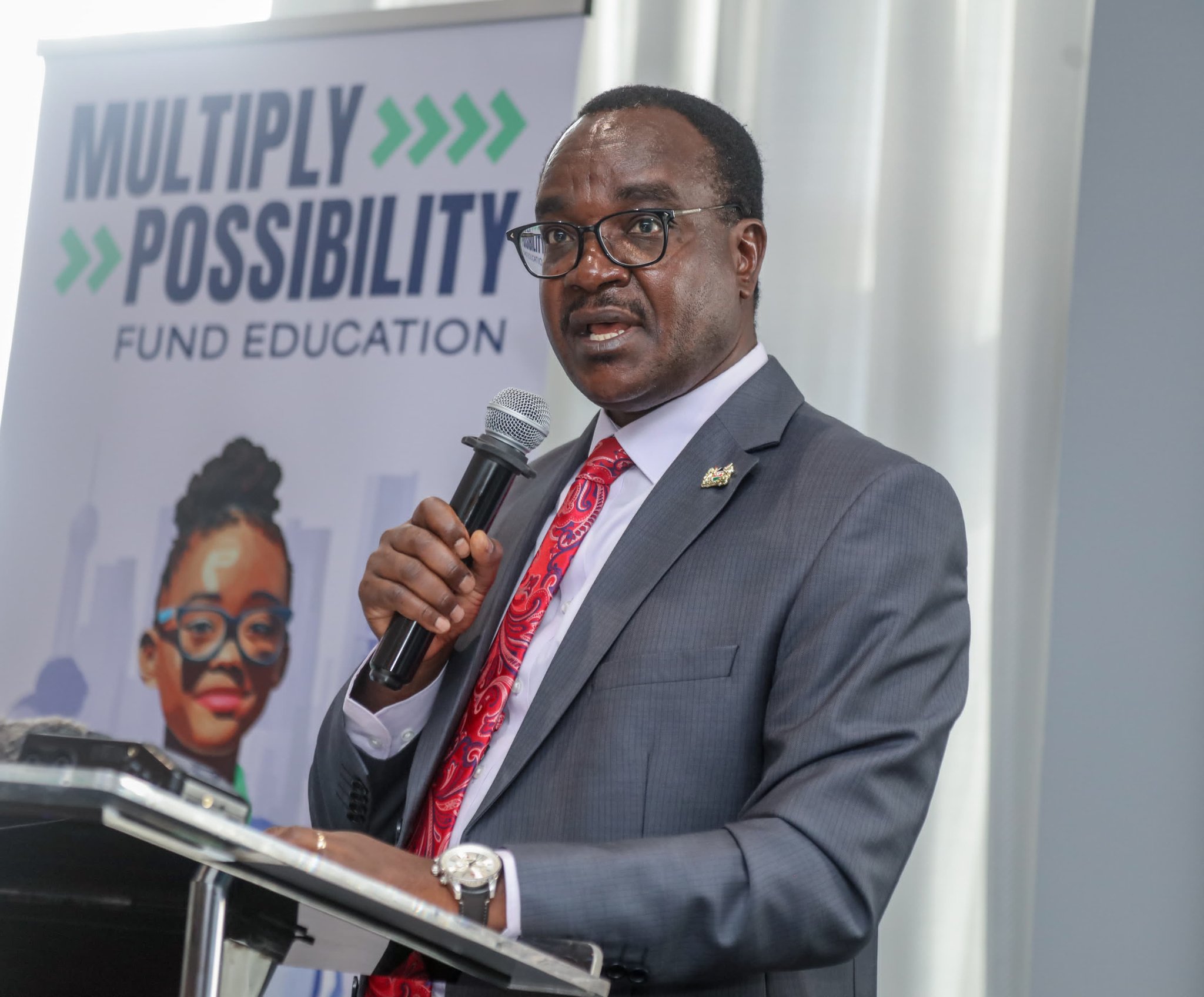
 Education CS Julius Ogamba speaks during development partner's roundtable on education funding at Radison Blu hotel, January 26, 2026. /MoE
The government is racing to complete 1,600 science laboratories by June as the transition of learners to Grade 10 nears full capacity at 96 per cent nationwide.
Education Cabinet Secretary Julius Ogamba said the laboratories are critical to ensure the first cohort of senior school learners under the Competency-Based Education (CBE) can immediately begin practical lessons, a core requirement of the new system.
An audit by the ministry found that 1,452 senior schools lacked proper laboratories and were relying on makeshift facilities.
“Out of the senior schools, we discovered that some did not have laboratories. We are therefore constructing 1,600 laboratories, with some schools receiving one, two or even three facilities,” Ogamba said.
“We think we will be able to complete that in the first half of this year.”
He said the project is being supported by several partners, including NG-CDF and a development partner from Kuwait focusing on schools in Kisii and Nyamira counties.
Ogamba was speaking on Wednesday while briefing Members of the National Assembly on the second day of their retreat in Naivasha.
He revealed that the Grade 10 transition rate had reached 96 per cent and could rise further.
“We have done quite well, this being the first time that this transition is taking place. We think that we might be able to move to 98 per cent by Friday,” he said.
A total of 1,130,459 candidates sat the 2025 Kenya Junior School Education Assessment (KJSEA), the first such exam under the new system.
Of these, 578,630 were boys and 551,829 were girls. The assessment was conducted across 24,366 junior secondary schools.
According to Ogamba, as at January 27, about 52 per cent of learners had been placed in STEM pathway, 38 per cent in Social Sciences, while the Arts and Sports pathway had received 10 per cent of learners.
He said Senior school placement shows varying uptake across clusters, with national schools (C1) receiving about 10 per cent of learners, extra-county (C2 - 23 per cent), county (C3 - 31 per cent) and sub-county schools (C4 - 36 per cent).
Regionally, transition rates stood at 89.19 per cent at the Coast, 94.12 per cent in Eastern, 95.04 per cent in Nairobi, 99.31 per cent in North Eastern, 97.94 per cent in Central and 97.64 per cent in Western.
On learning materials, Ogamba said textbook distribution had reached 58 per cent, with full delivery expected by the first week of February.
He attributed delays to an Sh11 billion debt owed to publishers.
“The debt did not arise from the printing of Grade 10 books. It arose out of the previous distribution of those books,” he said, noting that printers halted work once funds disbursed to publishers were exhausted on lower-grade materials.
Each learner, he added, will receive one textbook per learning area and two books for each core subject.
The CS also defended capitation levels, saying Sh44 billion was released on January 2 and that approved rates had not changed.
He said allocation per learner in primary school still stands at Sh1,420, Junior school Sh15,042 and Senior school Sh22,244 per year.
“Capitation has not reduced. It remains at the policy level. The problem lies elsewhere, not with the policy,” he said.
Ogamba urged MPs to allocate more funds to the education sector to bridge the existing deficit, which stands at Sh48 billion.
Education received Sh702.7 billion in the 2025/2026 budget, about 28 per cent of national spending, though Ogamba said this was still Sh25 billion short of international benchmarks.
He said to fully meet its obligations of providing free basic education, the ministry requires Sh727 billion annual allocation.
On staffing, Ogamba said 100,000 teachers had been recruited over the past three years, bringing the total to more than 450,000 across primary, junior and senior schools.
He said the teachers include 44,000 interns comprising 20,000 hired on one-year contracts and another 24,000 slated to be hired this year.
“We are also retooling these teachers to prepare learners for assessment under the competency-based system,” he said.