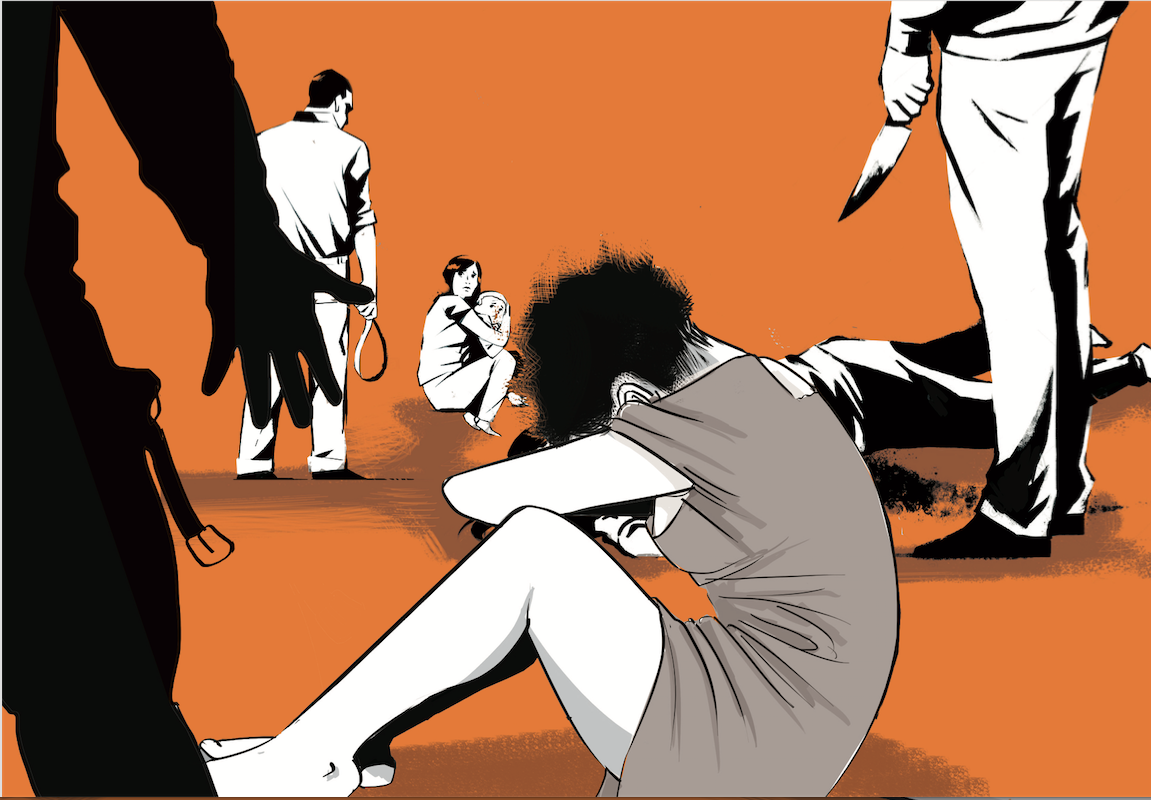
 An AI-generated image illustrating GBV/AI
Imagine a woman in her thirties, trusting her partner, only to meet a brutal end at his hands.
This nightmare repeats far too often in Kenya, where the home has become a killing field for many women.
A new report lays bare the horror. A total of 1,639 cases involving the killing of women were recorded, representing a 10 per cent rise in reported femicide between 2022 and 2024.
These chilling figures, drawn from National Police Service (NPS) data, are contained in a report by the Technical Working Group on Gender-Based Violence (GBV), chaired by retired Deputy Chief Justice Lady Justice Nancy Baraza.
Their overall overview is that the figures could be higher.
"A key concern is that these cases have not been officially tracked or classified under a specific femicide indicator. Instead, they have been broadly captured under general homicide statistics, which obscures the gendered nature of these killings and limits targeted policy and programmatic responses."
The team presented the findings to President William Ruto.
The report marks femicide not just as homicide, but as the intentional killing of women or girls because of their gender, often involving extreme violence.
The team compiled information using the International Classification of Crime for Statistical Purposes (ICCSP) typology, breaking down femicide by perpetrator identity, the circumstances, the reason behind the killing, and how it was carried out.
It cites drowning, burning, stabbing, or being beaten as the leading cause of death.
Domestic conflict between intimate partners, land disputes and cultural practices like FGM are cited as the biggest motivators of femicide.
Women aged 30-44 emerge as the most affected group, their vulnerability tied to intimate relationships or marriages.
"The most common perpetrators of physical violence among women who have ever been married or have ever had an intimate partner are their current husband/intimate partner (54 per cent), followed by a former husband/intimate partner (34 per cent), the report says.
It says current husbands and intimate partners are also the most frequently reported perpetrators of sexual violence among women who have ever been married or have ever had an intimate partner at 71 per cent, followed by former husband or intimate partner at 19 per cent.
On the flip side, men also experience sexual violence from intimate partners, with most reported perpetrators being their current wife or intimate partner (63 per cent), followed by a former wife or intimate partner (32 per cent).
The above figures are derived from the 2022 Kenya Demographic Households Survey (KDHS).
Comparatively, the Africa Data Hub report indicates that women aged 18-35 years were most affected, at 59 per cent, from January 2016 to December 2024.
Women aged between 20 and 44 years in the NPS report are the most affected due to their likelihood of being in intimate relationships or marriages, where intimate partner violence (IPV) is a leading cause of femicide.
The working group's report starkly illustrates age disaggregation from NPS data for 2023-2024, showing adolescent girls aged 15-17 facing a four per cent increase.
A deeply disturbing presence that signals no one is safe is that of children aged 0-10 and young adolescents aged 10-14.
While cases in the two age brackets appear lower in number, the mere presence of femicide in these age groups is deeply concerning.
 A deeply disturbing presence that signals no one is safe is that of children aged 0-10 and young adolescents 10-14.
Perpetrators? Alarmingly, young adults aged 18-35 commit 66 per cent of cases, with husbands topping the list at 40.15 per cent.
This suggests that the home remains the most dangerous place for women and girls in terms of the risk of lethal victimisation.
In 77 per cent of instances, the killer was known to the victim, turning familiar spaces into killing fields.
Strangers or individuals with unknown relationships to the victims constitute 22.5 per cent of the killers.
"Although perpetrators below 18 years represent only 3 per cent, their involvement is still alarming and indicates the early onset of harmful gender norms and behaviours," the report notes.
The findings underscore the urgent need for age-specific prevention strategies, particularly focusing on young men.
Femicide hotspots
The report fingered Nairobi as the county with the highest reported femicide incidences in 2023 at 53 cases, followed by Meru (52) and Nakuru (42) in 2023-2024 data.
Out of the total 578 cases reported in 2024, Nairobi county leads at 54, followed by Nakuru (43), Meru (30) and Kiambu (29).
Garissa, Lamu and Mandera reported zero cases in police records.
The data clashes across sources: Africa Data Hub logs 677 cases from 2016-2024 (53 in 2022, 82 in 2023, surging 48.5 per cent to 127 in 2024).
The NPS tallied 535 in 2023 and 578 in 2024, underscoring the urgent need for a harmonised national database.
The working group said the apparent huge disparities in terms of prevalence and incidents reported calls for the need to harmonise and integrate a database for data collection on GBV, including femicide, and their reporting to address the non-uniformity.