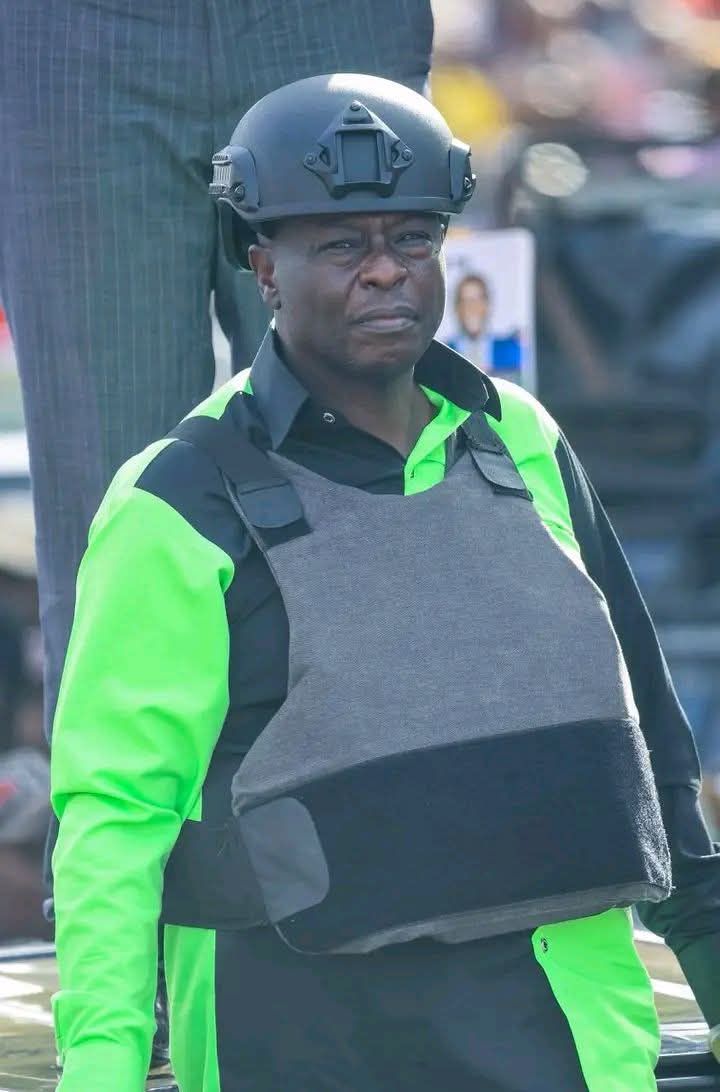
 DCP party leader Rigathi Gachagua./HANDOUT
Former Deputy President Rigathi Gachagua has come under a wave of relentless attacks as the country edges closer to the high-stakes 2027 General Election, triggering fresh debate over political intolerance.
The repeated incidents, unfolding across funerals, church services and public rallies, have fuelled speculation over whether the attacks are random acts of lawlessness or part of a calculated effort to neutralise rivals ahead of the next poll.
As pressure mounts on the government to explain persistent security lapses surrounding the former deputy president, Gachagua’s allies insist the pattern is too consistent to ignore.
They warn that the incidents point to a worrying slide towards the use of state machinery to settle political scores, a charge that government-allied leaders strongly deny.
The latest and most controversial incident occurred on January 25 at Witima African Church of Kenya (ACK) in Othaya, Nyeri County.
Gachagua had attended a church service alongside local leaders and supporters when chaos broke out after police officers stormed the compound, lobbed tear gas canisters, and allegedly fired shots, bringing the service to a sudden halt.
Worshippers fled in panic as smoke engulfed the church grounds, while several vehicles parked within the compound were destroyed, deflated, or damaged.
Gachagua later claimed that one of his vehicles was torched during the incident.
The Othaya attack has drawn widespread condemnation from politicians, religious leaders, and human rights groups, particularly because it unfolded inside a place of worship.
WHAT THEY SAID
Critics argue that the incident crossed a dangerous line by introducing force into spaces traditionally regarded as neutral and sacred.
Kiambu Senator Karungo wa Thang’wa sought to explain why Gachagua appears to be repeatedly targeted at church functions rather than open-air rallies.
Speaking during an interview with NTV, the senator suggested churches offer a more controlled environment for disruption.
“They are unable to attack us during rallies because of the public. There are so many people outside that are going to overwhelm them. The 15 rogue police officers cannot attack a public rally because we are thousands. The public is not afraid. They can face them,” he said.
Human rights defenders and church leaders have echoed similar concerns.
The Kenya National Commission on Human Rights (KNCHR) expressed shock and outrage over what it described as a brutal and unjustified attack on worshippers in Othaya.
The commission warned that such actions undermine fundamental rights and risk normalising the use of force against civilians engaged in lawful, peaceful activities.
The National Council of Churches of Kenya (NCCK), through a joint statement by chairperson Rev. Elias Otieno Agola and secretary-general Canon Chris Kinyanjui, condemned the incident as a serious violation of the sanctity of worship and a worrying sign of rising political intolerance.
“A church is a sacred refuge where Kenyans seek spiritual nourishment, hope, and unity. Turning such a space into a theatre of force is both unacceptable and deeply distressing,” the church leaders said.
They cautioned that deploying police force in church settings risks spreading fear among worshippers and undermining the constitutional guarantee of freedom of religion.
They added that the politicisation of security agencies could erode public trust in institutions meant to protect citizens.
Yet, the central question persists; is Gachagua being deliberately targeted by the government?
Whether the former deputy president is facing a coordinated state-backed campaign remains a matter of intense debate in Kenya’s polarised political climate.
Supporters of Gachagua argue that the pattern of disruptions and confrontations, including tear gas deployments at church services and stone-throwing at convoys, points to a deliberate effort by elements within the State to intimidate or suppress his political activities.
Gachagua himself has repeatedly claimed that his life, and those of his supporters, are in danger, alleging cooperation between police officers, intelligence operatives and organised gangs to harass him at funerals, worship services and rallies.
On the other hand, politicians allied to the government strongly deny that the State is orchestrating targeted attacks.
Some senior figures have characterised the incidents as spontaneous local clashes, poor coordination between organisers and police, or mismanaged events amplified for political sympathy.
They insist Kenya remains a democratic country where political competition is expected, and accuse Gachagua of politicising ordinary security operations.
THE CHRONOLOGY
A look at the chronology of events, however, shows a steady build-up of confrontations since his impeachment.
On October 17, 2024, Gachagua was impeached and removed as Kenya’s Deputy President by the Senate, becoming the first holder of the office to be ousted under the current Constitution. In the immediate aftermath, his official security detail was scaled down, with state-provided officers withdrawn in line with protocol once he ceased to hold office — a move his allies argue left him exposed.
Barely weeks later, in late November 2024, Gachagua’s convoy was attacked while he attended a funeral in Limuru, Kiambu County.
Stones and iron bars were hurled at his vehicle, shattering windows and forcing his team to flee.
Gachagua blamed the attack on reduced security and accused those in power of deliberately abandoning him.
On April 6, 2025, violence again followed him to a church service in Mwiki, Kasarani. Youths and armed men reportedly attempted to force their way into the sanctuary, gunfire was heard, and the service was temporarily halted amid chaos and confusion.
The tension escalated further on August 21, 2025, when Gachagua returned to Kenya from a prolonged tour of the United States.
As his convoy moved from Jomo Kenyatta International Airport along Mombasa Road towards Nairobi’s CBD and a planned rally in Kamukunji, groups of rowdy youths on boda bodas and on foot began hurling stones at the vehicles.
Windscreens were shattered, traffic ground to a halt, and panic spread among motorists and bystanders.
Despite a visible police presence, security officers deployed tear gas to disperse the crowd.
Journalists covering the event were also attacked, with crews from TV47, the Standard Group and other media houses reporting injuries and theft of equipment, prompting condemnation from media rights organisations.
The violence continued into 2026. On January 11, a service at the African Independent Pentecostal Church of Africa (AIPCA) in Kiamworia, Gatundu South, was disrupted after rival youth groups clashed outside the church. Police deployed tear gas to restore order, affecting worshippers inside and damaging vehicles parked nearby.
Gachagua accused the government of mobilising “goons” to disrupt his visit, framing the chaos as part of a broader campaign against him.
Just two weeks later came the Othaya incident, now seen as a defining moment in the debate over political violence and state conduct.
In response, the National Police Service said investigations were underway, with Inspector General Douglas Kanja directing the Internal Affairs Unit to probe the circumstances.