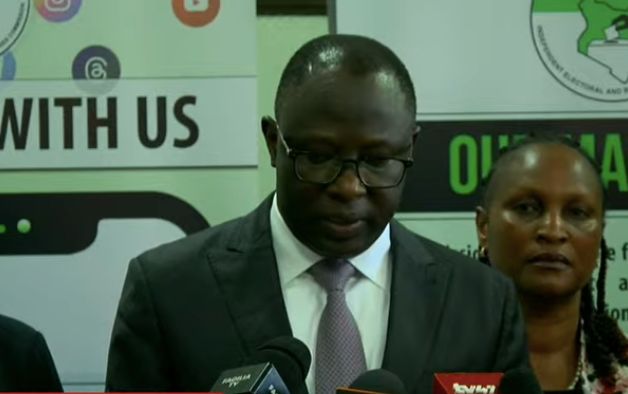
The Independent Electoral and Boundaries Commission (IEBC) has disclosed a funding deficit of about Sh20 billion as it ramps up preparations for next year’s general election.
Chairperson Erastus Ethekon said the financial constraints, coupled with ongoing legal and logistical challenges, pose a significant risk to the commission’s ability to deliver free, fair and transparent elections.
“We have a deficit of about Sh20 billion to conduct the general election. We will be requesting these funds from the National Treasury,” he said on Tuesday.
Ethekon said the deficit is from multiple operational demands, including the acquisition of electoral materials, voter education, recruitment and training of polling staff, as well as technological upgrades such as electronic voter identification systems.
He said the commission must also continue critical preparatory work for boundary delimitation, which is being undertaken through a phased approach due to constitutional and litigation constraints.
“The phased boundary review, continuous voter registration and by-elections across the country all require significant financial and human resources. Without adequate funding, there is a real risk of operational bottlenecks that could compromise the integrity of the 2027 polls,” Ethekon said.
He said the commission is already managing ongoing electoral activities, including several by-elections and reforms in voter registration, even as it navigates challenges stemming from unresolved legal disputes over the 2019 census data.
These disputes affect population quotas needed for electoral boundary adjustments, further adding to the financial and logistical pressure on the commission.
The IEBC chair said securing additional funding from the Treasury is critical to meet timelines for procurement, staff training and deployment of technology for a credible electoral process.
Ethekon said the commission has engaged in preliminary discussions with the Treasury and expects to formalise the funding request in the coming weeks.
Political partners and civil society organisations have repeatedly emphasised the importance of timely financing for the elections.
Delays or underfunding could disrupt preparations, particularly for voter education campaigns and recruitment of polling staff, which are essential to ensuring public confidence in the electoral process.
Ethekon reassured Kenyans that the IEBC remains committed to transparency and accountability in the use of public funds.
“Every shilling will be accounted for. Our mandate is to deliver elections that uphold constitutionalism and democratic principles. Adequate funding is non-negotiable to achieve that goal,” he said.
A week ago, CEO Hussein Marjan presented documents to the Parliamentary Committee on Constitutional Implementation Oversight (CIOC), revealing that Sh7.63 billion is required solely for staff salaries.
The commission is also grappling with Sh5.75 billion in unpaid bills, largely covering legal fees from previous elections.
“These pending bills have been accumulating over time and will adversely affect the operations of the commission in conducting the 2027 elections,” IEBC noted.
The CIOC, chaired by Suba South MP Caroli Omondi, warned in its report to the National Assembly that the funding shortfall “threatens the commission’s ability to discharge its constitutional mandate effectively” and urged the Treasury to bridge the deficit.
The committee also recommended a clear disbursement schedule to ensure timely execution of electoral activities and restore supplier confidence.
The commission, constitutionally tasked with managing elections, referenda, voter registration, constituency delimitation, voter education and election technology, has requested Sh61.74 billion over three financial years for next year’s polls: Sh15.3 billion in 2025-26, Sh25.4 billion in 2026-27 and Sh21 billion in 2027-28.
Treasury has committed Sh55 billion as a baseline, while Parliament approved Sh9.33 billion for the first year, up from Sh3.82 billion in 2024-25.
The funds are intended to cover election management, voter education, ICT systems, and boundary delimitation.
The commission also plans to acquire 59,352 Kenya Integrated Election Management System (Kiems) kits, including 3,959 units for training and replace 45,352 kits from the 2017 elections.
Earlier, Treasury rejected IEBC’s Sh62 billion budget proposal, which included Sh7 billion for new Kiems kits.
The commission had proposed Sh55 billion as a baseline, Sh6.7 billion for its overall deficit, and Sh3.8 billion for pending bills.
Its request also sought funding spread over three financial years, 2025–28, to cover voter registration, new polling stations and the replacement of outdated kits.
So far, Treasury has allocated Sh45.3 billion; Sh9.3 billion for 2025/26, Sh24.9 billion for 2026-27, and Sh20.4 billion for 2027-28.
The allocations include Sh26 billion for election management, Sh1.9 billion for voter education, Sh12.7 billion for ICT and about Sh100 million for boundary delimitation.
Despite this, IEBC faces a Sh16.5 billion shortfall as preparations for the polls continue less than two years away.