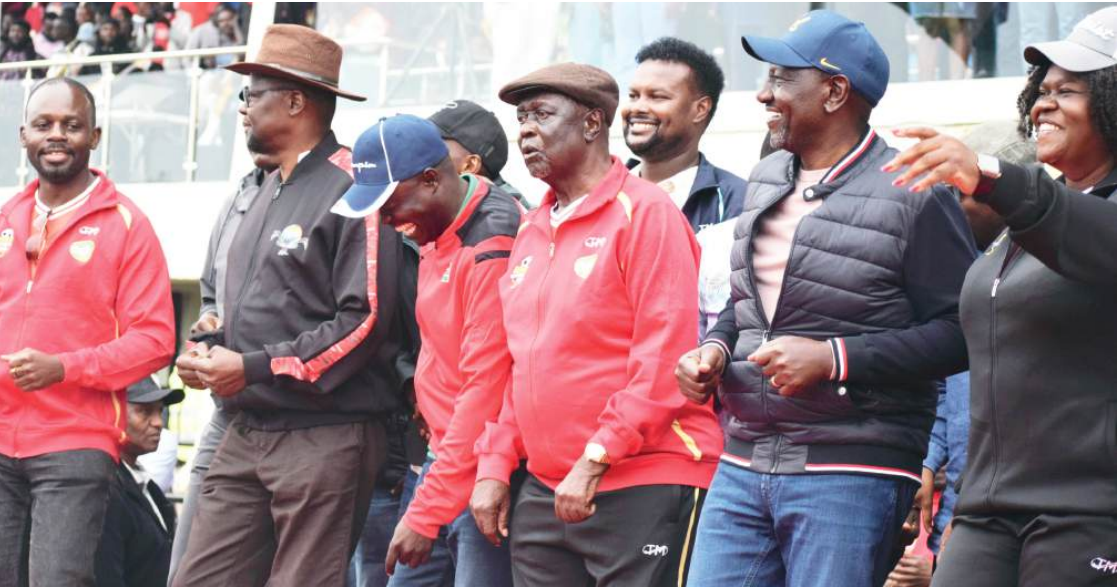
 Senator Moses Kajwang’, Governor Ochillo Ayacko, MP Peter Kaluma, ODM leader Oburu Oginga, President William Ruto and Governor Gladys Wanga at Raila Odinga Stadium in Homa Bay town on December 28 last year /ROBERT OMOLLO
The perceived shortcomings of the 2018 handshake between retired President Uhuru Kenyatta and former ODM leader Raila Odinga are quietly fuelling President William Ruto’s inroads into traditional opposition strongholds.
Seven years later, a deal once sold as a national truce is increasingly viewed within ODM circles as a raw bargain—one whose political costs are now working to Ruto’s advantage.
Uhuru's sympathisers have, however, trashed the claims, arguing that individuals critical of the handshake are doing so to please their new "political sponsor"
Some of Raila's allies argue that the handshake delivered little by way of tangible political or economic gains for his support base.
While Raila gained access to the corridors of power, many of his foot soldiers say the arrangement yielded nothing concrete for communities that stood by him.
This sentiment contrasts sharply with views on Ruto’s broad-based government, which ODM insiders now say has delivered visible political inclusion.
President Ruto has appointed five Cabinet Secretaries from ODM, two of them from the Nyanza region, alongside placing party figures in state agencies and rolling out infrastructure projects in opposition zones.
Treasury Cabinet Secretary John Mbadi has been among the most vocal critics of the Raila-Uhuru deal, arguing that the handshake merely stabilised the country without benefiting Raila’s strongholds.
“I felt disappointed when Raila got us into the handshake with Uhuru Kenyatta. I did not feel it was a good move. He explained to me, and I thought he was right. What came out of it? zero apart from stabilising the country," Mbadi said.
Mbadi said the experience informed the region’s current political choices, adding that the Luo community had resolved to back President Ruto’s bid for a second term.
Ruto has co-opted into his cabinet five Cabinet Secretaries from Raila’s ODM and two from his Nyanza backyard.
They are John Mbadi (Treasury), Opiyo Wandayi (Energy), Hassan Joho (Mining), Wycliffe Oparanya (Cooperativess) and Beatrice Askul (East Africa Community).
During the handshake, Raila did not get an opportunity to have his allies in Uhuru’s cabinet even though some of his men were considered in various government appointments.
Uhuru's administration is however credited for the revival of the Kisumu port after years of dormancy and the expansion of the Kisumu International Airport.
Another recurring accusation among Raila’s inner circle is that Uhuru, despite wielding the full instruments of state power after the 2017 election, failed to deliver the presidency to Raila.
Uhuru’s firm grip on state machinery at the time, according to National Assembly Minority Leader Junet Mohammed would have been deployed to engineer a Raila succession in 2022.
Instead, the Suna East MP said, Uhuru retreated into a moral support role, backing Raila politically but stopping short of fully neutralizing Ruto, then his deputy, who went on to win the presidency.
That outcome has hardened the belief within ODM that the handshake served Uhuru’s legacy and stability agenda more than Raila’s long-term political interests.
“Baba (Raila) lost the elections because Uhuru was campaigning for him from State House instead of engaging with people on the ground,” Junet said during an interview with Citizen TV on Wednesday.
The Minority Leader was the focal point of Raila’s 2022 campaigns and was the Secretary of the Azimio la Umoja, the coalition party Raila used for his fifth presidential bid.
“There were senior people in government who told me that in a contest between Raila and Ruto, Raila would lose, yet those were the very people we were relying on,” Junet disclosed.
“I just wish we had run that election without associating with the government; it was just a baggage that we carried. They didn’t want to make Raila President.”’
But Jubilee Party has, however, denied claims of sabotage saying the retired President did his part and that Raila was failed by his inner circle.
“Resources were being given to Azimio Party for purposes including paying the agents, one of the individuals who was in charge is the SG and you know who was the Azimio SG. If he managed it well, Raila would have been in State House,” former Jubilee Secretary General now Deputy Party Leader Jeremiah Kioni fired back.
“We understand that popularity of our party leader is intimidating to some leaders in this country,” added Matiang’i.
Political analyst Mutahi Ngunyi, who was in Uhuru’s inner circle during his last term in office, also concurred with Junet claiming Raila’s loss was well scripted to allow for an Uhuru’s ally to make a comeback after Ruto’s two terms.
“Uhuru wanted Raila to lose in 2022 and the architect of this failure was Matiang’i (former Interior Cabinet Secretary Fred Matiang’i). I was there. I saw it. Use Baba as a decoy in 2022, but give Ruto the presidency for 10 years. Then in 2032, make Matiang’I the President. No opposition, This was the plan,” the analyst posted on his X.
This perceived 'betrayal' has quietly but steadily eroded the emotional firewall that once insulated Raila’s bases from Ruto’s overtures.
Ruto has been quick to exploit this disillusionment.
His approach to Raila’s strongholds has been deliberately pragmatic: development promises, budgetary allocations, infrastructure launches and the inclusion of local leaders in national decision-making.
Ruto’s administration has, in the current budget, rolled out a raft of mega road projects across the Nyanza region, a move widely seen as part of a broader strategy to penetrate long-standing opposition stronghold.
The projects include the upgrading of key highways linking Kisumu to Siaya, Homa Bay and Migori, as well as major urban roads within the expansive lake region.
Some of the 37 new road projects earmarked for tarmacking in the current budget include Kanyawanga-Dede-Rapogi, Stella-Gogo, Masara-Muhuru, Awasi-Katito, Rabuor–Chiga, Kalamindi–Osani–Nyakweri, Kalamindi–Osani–Nyakweri, Kalamindi-Osani- Nyakweri amongst others.
Political observers, however, view the aggressive infrastructure push as a calculated attempt by Ruto to win over Raila’s traditional support base ahead of the 2027 elections.
By prioritising visible development projects, the President appears keen to win over voters who have long complained of marginalisation.
This seems to have softened resistance on the ground, especially among leaders wary of being locked out of power cycles as happened after the handshake.