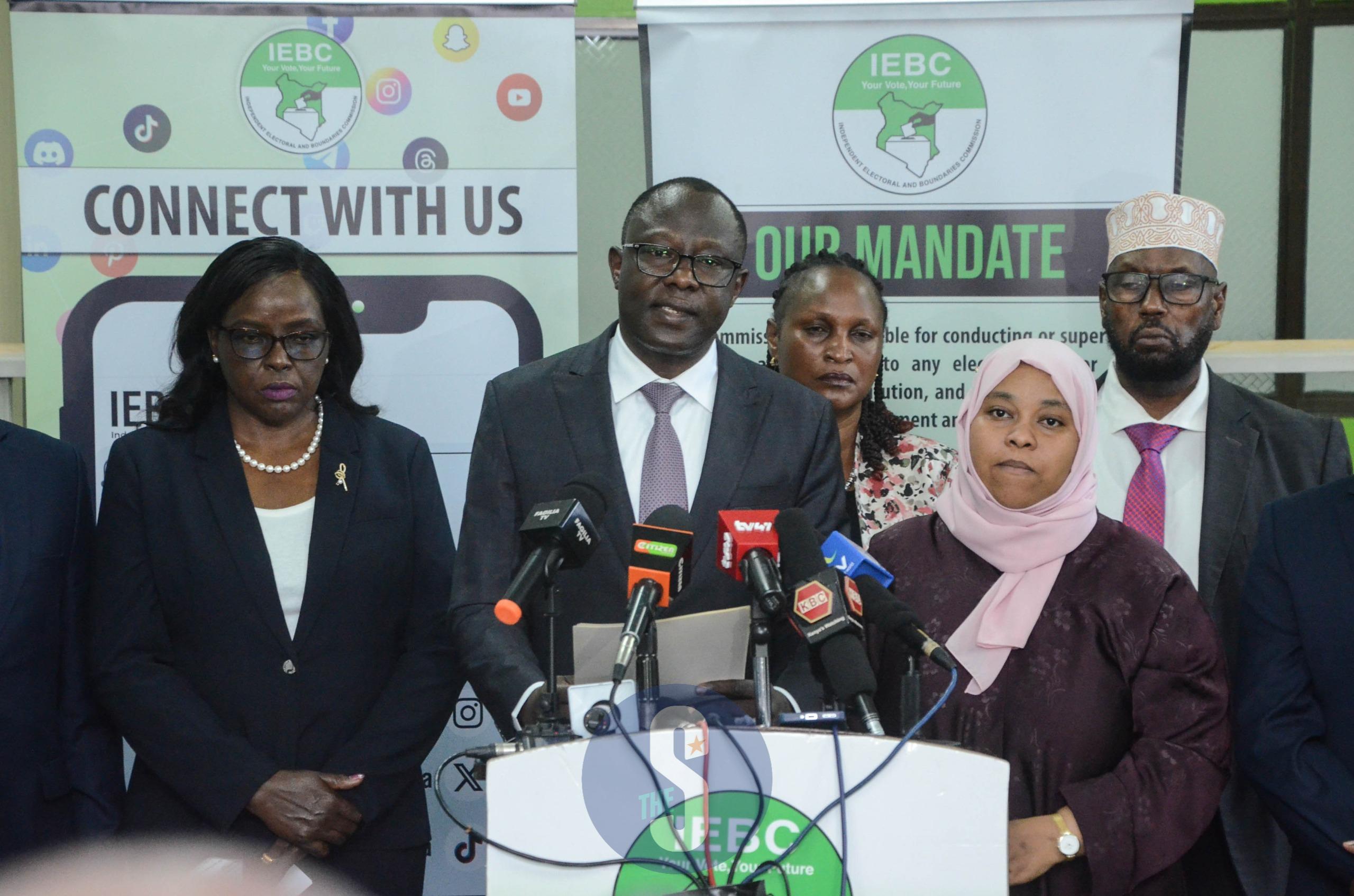
The Independent Electoral and Boundaries Commission (IEBC) announced on Tuesday, January 27, that it will adopt a phased approach in reviewing constituency and ward boundaries.
The commission cited constitutional, legal, and operational constraints that make a full delimitation before the August 2027 General Election impractical.
In a statement, the Commission emphasised that boundary delimitation is central to Kenya’s representative democracy, ensuring the principle of “one person, one vote, one value” is upheld.
The review process, it said, must reflect population changes and evolving geographic realities.
“The Commission’s decision reflects our commitment to upholding constitutionalism while safeguarding the integrity and preparedness of the electoral process,” the statement said.
Boundary delimitation is the constitutional process through which the names, numbers, and geographical boundaries of constituencies and wards are reviewed to support fair political representation.
The exercise is anchored in the democratic principle that every vote should carry equal weight, commonly expressed as “one person, one vote, one value.”
Over time, population growth, urbanisation, migration and settlement patterns can affect this balance, leaving some electoral areas highly populated while others remain sparsely populated.
When such imbalances persist, voters in more populated constituencies may have comparatively less influence than those in smaller ones, raising concerns about equality of representation.
In Kenya, delimitation is not a technical exercise undertaken for convenience, nor is it intended as a political favour extended to particular regions.
It is a constitutional mechanism designed to keep the country’s representative system aligned with demographic realities.
By periodically reviewing boundaries, the electoral system seeks to remain responsive to population shifts, support equitable distribution of political power and reinforce the legitimacy of elected institutions at both national and county levels.
IEBC’s constitutional mandate and independence
The responsibility for conducting boundary delimitation is vested in the IEBC under Articles 88(4)(c) and 89 of the Constitution.
This mandate requires the commission to periodically review electoral boundaries while applying specific constitutional criteria, including population equality, community of interest, geographical features and means of communication.
By assigning this role to an independent commission, the Constitution seeks to insulate the process from political influence, recognising that boundary reviews can have significant political implications.
IEBC’s role is therefore both technical and constitutional.
It must balance competing interests, promote fairness across regions, and make decisions capable of withstanding legal scrutiny.
Delimitation directly affects representation in Parliament and county assemblies, resource allocation and political influence.
For this reason, the process is expected to be guided by objective data, particularly census figures, and conducted in a manner that is transparent, consultative and consistent with constitutional principles.
Why 2024 boundary review was not completed
Kenya’s last boundary review was completed in 2012 and gazetted through Legal Notice No. 14 of 2012, setting the constitutional timeline for the next review to be completed by March 6, 2024.
However, a combination of institutional and legal challenges meant the deadline was not met.
Among these was the absence of IEBC Commissioners between January 2023 and July 2025.
Boundary delimitation is regarded as a substantive constitutional function, which the Commission has stated cannot be undertaken by the Secretariat in the absence of Commissioners.
This position was supported by legal advice referenced by the Commission and later addressed by the Supreme Court, which held that delimitation requires collective consideration by a duly constituted Commission.
Proceeding without Commissioners would have raised constitutional questions and heightened the risk of legal challenges.
As a result, although the Secretariat remained operational, it did not initiate or conclude the review.
Further complicating the process were court cases challenging the validity of census data for Garissa, Wajir and Mandera counties.
Census data is central to boundary delimitation because it is used to calculate the population quota that informs assessments of equality of representation.
Without finalised and legally settled national census figures, the Commission indicated it could not proceed with the exercise without exposing the process to legal contestation.
Supreme Court guidance and case for a phased approach
The legal uncertainty surrounding delimitation led IEBC to seek guidance from the Supreme Court, which delivered an Advisory Opinion on September 5, 2025.
In its decision, the Court acknowledged the importance of fair representation and equality of the vote, while also recognising practical constraints facing the Commission.
The Court observed that delimitation implicates broader constitutional values, including electoral integrity, stability and institutional independence, and cautioned against reducing the process to rigid timelines alone.
The Supreme Court also affirmed IEBC’s independence, noting that the Commission bears primary responsibility for applying constitutional principles before seeking judicial guidance.
The Court further noted that while population growth and demographic change may raise concerns about voter dilution, rushed or unlawful delimitation could undermine electoral credibility.
Guided by this opinion, IEBC evaluated three options:
Conducting a full boundary review before the August 2027 General Election was discounted due to unresolved legal matters, time limitations and potential disruption to election preparations.
Deferring the entire exercise until after 2027 was also set aside because it would maintain existing disparities in representation.
The Commission ultimately adopted a phased approach, describing it as the most lawful, practical and constitutionally defensible option under the circumstances.
What phased delimitation approach means
Under the phased approach, IEBC will undertake preparatory, technical and consultative activities ahead of the 2027 General Election while avoiding actions that could interfere with the electoral process.
Commission chairperson Erastus Ethekon said competing electoral priorities have further complicated the timeline.
The Commission is simultaneously handling by-elections, continuous voter registration, legal and institutional reforms, and preparations for the 2027 General Election.
“Undertaking full delimitation alongside other critical obligations would create operational bottlenecks and affect overall electoral preparedness,” Ethekon said.
These preparatory activities include data analysis, internal capacity building, stakeholder engagement and planning for public participation.
The Commission has said it will complete the substantive boundary review after the 2027 elections, subject to the availability of legally validated census data.
IEBC has also indicated that there will be no changes to constituency or ward boundaries before the 2027 General Election.
Existing boundaries will therefore apply for that election, providing predictability for voters, candidates and political parties.
The phased approach, according to the Commission, is intended to progressively realise the constitutional mandate while managing legal, operational and electoral considerations.
Constituency numbers, mergers and public participation
The Constitution sets the number of constituencies at 290, meaning this figure cannot be altered without a constitutional amendment.
However, IEBC is mandated to review constituency and ward names, boundaries and configurations, provided the total number remains unchanged and constitutional criteria are met.
This may include mergers or reconfigurations where population disparities are identified.
The Commission has stated that no constituency is permanently exempt from review.
The 27 constituencies protected during the first boundary review were covered under transitional provisions that have since lapsed.
As a result, all constituencies fall within the scope of subsequent reviews.
Public participation is a required component of the delimitation process.
IEBC is required to hold public hearings, engage political parties, county governments, civil society and citizens, and communicate openly throughout the exercise.
Participation is intended to give citizens an opportunity to contribute to decisions affecting political representation.
Why boundary delimitation is central to democracy
Boundary delimitation plays an important role in supporting Kenya’s democratic framework.
By addressing voter dilution, it seeks to ensure that representation in Parliament and county assemblies reflects population patterns.
It also supports equitable resource allocation, accountability between citizens and elected leaders, and confidence in electoral outcomes.
IEBC has indicated that the full delimitation process is estimated to cost approximately Sh8.49 billion, covering geo-data systems, public participation, legal processes, capacity building and voter education.
While the cost is high, the Commission has framed the exercise as an investment in representative governance.
With the phased process expected to conclude ahead of the 2032 General Election, boundary delimitation remains a key constitutional process shaped by legal requirements and electoral stability.