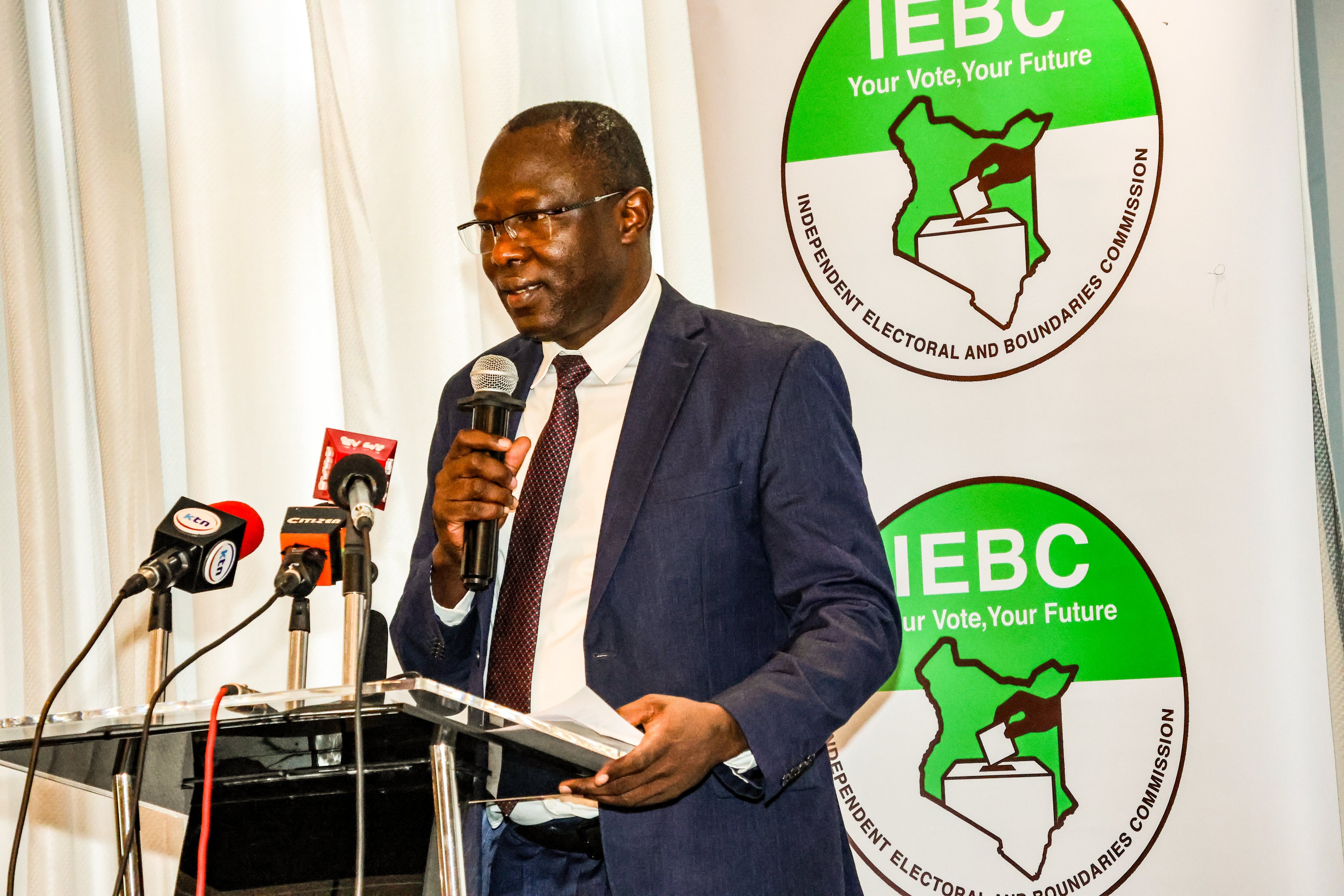
Independent Electoral and Boundaries Commission (IEBC) Chairman Erastus Ethekon has warned that legal and financial pressures are constraining the Commission’s ability to manage election-related disputes and compliance obligations ahead of future polls.
Ethekon said the Commission has in recent months been grappling with legal uncertainties and structural constraints that have disrupted operations and created bottlenecks in the electoral litigation pipeline.
The chairman noted that the Commission is carrying substantial legal liabilities accumulated over multiple electoral cycles.
“In the last few months, the Commission has been faced with certain legal challenges that have affected election legal operations, including gaps and inconsistencies between electoral laws and court decisions which have created uncertainty in election processes, necessitating legislative harmonisation,” he said.
“The Commission has unpaid, audited legal fees, including Sh3.8 billion (from 2013 to date), constraining the Commission's ability to engage external counsel for election petitions and disputes.”
He further underscored capacity challenges, revealing that IEBC currently has a limited legal team to manage an expansive dispute ecosystem inherent to elections.
“Currently, we are only operating with four in-house lawyers; during the election period, you have to deal with over 100 election-related disputes,” he said.
“We are not only dealing with the main elections but also disputes arising from the party primaries during the registration of candidates. I must state clearly that internally we cannot as a commission cope with those litigation cases and other internal legal advisories that we need.”
Earlier, the Commission announced it will adopt a phased approach to reviewing constituency and ward boundaries, citing constitutional, legal, and operational constraints that make a full delimitation before the August 2027 General Election impractical.
In a statement, the Commission emphasised that boundary delimitation is central to Kenya’s representative democracy, ensuring the principle of “one person, one vote, one value” is upheld.
The review process, it said, must reflect population changes and evolving geographic realities.
“The Commission’s decision reflects our commitment to upholding constitutionalism while safeguarding the integrity and preparedness of the electoral process,” the statement said.
The IEBC traced the origins of the current review process to the first boundaries review concluded in 2012 and the subsequent development of the Boundaries Review Operations Plan (BROP) 2019-2024. Preparatory work, including strategy development, situational analysis, pilot studies, acquisition of geospatial tools, and institutional capacity building, has been ongoing since 2019.
However, the Commission said progress was hampered by a series of constraints. Between January 17, 2023 and July 11, 2025, the Commission operated without commissioners, leaving the Secretariat unable to make key policy decisions.