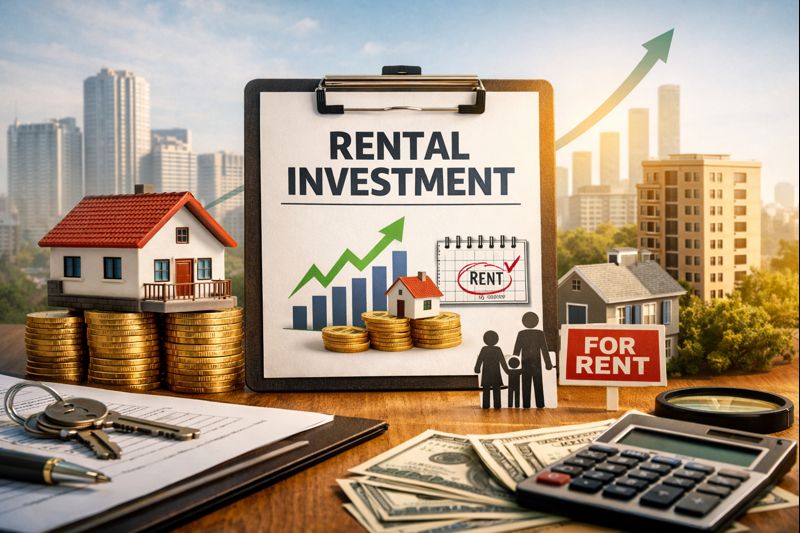
 Rental investment / Artificial Intelligence Illustration
Rental properties remain one of the most dependable long-term asset classes for investors seeking predictable returns and stability, according to Together Comfort Homes Director Hezekiah Kariuki.
Kariuki, a seasoned real estate entrepreneur, argues that while rental investment may not deliver rapid cash flow, it offers unique security compared with equities or operational businesses whose performance can fluctuate.
According to Kariuki, the key metric for assessing rental investment is the monthly return on investment (ROI).
Rental investment refers to purchasing property such as residential apartments, houses, commercial spaces, or land intended for leasing specifically to generate income from tenants. Instead of buying to occupy or resell immediately, the investor earns returns through rent paid monthly or annually.
 Comfort Homes Director Hezekiah Kariuki during a past investment forum at Safari Park Hotel Nairobi. /SCREENGRAB
At the 0.8 to 1.0 percent band, investors typically recoup their capital over approximately 15 years. Higher-performing investments, returning 1.2 to 1.5 percent monthly, can shorten the capital recovery period to about seven years.
“When you invest in rentals, make sure the monthly return on investments should be 1.2 per cent, if it is low, it should give you one percent or 0.8 per cent. The return on investment will take about 15 years to return your money. With a 1.2 per cent return on investment to a 1.5 return on investment. It will take you about seven years to return your investment,” Kariuki said.
He noted that many investors ignore entry pricing when buying rental property and end up overpaying relative to expected rental income and payback timelines.
Kariuki added that although real estate often appreciates, the value of money itself depreciates over time, making irrational pricing costly in the long term.
“The initial price is a determinant factor, many people invest a lot of money but they buy houses aimlessly without knowing how long it will take to return the investment. We say that the investment appreciates, but money also depreciates.”
Kariuki observes that many people prefer investing in companies or running businesses because of the potential for faster capital multiplication.
However, he warns that corporate investments can also fail, introducing risk that does not exist in the same form within rental property.
“Many people focus on investing in companies, but the business can fail,” he said.
He said that rentals is a comparatively conservative hedge that does not rely on operating capacity or managerial oversight once the units are built and occupied.
Kariuki advised investors to align investment choices with age and stage of life. Those between 30 and 50 years old, he argues, are better positioned for high-energy, high-return business ventures, as they have the stamina to drive growth and manage operational risks.
By contrast, investors above 50 years old, typically nearing retirement, benefit more from passive and predictable cash flow streams generated by rentals.
“Your age should dictate the kind of investment you are making. Those between 30 and 50 years old can succeed in investing in a company because you are energetic, but when you are past 50 years old, it is hard to manage the companies; the mind will not allow them to manage the company as a chairperson. Rental or long-term investment can best be done by those who are above 50 years old because they are about to retire,” he said.
The entrepreneur described rentals as a “lazy investment” that often employs only one person.
Despite calling rentals “lazy,” Kariuki frames that feature as an advantage rather than a drawback for certain investors. While dynamic business ventures demand continuous attention and managerial input, rentals offer stable cash flow with low operational intensity.
“If you are between 30 and 50 years old, you are not advised to invest so much in rentals because it is a lazy investment because it only employs one person. When you have invested in a company, the money will multiply fast and get you more money to build the rentals; however, your energy will be needed seven times more than when you invest in rentals,” he added.
According to him, rental investment remains one of the most reliable long-term asset strategies, slow in growth but strong in security.
Kariuki said that its appeal stems from dependable occupancy-driven returns, protection against inflation, and low operational demands.
For younger investors seeking aggressive wealth accumulation, Kariuki suggests business ventures first, rentals second; for older investors seeking stability, rentals become the preferred option.