The Kenya Revenue Authority (KRA) plans to monitor smugglers form the air and sea in a bid to combat tax evasion.
To attain this, it has has floated a decade-long multi-billion-shilling technological upgrade that will see the taxman deploy high-tech surveillance drones and marine patrol boats.
A joint report by the National Taxpayers Association and Oxfam estimates that the country loses between Sh243 billion and Sh253 billion annually to illicit financial flows, a figure that has more than doubled over the past four years.
The plan, outlined in the tender announcement dated January 16, signals a shift by the revenue collector toward an aggressive, tech-led enforcement strategy aimed at sealing revenue leakages across Kenya’s porous borders and territorial waters.
The tender document seen by the Star, for instance, shows that the revenue agency is seeking the procurement of a fleet of Unmanned Aerial Vehicles (UAVs) and advanced Non-Intrusive Inspection (NII) systems.
These assets are expected to provide the KRA with real-time aerial surveillance over remote border points and transit routes that have historically been difficult to police, providing a much-needed vigilance in the sky.
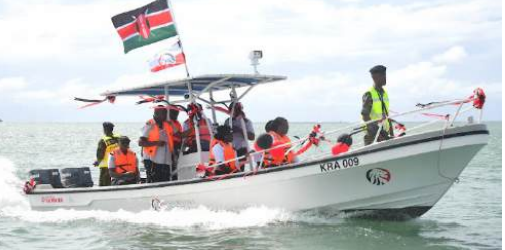
To complement the aerial surveillance, the taxman is seeking specialized marine patrol boats to tighten the net on smuggling activities along the coastline and inland water bodies, which remain major conduits for illicit trade.
The high-tech assets will be synchronized through a centralized Command and Control Center, allowing enforcement officers to monitor live data feeds.
This is expected to enable faster response times and more precise interventions by the KRA’s enforcement unit.
Under the project timelines, the implementation of the drone and marine surveillance systems is expected to be completed within 18 months of the contract award.
This will usher in a new era of high-tech tax enforcement, potentially setting a benchmark for revenue authorities in the East African region.
“By reducing reliance on manual inspections and physical patrols in high-risk areas, the authority aims to increase the safety of its staff while simultaneously improving the efficiency of cargo clearance and tax compliance,” KRA says in the tender documents.
Furthermore, the agency is looking to integrate blockchain technology, AI-powered risk engines, and smart gates at border crossings.
The move is part of a broader transition into a fully digital tax administrator, moving away from traditional, labour-intensive audit and enforcement methods.
The Authority has previously credited its use of technology, specifically the iTax and Integrated Customs Management System (iCMS), for the steady growth in revenue collection despite a challenging economic environment.
Addressing the media at the Supreme Court on Thursday, KRA chairman Ndiritu Muriithi said that the modernisation drive is part of KRA’s 9th Corporate Plan, which focuses on leveraging data and automation to meet the ambitious revenue targets set by the National Treasury.
“We are seeking a private strategic partner to fully finance a large-scale technology overhaul, including AI-driven analytics, drones, non-intrusive inspection systems, and a centralised data platform,’’ he said.
He revealed that the investor would recover capital, operating costs, financing costs and profit through negotiated periodic installment payments over an estimated 10-year contract.
He outlined the agency’s performance for the first six months of the year, indicating that it collected Sh307.6 billionagainst a target of Sh285 billion in December 2025.
The collection represented a performance rate of 108 per cent and a growth of 29.3 per cent.
Customs and Border Control collected Sh85.9 billion against a target of Sh83 billion, translating to a performance rate of 103.5 per cent and a growth of 23.5 per cent.
“In addition to surpassing the target, the department recorded the highest monthly collection in KRA’s history.”
Large and Medium Taxpayers (LMT) collection amounted to Sh194.9 billionagainst a target of Sh175.1 billion, a performance rate of 111.3 per cent and a growth of 33.1 per cent.
Furthermore, the new Micro and Small Taxpayers (MST) department collected Sh26.3 billion against a target of Sh26.4 billion, a performance rate of 99.6 per cent, and a growth of 21.9 per cent.
Generally, revenue collection hit Sh1.38 trillion against a target of Sh1.44 trillion.
This resulted in a performance rate of 96.2 per cent against the target, leading to a deficit of Sh55.5 billionand a growth of 11.6 per cent
KRA boss, Humphrey Wattanga, said that the agency remains optimistic about meeting the overall revenue target for the Financial Year 2025/26, which standsat Sh2.97 trillion.
“This target represents a required growth of 15.4 per cent over the Sh2.6 trillion collected in Financial Year 2024/25,’’ he said.