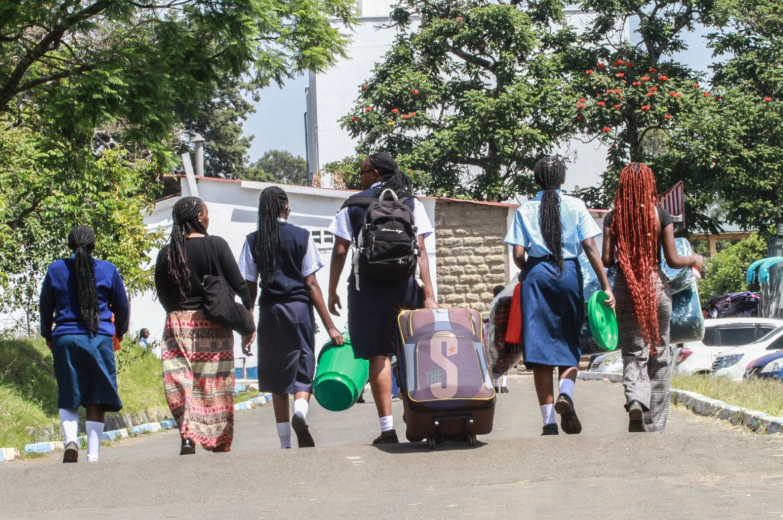
 A family escorts their daughter to Moi Girls High School Nairobi for admission in Grade 10 on January 12, 2026. /ENOS TECHE
The government is considering merging or shutting down senior schools that have received few or no Grade 10 students since the pioneer Competency-Based Education class began reporting on January 12.
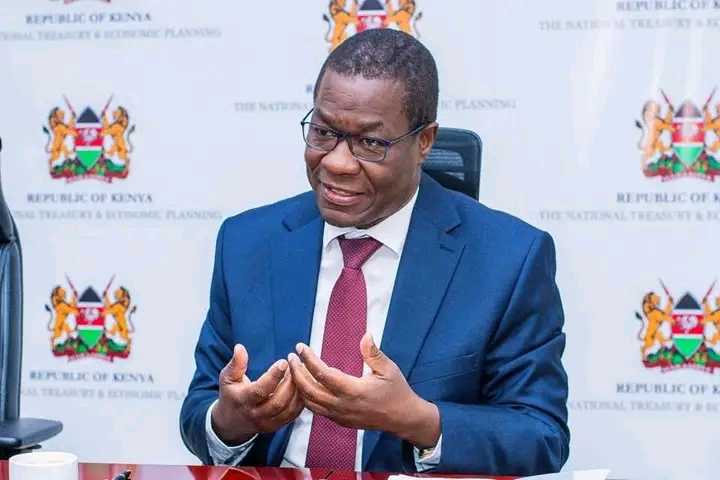
Education Cabinet Secretary Julius Ogamba said the option was becoming unavoidable as the 8-4-4 system enters its final two years before being fully phased out.
Schools that fail to attract Grade 10 learners will, for now, be left with only Form Three and Form Four classes, a situation he said raises serious questions about sustainability.
“When we finish with the placement, we will determine which schools do not receive any students. Remember, we do not have Form Two yet, so they will be remaining with only Form Three and Form Four. What then are we supposed to do?” Ogamba posed.
He was speaking during the Elimu Mashinani forum at Lavington Primary School in Nairobi.
According to the CS, early reporting data has revealed a clear trend: a small number of high-performing schools are struggling with overwhelming demand, while many others continue to post very low enrolment.
“These numbers and this data are telling us a story. We have been holding up schools that do not need to survive,” he said.
To address the imbalance, Ogamba said the ministry is weighing the merger of neighbouring schools with low or zero Grade 10 enrolment, allowing resources to be redirected to institutions that attract sufficient numbers of learners.
During the selection exercise in May last year, Grade 9 learners were required to choose 12 schools across all four categories — C1 (former national schools), C2 (former extra-county schools), C3 (former county schools) and C4 (former sub-county schools).
Despite this broad choice, some schools were not selected at all, while others attracted only one or two students.
“In other words, if the students did not choose your school, the system would not place them in your school,” Ogamba said.
By contrast, he noted, some schools received more than 50,000 applications for just 700 available slots.
For efficient use of resources and to meet constitutional thresholds, the CS said learners from nearby under-enrolled schools would be consolidated into a single institution, with the remaining schools closed.
This could mean that some learners who have already reported may be transferred to new schools.
“There would be no point in having a school with 10 children, where you have a headmaster, a classroom, a watchman and a teacher. It does not make sense. We need schools that have all the facilities with the right number of students,” he said.
Ogamba also said the ministry would move to end what he termed “patriotic schools”, arguing that the practice has led to an oversupply of institutions built for legacy reasons rather than to address genuine education gaps.
“We are not going to be bullied to have what I call patriotic schools where anybody comes and says, ‘because I have capacity to build a class or a school, let this be a school called my name, or my late mum or something like that,’” he said.
The CS said the ministry is analysing data from the ongoing placement exercise to identify schools that require consolidation.
Speaking on Thursday at the Kenya Institute of Curriculum Development, he said updated reporting figures would be released later in the day.
“We will be issuing a press conference this afternoon to confirm the actual number of students who have not reported,” he said.
Since Monday, the Ministry of Education and the Ministry of Interior have been working together to trace learners who had not reported by the initial January 16 deadline.
By Tuesday, the reporting rate had risen to 85 per cent, up from 61 per cent recorded on January 17.
The reporting extension lapsed on Wednesday, January 21.
Ogamba expressed confidence that learning would begin in earnest on Monday, January 26, noting that textbook distribution had surpassed 50 per cent by Thursday, ahead of the ministry’s earlier target of 40 per cent by Friday.
He also said President William Ruto had directed schools to admit learners even if they lacked uniforms or had not paid fees.
As a result, principals were instructed to allow students to report in the uniforms they wore in junior school.
“No student should be charged admission fees or denied admission to a public school,” Ogamba said.
“Senior school principals shall optimise the use of the capitation funds that were disbursed to schools on 2nd January, 2026, while permitting parents and guardians the necessary flexibility in paying their household contributions.
“Any report of non-compliance with the foregoing directives shall be made to the nearest Education Office or National Government Administration Office for appropriate action in accordance with the applicable law,” he warned.
The proposed restructuring signals a major shift in how senior schools will operate under the CBE system, with enrolment data now set to determine which institutions survive and which are merged or closed.