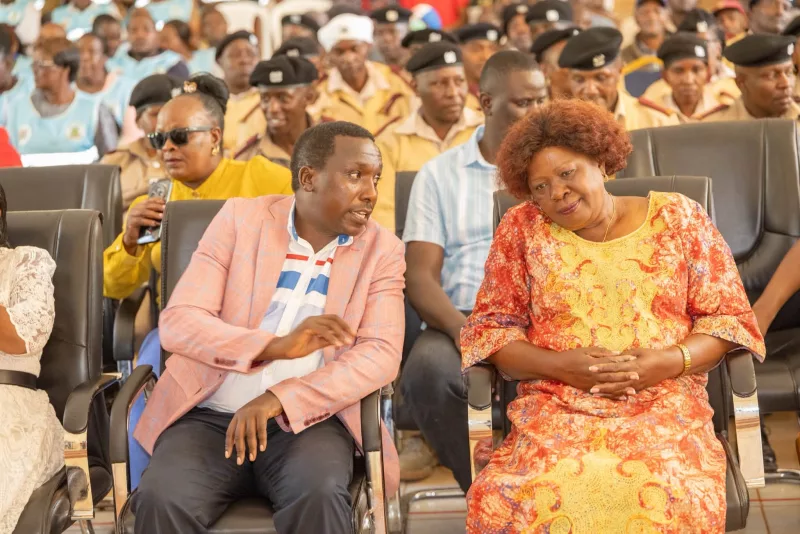
Education CS Julius Ogamba has directed senior schools to allow Grade 10 learners whose parents are facing financial challenges to report in the uniforms they used in their previous schools.
Speaking at the Kenya Institute of Curriculum Development (KICD), the CS said the ministry is aware that many parents had delayed sending their children to Grade 10 due to financial constraints.
“Today, we have made an announcement by the President, supported by the Ministry of Education, that for those students who have not been able to report to Grade 10 because they do not have uniforms, we are directing principals across all institutions to admit those students using the uniforms they wore in junior school,” he said.
He added: “We anticipate that by the end of tomorrow, we will have 100 per cent transition of all our learners to Grade 10.”
The directive comes barely 24 hours after Ogamba urged parents and guardians to report school principals who force them to buy school items from specific shops as Grade 9 graduates transition to senior school.
Ogamba emphasised that there is no government policy mandating parents to purchase uniforms, mattresses, or other school utilities from particular vendors.
During a TV interview Wednesday night, the CS issued a stern warning, saying the furthest school heads can go is to issue guidance on the design and colour of uniforms and the size and colour of mattresses.
“Parents should only be informed of what is required and be free to purchase it wherever it is cheaper for them. For the mattress, you are just supposed to be told the size and colour. Where to buy from should not be dictated to you,” he said.
Some schools in Kenya require parents to buy uniforms and other learning materials from specific shops, often citing quality standardisation and convenience.
However, despite being illegal and exploitative, some officials enforce the policy purely to earn kickbacks or commissions from the retailers.
Ogamba stressed that the choice of where to purchase these items must remain entirely with the parent.
He encouraged parents to help identify schools or principals that continue such practices so that appropriate administrative action can be taken.
“That is why we are saying that if parents are being forced to buy uniforms or school supplies from a particular shop or person, they should report the matter to our field officers so we can take action against those principals,” he said.
“This practice is not allowed. It is not a policy of government,” Ogamba added, urging parents to report cases with documented evidence, such as receipts, to enable the ministry to act against colluding headteachers.
The practice creates monopolies and limits parents’ choice, as the items are often sold at inflated prices far above market rates.
Many parents reported facing challenges while shopping for their children, forcing delays in enrolling them for Grade 10.
Some parents revealed they were given “referral slips” to specific downtown shops, where a shirt that costs Sh500 elsewhere is sold for Sh1,200.
The CS urged parents to report rogue principals to County Education Directors.
“Don’t just complain on social media,” he said. “Write a letter. Attach the evidence. We will fire them.”
He concluded: “For parents already squeezed by the cost of living, every shilling counts.”