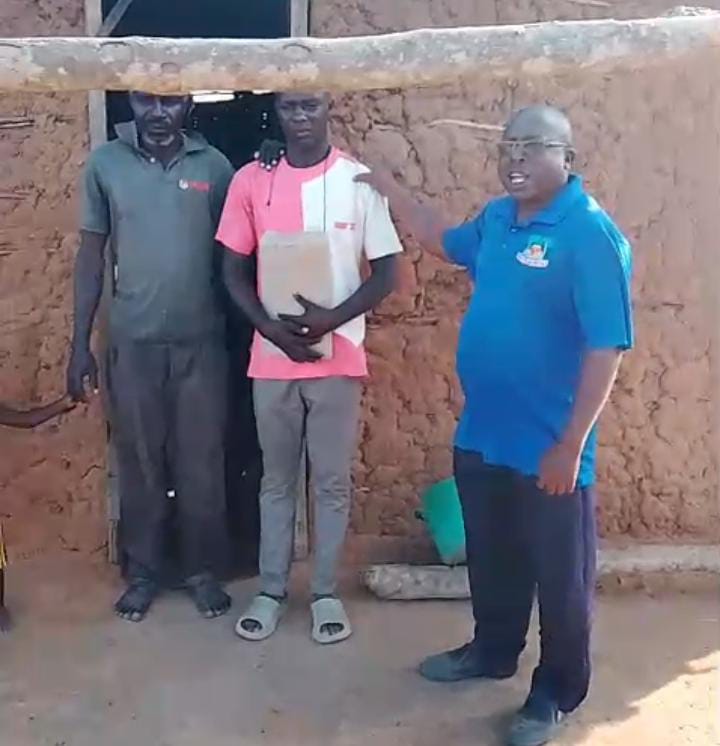
 A chief at a village in Magarini, Kilifi county, appeals for help for a Grade 10 learner to join a national school.
Chiefs and other national government administrative officers are racing against the clock to trace more than 400,000 learners who had yet to report to their respective schools by the close of the initial Grade 10 reporting deadline on January 16.
Data from the Ministry of Interior and National Coordination shows that only 61 per cent of the 1,130,459 candidates who sat the 2025 Kenya Junior School Education Assessment (KJSEA) had reported by the January 16 deadline.
This left about 440,879 learners still at home for varied reasons, prompting the Ministry of Education to extend the reporting window to Wednesday, January 21.
In a status update issued on January 18, the Interior ministry said a report compiled by National Government Administrative Officers (NGAOs), working with County Directors of Education, pointed to financial constraints, delayed placement and social vulnerabilities as the main factors slowing the transition.
While noting that overall progress remained encouraging, the ministry said challenges persisted.
“Financial constraints, isolated cases of early pregnancies, learner absenteeism or reluctance, and placement delays linked to families seeking alternative schools continue to delay some learners from transitioning,” the report said.
The scale of desperation facing some families has been laid bare by interventions at the grassroots.
In Uasin Gishu County, a chief in Turbo area sanctioned a family of seven orphans to seek public donations so that one of them could raise school fees to join senior school.
Kiplombe area Chief William Koros issued a formal letter authorising the family to appeal for assistance.
A similar case has been reported in Sogorosa area, Magarini constituency in Kilifi county, where a vulnerable family is seeking Sh40,000 to enable their son, Onesmus Tsofa, to join a national school.
“From what I have seen, the family really needs help,” Chief Munga Maina said as he appealed to well-wishers to step in.
To stem the growing gap, the government has rolled out a three-pronged intervention aimed at ensuring every eligible learner transitions smoothly to Grade 10, which marks the start of senior school.
One of the measures included reopening a second phase of placement review between January 6 and 9 after more than 300,000 learners applied to be transferred to different schools.
Last week, the ministry disclosed that some C4 schools — formerly day secondary schools — had not received a single learner, either because no students selected them during placement or those placed there were yet to report.
Efforts to trace the ‘missing’ learners now include door-to-door tracing and household mapping by chiefs and their assistants.
The ministry said it is also conducting public sensitisation through barazas, religious institutions and other local platforms to reach parents and help address challenges faced by individual households.
Through coordination with county governments, the National Government Constituencies Development Fund (NG-CDF) and NGAOs, the government says it is fast-tracking the disbursement of bursaries and scholarships to support vulnerable learners.
Education Cabinet Secretary Julius Ogamba said last week that the high number of learners yet to report could partly be attributed to delays by some principals in submitting updated enrolment data.
He added that the government was considering elevating at least 1,000 C4 schools to national school status if enrolment remains negligible once final reports are submitted after the January 21 deadline.
The move, he said, is intended to ensure that each of the country’s 1,450 wards has a senior school of national status, easing pressure on the 105 existing national schools that continue to attract overwhelming demand.
The situation is further complicated by emerging reports that some schools are struggling to develop timetables aligned to the Competency-Based Education (CBE) curriculum as the 8-4-4 system is phased out.
Despite assurances from the Teachers Service Commission (TSC), learning has yet to begin in some schools, with teachers citing delays in the supply of CBE textbooks.
Speaking during the release of the KCSE examination results on January 9, TSC acting chief executive Evaleen Mitei assured the country that teachers were fully prepared to receive the first cohort of Grade 10 CBE learners.
She said educators had been adequately equipped with the competencies, skills and confidence needed to meet the diverse learning needs of the new system.
However, some schools are reporting that they are having challenges developing timetbales for the new curriculum and are left wondering what to do with the learners who have already reported.