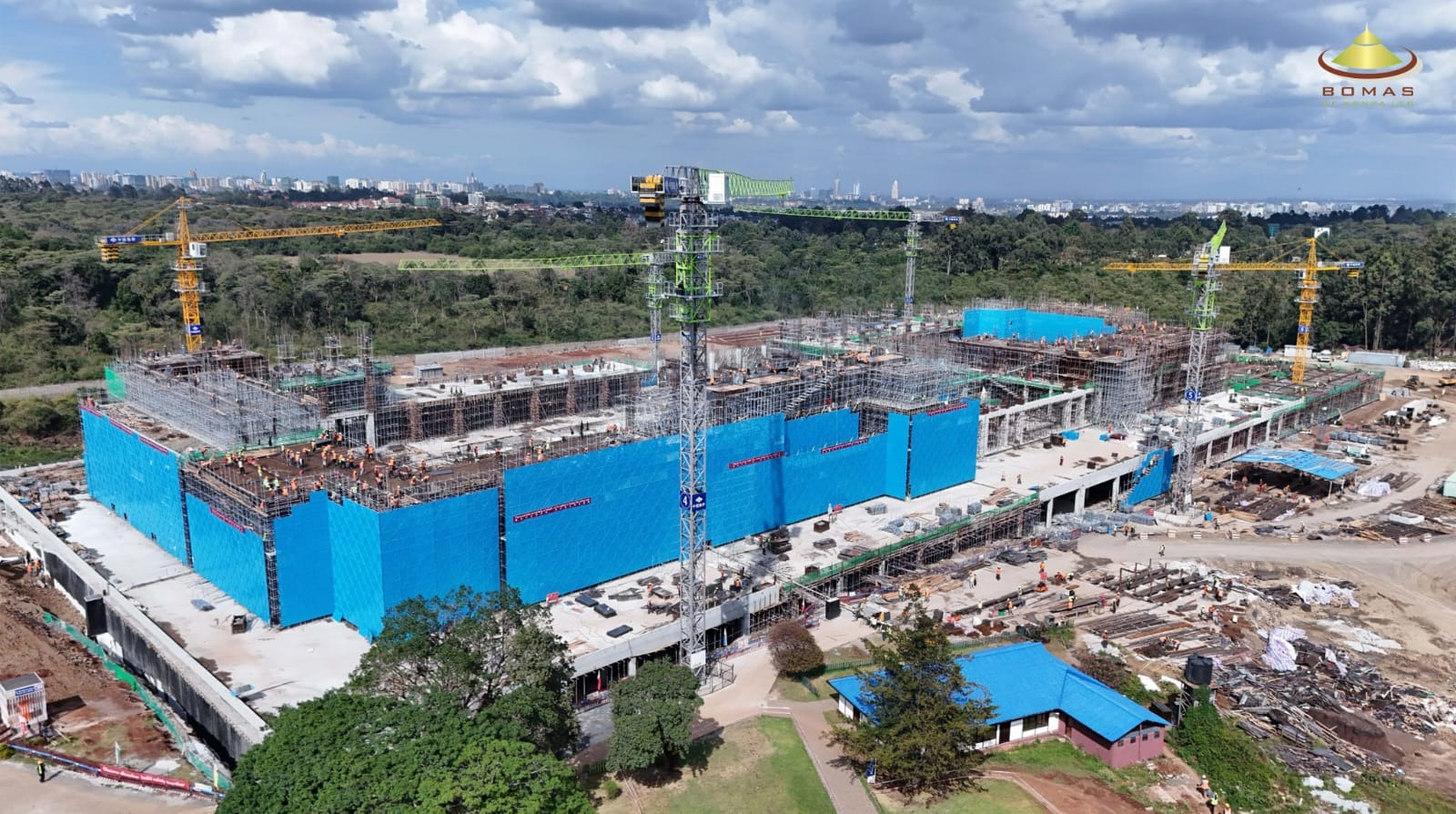
The race to position Nairobi among the world’s top conference cities is gaining serious momentum, thanks to the ambitious construction of the Bomas International Convention Complex (BICC).
Designed to host up to 11,000 people, the facility is poised to redefine Kenya’s profile as a premier destination for business, tourism, and high-level international events.
President William Ruto has described the BICC as a cornerstone of the country’s Meetings, Incentives, Conferences, and Exhibitions (MICE) strategy.
According to the Head of State, large-scale conference facilities like BICC are not just venues; they are engines for economic growth, job creation, and global recognition.
“We are building the largest conferencing facility in East and Central Africa, right at the Bomas of Kenya,” President Ruto said during the Jamhuri Thematic Week last December.
“It is being constructed 24 hours a day because I have set a timeline for it to begin generating revenue for the country. I am confident that with the infrastructure we are putting in place and the creativity around our tourism products, we can reposition Kenya as a holistic business-tourism destination.”
Ruto emphasised that the BICC is part of a wider plan to leverage Kenya’s rich culture, natural beauty, and modern infrastructure to attract international events and conferences.
By tapping into the MICE sector, the government expects to create jobs across multiple industries, from hospitality and transport to agriculture and entertainment, while raising Nairobi’s global standing.
Global benchmark: What leading conference cities look like
To understand the scale of Kenya’s ambition, it helps to look at the cities currently leading the global meetings industry.
According to the International Congress and Convention Association (ICCA), which tracks international association meetings worldwide, the top conference cities in 2024 included Vienna (Austria), Lisbon (Portugal), Singapore, Barcelona (Spain), Prague (Czech Republic), Paris (France), Seoul (South Korea), and Bangkok (Thailand).
Vienna claimed the No. 1 spot with 154 international congresses, closely followed by Lisbon and Singapore.
Other major hubs like Barcelona and Paris also hosted well over 100 events in the year, driving significant business tourism and economic activity.
Bangkok’s rise to 7th place worldwide highlights Asia’s expanding footprint in the MICE industry and shows how strategic investment in facilities and destination marketing can elevate a city’s global profile.
In addition to these top-volume cities, emerging destinations are steadily gaining ground in the ICCA rankings.
Copenhagen was ranked 13th worldwide, highlighting its growing strength in hosting business events.
Meanwhile, Cape Town, South Africa, climbed to 35th globally in 2024 and secured a top-10 global placement in average attendance per meeting, underscoring Africa’s rising influence in the MICE sector.
These rankings focus on association meetings, events organised by international bodies that rotate between countries, making them particularly significant as they reflect consistent global engagement rather than one-off conferences.
According to the 2023 ICCA Business Analytics report, Kenya ranked third in Africa for the number of international association meetings hosted, trailing only South Africa and Rwanda.
For Nairobi, breaking into this league would mark a major milestone, not only for Kenya but for the wider East African region.
Bomas acting CEO, Jimmy Okidiang, described the project as a “game changer” for the nation and the continent.
“Once complete, Nairobi will join the league of top conference cities in the world,” he said.
“This facility is unmatched in East Africa and will compete with global standards. Regional countries have smaller facilities, but for a complex of this magnitude, the BICC will transform not only the city but also Kenya’s profile internationally.”
Currently, construction is about 40 per cent complete, Okidiang confirmed, with the facility already securing bookings for major global events, including the Africa-France Summit scheduled for May.
“The BICC will have a ripple effect across the economy. It is not just about those working within the facility, but all sectors linked to it,” he noted.
"Farmers will supply fresh produce, taxi drivers will transport delegates, and hotels and restaurants will cater to visitors. This will inject significant revenue into the economy and create employment opportunities across the board.”
Okidiang also highlighted the innovative architectural and technological designs that have gone into the project.
“This is a modern facility equipped with cutting-edge technology, capable of hosting 11,000 people. It is a historic milestone, and I am excited to be part of a team that is shaping the future of this nation,” he said.
The BICC represents a significant upgrade from the existing Bomas amphitheatre, which had a seating capacity of 3,400.
The new facility more than triples that capacity and includes key features such as a presidential pavilion designed to host 30 heads of state.
According to Okidiang, the scale and sophistication of the complex put Kenya on par with leading international conference destinations such as Singapore, Dubai, and Cape Town.
“The facility is not only about size but also about strategic positioning,” Okidiang said.
“We want Kenya to attract high-level summits, regional conferences, and global exhibitions. This is part of a deliberate government strategy to use infrastructure development as a tool to elevate Nairobi to the world stage.”

The BICC is expected to have a transformative effect on the city’s economy.
Beyond employment opportunities, the complex will stimulate growth in transport, hospitality, and ancillary industries.
Hotels, restaurants, travel agencies, and entertainment venues stand to benefit from increased international footfall, while farmers and suppliers of food and services will gain new markets.
“The economic benefits are extensive,” Okidiang said.
“Taxi operators, caterers, security personnel, and other service providers will all see growth opportunities. The BICC will act as a magnet for business tourism, driving revenue not just within Nairobi but throughout Kenya.”
President Ruto’s administration views the project as part of a broader push to leverage infrastructure and tourism for sustainable economic growth.
By combining world-class facilities with Kenya’s cultural and natural assets, the government aims to position Nairobi as a hub for international business and diplomacy.
Once completed, the Bomas International Convention Complex will not only host thousands of delegates from around the world but also elevate Kenya’s status as a key player in Africa’s conference and business tourism sector.
The facility represents a bold statement of ambition: that Nairobi is ready to compete with the world’s leading conference cities, attract global investment, and create opportunities for generations of Kenyans.
In the words of Okidiang, “We are not just building a facility; we are building a legacy. Nairobi is on its way to joining the top league of conference cities, and the BICC is central to that vision.”
With construction progressing around the clock and bookings for global events already confirmed, the BICC is on track to deliver a new era of economic growth, international prestige, and opportunity for Kenya.