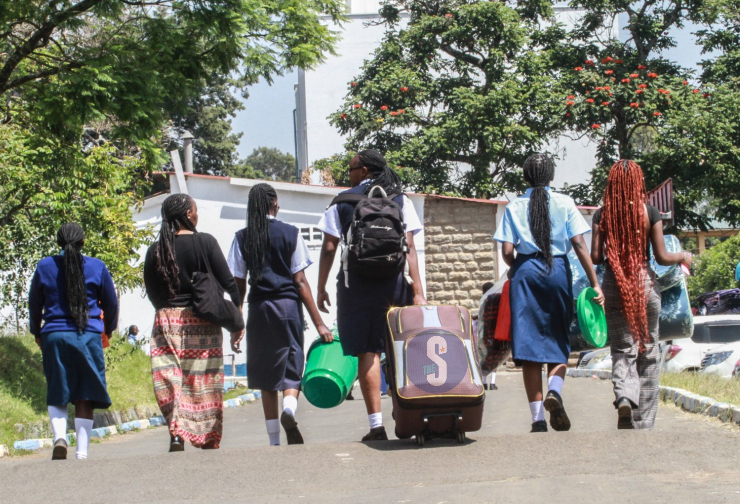
 A parent escorts her daughter for Grade 10 admission at Moi Girls High School, Nairobi, January 13, 2025. /ENOS TECHE
The Ministry of Education’s proposal to elevate about 1,000 day senior secondary schools to national status has drawn criticism from a section of parents and the general public, even as the policy change remains under review.
Education Cabinet Secretary Julius Ogamba revealed last week that the proposal was informed by low enrolment of Grade 10 learners in Category Four (C4) schools following the transition of the first cohort under the Competency-Based Education (CBE) system to senior school from January 12.
The broader plan, the CS said, is to ensure that every ward in the country has a senior school of national status, translating to about 1,450 Category One (C1) institutions.
He noted that a final decision would be made after assessing feedback from principals on reporting rates at the close of Grade 10 admissions, which were initially scheduled for January 16, but extended to accommodate learners facing challenges.
In the meantime, Ogamba said the ministry had already recorded low turnout in several C4 schools.
“This was expected, as some of these schools were never chosen by any candidate at all during the selection process, so we have to decide what to do with them,” Ogamba said during a media interview.
A total of 1,130,459 Grade 9 candidates sat the inaugural Kenya Junior School Education Assessment (KJSEA) in 2025, with those categorised as Approaching Expectation and above qualifying to transition to Grade 10.
At the close of phase one of the review of placement results on December 29, Basic Education Principal Secretary Julius Bitok revealed that 68,000 placement change requests had been rejected, most of them targeting a small cluster of national schools with limited capacity.
Currently, there are only 105 national schools, each with an average enrolment capacity of about 500 learners.
The surge in applications to top-tier schools resulted in some C4 institutions receiving negligible to zero admissions of Grade 10 learners, raising fears that such schools could face imminent closure once the final cohort under the 8-4-4 system sits the KCSE in 2027.
While Ogamba’s proposal to elevate C4 schools to C1 status appears plausible, it has been met with criticism, with many stakeholders calling instead for proper equipping of the institutions while retaining their current day school status to attract enrolment.
Critics argue that changing a school’s status without upgrading infrastructure will not address the underlying problem.
“We don’t want any national school status. Instead, equip all schools well using the national kitty or exchequer. Changing a school name without facilities makes no sense,” one parent said.
The view was echoed by others who argued that existing national schools attract high enrolment not because of their designation, but because they are better equipped.
They accused the ministry and the government of applying cosmetic solutions that could further burden already struggling parents.
“Most of the so-called national schools charge up to Sh100,000, and given the economic turmoil in the country, most learners will not access these schools,” another parent said.
“Equip the schools with facilities. We don’t need your upgrading to national level. This is one way of adding school fees; we don’t want it,” added another.
“Is that an achievement, and how is that helping parents like us whose children are still at home due to lack of school fees?”
The sentiments reflect the general mood among parents, the key stakeholders in the education sector.
The debate comes as the Ministry of Interior tasked chiefs and their assistants to trace Grade 10 learners in their jurisdictions who had not reported to their respective schools by the January 16 deadline.
At the close of the now extended deadline, reporting stood at 61 per cent.
Most families cited financial constraints and placement delays, particularly among those seeking alternative schools.
“We are intensifying targeted interventions to ensure every eligible learner transitions smoothly across all pathways,” the ministry said, adding that door-to-door tracing of learners who have not reported was ongoing.
The ministry also said the award of bursaries and scholarships to qualifying vulnerable learners had been activated to support the push for 100 per cent transition to senior school.
As Ogamba and his team await final reporting rate data from school principals, it remains unclear whether the door-to-door strategy will be sufficient to reverse low enrolment and stabilise C4 schools.