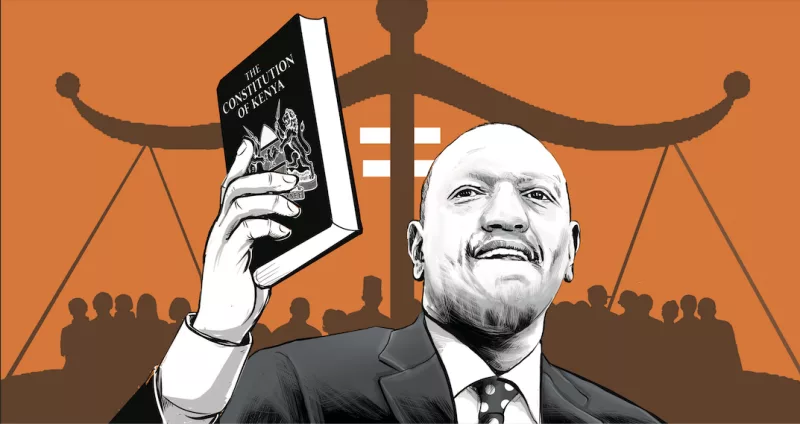
President William Ruto does not need political enemies in Mt Kenya—especially when some of his most vocal allies in the region appear determined to do the damage for him.
Politics is a team sport. When a president wins, his allies are expected to consolidate goodwill, amplify development gains, and sell a clear, coherent message to the public.
Yet in the Mountain, the opposite appears to be happening. Instead of operating as a disciplined political team, some leaders have chosen to rock the boat from within, replacing coordination with confrontation and collective responsibility with personal grandstanding.
The result is a brand of chest-thumping politics that shifts attention away from the presidency and steadily erodes the goodwill the President needs in a region that has historically valued both development and political respect.
From recent events, it is evident that leaders and MPs from the region have worked hard—perhaps unintentionally—to obscure the President’s work.
Rather than strengthening the centre, they have invested their energy in fighting fellow leaders, provoking unnecessary political standoffs, and attempting to impose a boisterous, abrasive style of politics on everyone else.
Their public pronouncements are often poorly thought out and politically careless. In the process, they quietly but effectively rob President Ruto of political credit and goodwill.
Take the issue of roads and markets, for example—matters that resonate deeply with wananchi because infrastructure is one of the most visible indicators of government performance.
When new roads are launched or ongoing projects highlighted, the narrative should be clear: this is government at work, under the leadership of the President.
Instead, what the public often hears are claims that “these are my projects,” that “I delivered this road,” that “I fought for this tarmac,” or that “I am behind the construction of this market.”
When MPs present national government projects as personal achievements without clearly linking them to the President’s development agenda, the message to the public is both simple and dangerous: that government is secondary, and individuals are the real drivers of progress.
It is telling that some voters now argue that certain leaders will be re-elected “because they built roads” in their constituencies.
Yet the same argument is rarely made about the President, who is, in reality, the ultimate driver and financier of these projects. If people do not associate development with the President, they will not associate improved livelihoods with his leadership—even when his administration is the one coordinating, funding, and implementing the work.
Worse still, the same leaders scrambling for personal credit are also accused, publicly and privately, of orchestrating chaos in political forums.
If they are not allegedly mobilising hecklers to disrupt meetings, they are said to be plotting the political downfall of colleagues who refuse to toe their line. This culture of intimidation and internal warfare does not strengthen President Ruto in Mt Kenya; it weakens him.
Recently, the President spent days touring parts of the region, investing time, energy, and resources to rebuild trust with a community that had once strongly supported him.
Yet almost immediately, unrelated political actions—linked in the public mind to figures within his broader political camp—triggered widespread anger and resentment. The backlash was swift.
Public outrage was directed at the President, with many interpreting these events as politically motivated persecution.
In a matter of hours, much of the goodwill generated by the tour was buried under anger and suspicion. The tragedy is that some of the loudest voices claiming political victories in Mt Kenya are, ironically, the very ones who need President Ruto the most for their own political survival.
The President would do well to take a hard look at some of his so-called foot soldiers in the region.
Several face serious political headwinds in their own constituencies, with diminishing grassroots appeal and uncertain re-election prospects. Instead of strengthening the President’s standing, they risk dimming his star.
These leaders need President Ruto far more than he needs them. They have become political baggage—burdens rather than assets—at a time when the region demands humility, discipline, and results-driven leadership.
This raises an uncomfortable but necessary question: how can leaders who are struggling to maintain their own political relevance be expected to sell the President’s agenda effectively?
Rather than acting as disciplined ambassadors of government policy, some have chosen confrontation, endless political noise, and theatrical displays of loyalty that add little to the President’s actual support in this populous and politically important region.
Historically, the Mountain has rewarded leaders who combine influence with humility and development with tangible results.
It has little patience for political showmanship that generates more headlines than solutions.
President Ruto’s administration has real achievements in the region—roads, markets, affordable housing, agricultural support, and major infrastructure investments.
Yet these gains risk being drowned out by political drama, internal fights, and relentless personal credit-taking by his supposed defenders.
Credit must be given where it belongs. Institutions must be allowed to speak for themselves. Above all, the President must be clearly seen as the driver of the national development agenda.
Otherwise, the uncomfortable truth will remain: President Ruto is not being undermined by his critics, but by the careless conduct of some of his most visible allies.
The writer is a political commentator and former Majority Leader, Kiambu County.